


Introduction
You spot a fun gravel cut-through, roll in with confidence, and then the ride turns into rattles, wheel slip, and sketchy braking. That is the moment you realize your setup is not built for loose surfaces, even if it feels fine on smooth pavement. Pick the wrong ride and you can pay twice: extra flats, brake adjustments, and the kind of battery range disappointment that leaves you walking the last mile.
This shortlist is built to help you choose a best-value electric ride for light off-road exploring in 2026, without overbuying for extreme trails. You will see three practical picks (two off-road scooters and one fat tire folding e-bike), plus a quick buying guide that explains what actually changes on gravel and hardpack. The logic is simple: prioritize stability and control first, then power and features.
1) iSinwheel GT4 2400W Dual Motor Off-Road Electric Scooter

If you want an electric ride for outdoor adventure that still feels like a value buy, the GT4 is the pick for riders who hate losing momentum on loose climbs. The real frustration on gravel is not top speed, it is the constant micro-corrections when the surface breaks traction. A dual-motor option can make acceleration feel more composed, especially when your route mixes hardpack, dust, and short steep grades.
What it feels like on gravel and hardpack
- Dual-motor option helps traction when the surface loosens
- 12 x 2.75-inch all-terrain tires calm down small chatter
- Dual swingarm suspension reduces fatigue on washboard sections
- Hydraulic disc brakes help with controlled stops on dusty paths
Key specs to check before you buy
- Motor and speed options: 1200W (32 MPH) or 1200W x 2 (45 MPH)
- Battery: 52V 18.2Ah (dual-motor version)
- Max range: up to 50 miles
- Tires: 12 x 2.75-inch off-road tires
- Payload: up to 330 lbs
- App: isinwheel Club app control
Shop: GT4 2400W Dual Motor Off-Road Electric Scooter
Why it wins
If your goal is light off-road exploration with fewer stalls on hills, the GT4s dual-motor option gives you the most headroom in this short list. The combination of larger tires, suspension, and hydraulic disc brakes is the kind of package that keeps the ride calm when the path is not. It is also one of the easiest ways to step into higher-performance electric mobility solutions without jumping straight to boutique pricing.
2) iSinwheel GT1 Dual Motor Off-Road Electric Scooter
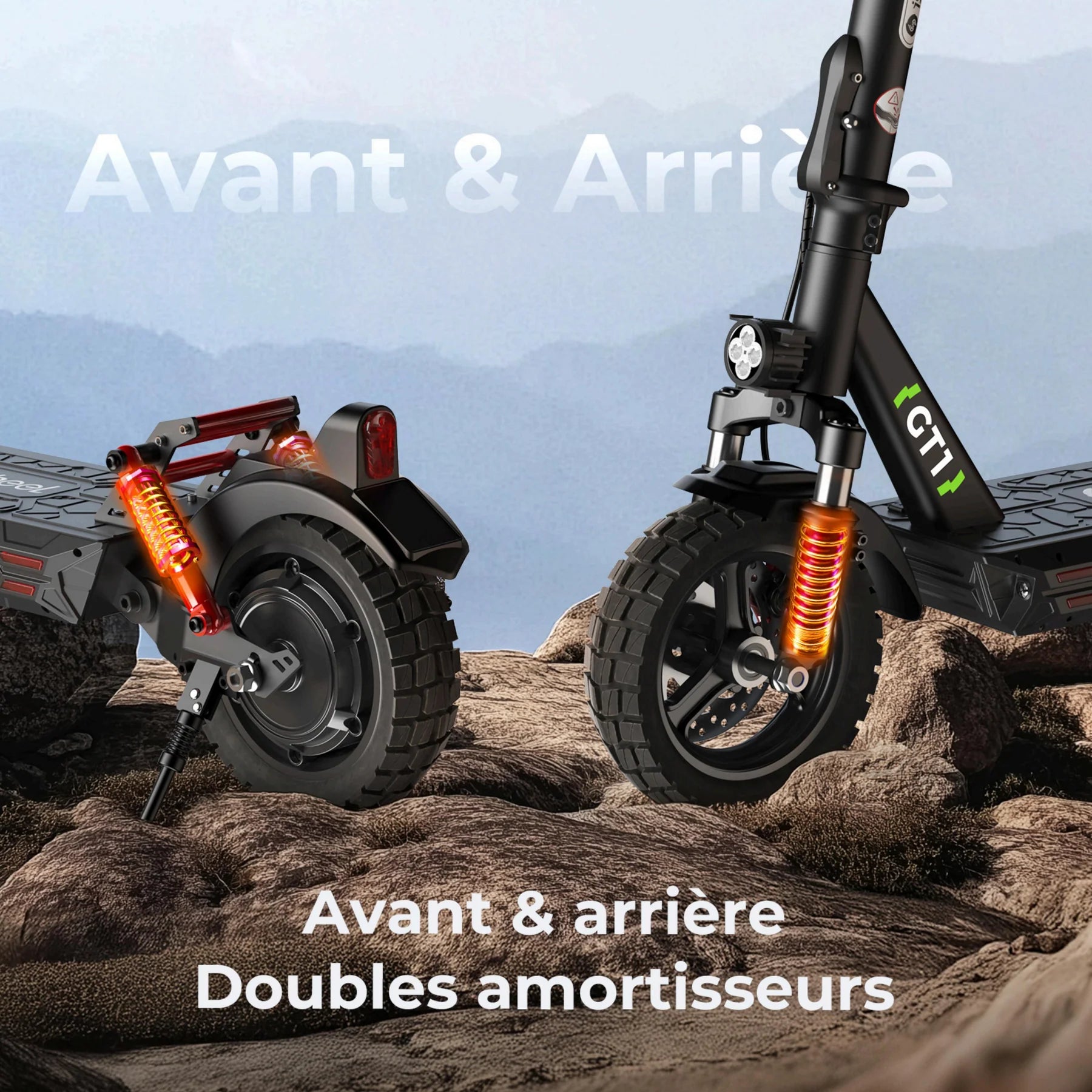
If your frustration is budget first but you still want real off-road tire grip, the GT1 is the more practical entry point. It fits riders who mostly ride packed dirt, light gravel, and park paths, and who care about easier storage more than maximum speed. This is also the safer choice if you are trying to avoid buying an overpowered scooter that you will never fully use.
Where it fits best (and where it does not)
- Great for: packed dirt, mild gravel, and smoother trail connectors
- Good for: riders who want simpler ownership and smaller tires
- Not ideal for: riders who want 12-inch tires or max hill headroom
Key specs to check before you buy
- Motor: 800W
- Battery: 48V 10Ah
- Top speed: up to 45 km/h
- Max range: up to 45 km
- Tire: 10-inch off-road tire
- Load capacity: 150 kg
Shop: GT1 Dual Motor Off-Road Electric Scooter
Why it wins
For light off-road use, you usually get more value by buying the setup that needs fewer fixes, not the setup with the biggest numbers. The GT1 focuses on the basics that matter for mixed surfaces: off-road tires, a suspension system, and enough power to keep you moving without constant full-throttle riding. If you are collecting Isinwheel reviews, this is the model that often makes sense for people who want capability without committing to a larger, heavier platform.
3) Gotrax F5 Fat Tire Folding Electric Bike
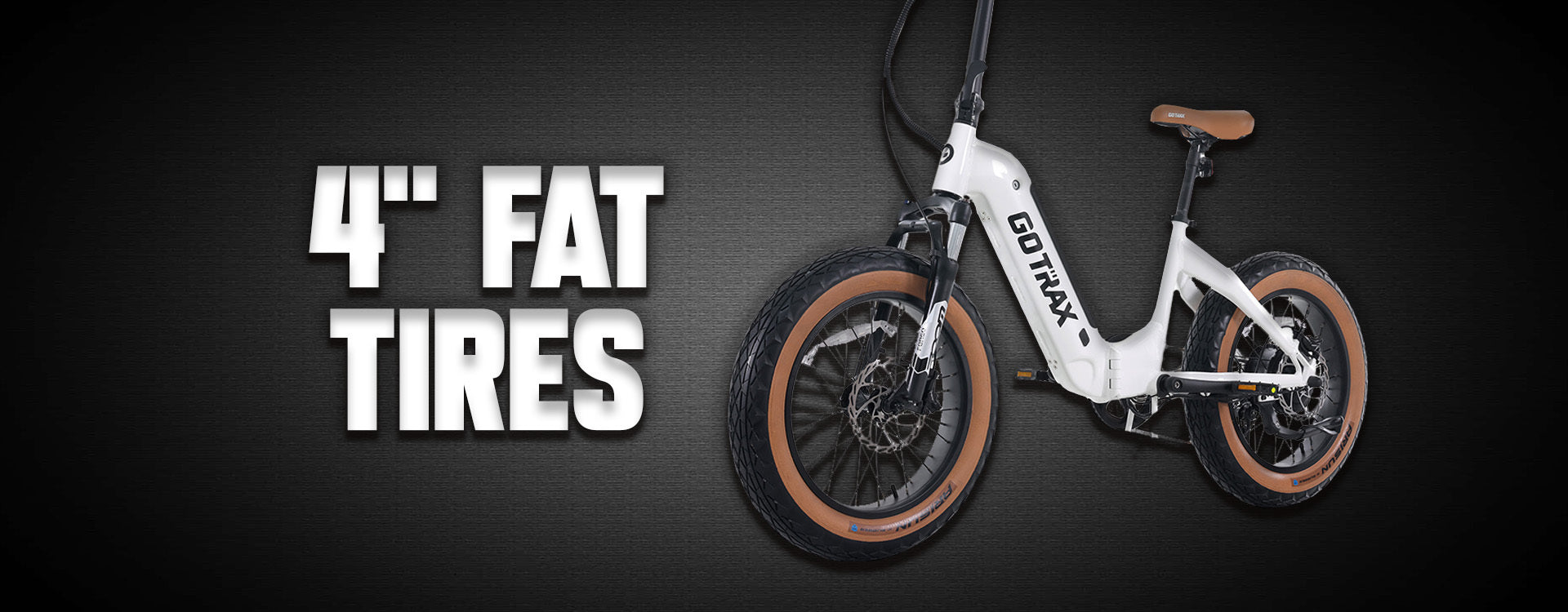
If you want a true e-bike feel (pedals, riding geometry, and the option to extend range with your legs), the Gotrax F5 is the most natural transition from a traditional bicycle. It is also the easiest fit if you want green commuting solutions during the week and mellow trail rides on the weekend. For many riders, fat tire e-bikes are the confidence hack: the bike feels less twitchy on loose gravel, so you spend less time correcting.
Why a fat tire folding e-bike can be the easiest all-rounder
- 20 x 4-inch tires add stability on loose surfaces
- Folding frame helps for apartments, trunks, and small garages
- Pedal assist plus throttle lets you manage effort on longer days
What to confirm on the product page
- Battery and range test method for your typical speeds
- Brake type and rotor size for dusty stopping power
- Total weight if you must carry it upstairs
Official Site: GOTRAX
Why it wins
If you are shopping for affordable electric bikes that still feel like a bike, the F5 checks the boxes that matter for mixed riding: fat tires, front suspension, and a folding frame for real-life storage. It is also one of the cleaner answers for eco-friendly transportation alternatives when your route includes short gravel segments that would feel annoying on narrower tires.
Buying guide: how to choose best-value for light off-road
The biggest buying trap is chasing speed while ignoring stability. On gravel, the ride that feels fastest on a spec sheet can feel slow in real life because you keep backing off the throttle to stay in control. Best value usually means fewer surprises: fewer flats, fewer brake tweaks, and a battery that does not feel stressed every time the trail tilts upward.
Quick shortlist logic (use this before you buy)
- If your route has loose climbs or soft corners: prioritize tire size and traction
- If you ride longer loops: prioritize battery capacity and cooling
- If you ride dusty paths: prioritize brake feel and modulation
- If you store indoors: prioritize foldability and carry weight
Tire size: what changes off-road?
Tires are your suspension before suspension. Larger scooter tires (10 to 12 inches) roll over small rocks and trail seams more smoothly, and wider tires reduce washout on loose gravel. Air-filled tires usually ride smoother than solid tires, but you should plan for routine pressure checks and occasional puncture prevention.
- Scooter tires: 12-inch beats 10-inch for rollover
- Fat tire e-bikes: 4-inch width boosts stability
- Pressure: lower can grip better, but avoid pinch flats
Battery and range: plan for the boring stuff
Real range is always lower than the best-case number because speed, hills, rider weight, and temperature all stack against you. A larger battery can also be less stressed per mile, which often helps consistency over time. If you care about last-mile delivery or errands, treat range like a reliability feature, not a bragging number.
To ground safety expectations, the U.S. Consumer Product Safety Commission reported micromobility injuries increased nearly 21% in 2022 versus 2021, which is a good reminder to buy control and braking before you buy speed. Consumer Product Safety Commission
Braking and control: do not under-buy this
On dusty paths, braking becomes a control problem, not just a stopping problem. Hydraulic disc brakes can feel more consistent under repeated braking, and suspension reduces rider fatigue so you make fewer mistakes late in the ride. Helmet use is one of the few safety variables that repeatedly shows strong benefit; an NTSB briefing document cites a meta-analysis finding that helmet use reduced all head injuries by 48%. National Transportation Safety Board
App features: nice-to-have vs real value
App features can help, but only if they reduce ownership friction. Battery health visibility, ride logs, and mode control can keep you from wasting range and can support predictive maintenance habits (like spotting unusual voltage sag early). Still, treat GPS navigation, anti-theft systems, and app dashboards as bonus features, not the reason you buy.
- Useful: mode limits, battery health, ride diagnostics
- Nice-to-have: lighting customization, trip stats
- Watch-outs: app-only locks that fail offline
Comparison table (quick scan)
| Pick | Type | Speed (max) | Range (max) | Battery | Tires | Max load | Trade-offs |
|---|---|---|---|---|---|---|---|
| iSinwheel GT4 (dual option) | Electric scooter | 45 MPH | 50 miles | 52V 18.2Ah | 12 x 2.75 in | 330 lbs | Heavier, larger footprint |
| iSinwheel GT1 | Electric scooter | 45 km/h | 45 km | 48V 10Ah | 10 in | 150 kg | Less rollover than 12 in |
| Gotrax F5 | Electric bike | 20 MPH | 60 miles | 48V 13.6Ah | 20 x 4 in | 300 lbs | Heavier carry, folding bulk |
Conclusion
If you want the most off-road headroom for the money, start with the iSinwheel GT4 and choose the dual-motor option if your routes include loose climbs. If you want a simpler value entry for packed dirt and light gravel, the iSinwheel GT1 is the more budget-focused way to get off-road tires and suspension. If you want a pedal-first ride feel with fat tires and folding storage, the Gotrax F5 is the most bike-like choice for eco-friendly transportation and weekend exploring.
FAQ
What counts as light off-road for an electric ride?
Light off-road usually means packed dirt, gravel paths, park trails, and mild hard pack with small bumps. It does not mean deep sand, mud ruts, or rocky trail features where you need high ground clearance and aggressive tread. If you can comfortably walk the trail in normal shoes without sliding, it is typically within the light off-road zone. Your biggest limiter is often braking distance and front-tire washout, not top speed.
Do fat tires actually help on gravel, or is it mostly hype?
Fat tires help on gravel because the larger contact patch improves stability and reduces the tendency to sink or skate on loose stones. They also let you run lower pressure, which can reduce vibration and improve traction on washboard sections. The trade-off is higher rolling resistance and often more overall vehicle weight, which can cut real-world range. For mellow trails and mixed pavement, the confidence gain is usually noticeable.
How should I estimate real-world range before buying?
Assume you will get less than the advertised maximum because wind, hills, stops, colder weather, and soft terrain all reduce efficiency. A practical planning rule is to expect about 50% to 70% of the stated max range unless the brand publishes a test method that matches your riding style. If you ride fast, climb often, or carry cargo, plan closer to the low end. Always leave a buffer so you are not limping home at the last few percent.
What are the most important safety features for trail-adjacent riding?
Brakes are the first priority because dust and loose surfaces increase stopping distance and reduce grip. Next, tires and suspension matter because they keep the wheels planted and reduce fatigue, especially on small repetitive bumps. Lighting and reflectors still matter because many mixed-use paths have blind corners and crossings even in daylight. Finally, predictable throttle or assist response reduces the small surprises that cause falls.
Is a dual-motor setup worth it for mellow trails?
Dual-motor setups are most worth it when you ride hills, carry heavier loads, or frequently hit loose surfaces where traction is the limiting factor. They can help you maintain momentum without pushing a single motor to its limits, which often feels smoother in short climbs. The downsides are usually more weight and more complexity to maintain over time. If your routes are mostly flat hardpack, a single-motor setup can be the better value.
What maintenance should I expect if I ride on gravel regularly?
Plan on more frequent tire pressure checks and quick tread inspections for embedded sharp rocks. Brake pads can wear faster in dusty conditions, so expect earlier pad changes and occasional rotor cleaning. Suspension pivots and folding mechanisms should be checked for looseness because vibration can back hardware out over time. A simple habit is to do a 2-minute bolt and brake check every 2 to 3 rides, especially before longer outings.
How do I choose between an electric scooter and an e-bike for mixed terrain?
Choose an electric scooter if you want compact storage and quick, simple operation for short loops and trail connectors. Choose an e-bike if you want more control from a larger wheelbase, the ability to pedal when conditions change, and more comfort over longer distances. If you routinely ride 60 to 120 minutes, pedaling support usually makes the outing feel easier and more consistent. If you ride shorter trips and store indoors, a scooter can be the more practical daily tool.
Table of Contents
- Introduction
- 1) iSinwheel GT4 2400W Dual Motor Off-Road Electric Scooter
- 2) iSinwheel GT1 Dual Motor Off-Road Electric Scooter
- 3) Gotrax F5 Fat Tire Folding Electric Bike
- Buying guide: how to choose best-value for light off-road
- Comparison table (quick scan)
- Conclusion
-
FAQ
- What counts as light off-road for an electric ride?
- Do fat tires actually help on gravel, or is it mostly hype?
- How should I estimate real-world range before buying?
- What are the most important safety features for trail-adjacent riding?
- Is a dual-motor setup worth it for mellow trails?
- What maintenance should I expect if I ride on gravel regularly?
- How do I choose between an electric scooter and an e-bike for mixed terrain?


Share:
The Beginner Tire Decision Starts Here
Step by step guide to pick off-road e-scooters