



Where your beginner electric scooter will actually get ridden

Your first electric scooter usually goes wrong in a very ordinary way: you buy for top speed, then spend most of your time on cracked sidewalks, bike-lane connectors, parking lots, or short neighborhood runs. That mismatch matters. A scooter that feels great on paper can feel too bulky for apartment storage, too stiff on rough pavement, or too light-duty once you leave smooth city streets.
This roundup sorts beginner electric scooter options by real riding patterns instead of flashy numbers. You will see which commuter scooter fits short urban trips, which models leave room for longer weekly use, and when an off-road electric scooter starts making more sense for gravel, park paths, and rougher suburban routes.
Top beginner electric scooter picks for 2026
1. S Nova for easy city starts

If you want a beginner electric scooter that feels approachable from day one, S Nova is the cleanest entry point. It is built for short commutes, errands, and neighborhood riding, so you are not paying for trail-focused bulk you may never use. The tradeoff is simple: it is best on pavement-first routes, not loose or aggressive terrain.
- Best for
- First-time riders
- Short urban commuting
- Bike-lane and neighborhood routes
- What to watch
- Climbing ability is listed at up to 15%, so steeper hills may push it harder than larger commuter models
2. S Nova Pro for beginners who need room to grow
Some riders already know they will outgrow a basic commuter scooter quickly. S Nova Pro makes sense when your route is longer, your pavement is rougher, or you want more speed reserve without jumping straight to an off-road electric scooter. The main tradeoff is extra weight compared with lighter short-trip models, but you get noticeably more capability in return.
- Best for
- Mixed urban miles
- Longer weekday commuting
- Beginners who want one scooter for the next year, not just the next month
- What to watch
- At 60.4 lbs, it is less convenient for daily stair carrying or frequent transit handoffs
3. S9 Pro for short-distance commuting and easier storage
If your main problem is not distance but storage, the S9 Pro is the practical pick. It fits riders who need a scooter for campus, quick errands, or short city hops and may need to carry it indoors more often. Compared with bigger Isinwheel electric scooters, you give up power and rough-surface confidence, but portability improves.
- Best for
- Apartments
- Campus riding
- Short-distance urban commuting
- What to watch
- Isinwheel’s comparison content describes it as easier to carry and store, but also clearly more limited off pavement than the GT line
4. GT1 for beginners testing mixed-surface riding
GT1 is the bridge pick if your rides are no longer purely city-based but you are not ready for the largest off-road setup in the lineup. Think rough neighborhood pavement, gravel connectors, and recreational rides where a commuter scooter starts to feel underbuilt. Its limitation is range compared with the stronger GT2-family options.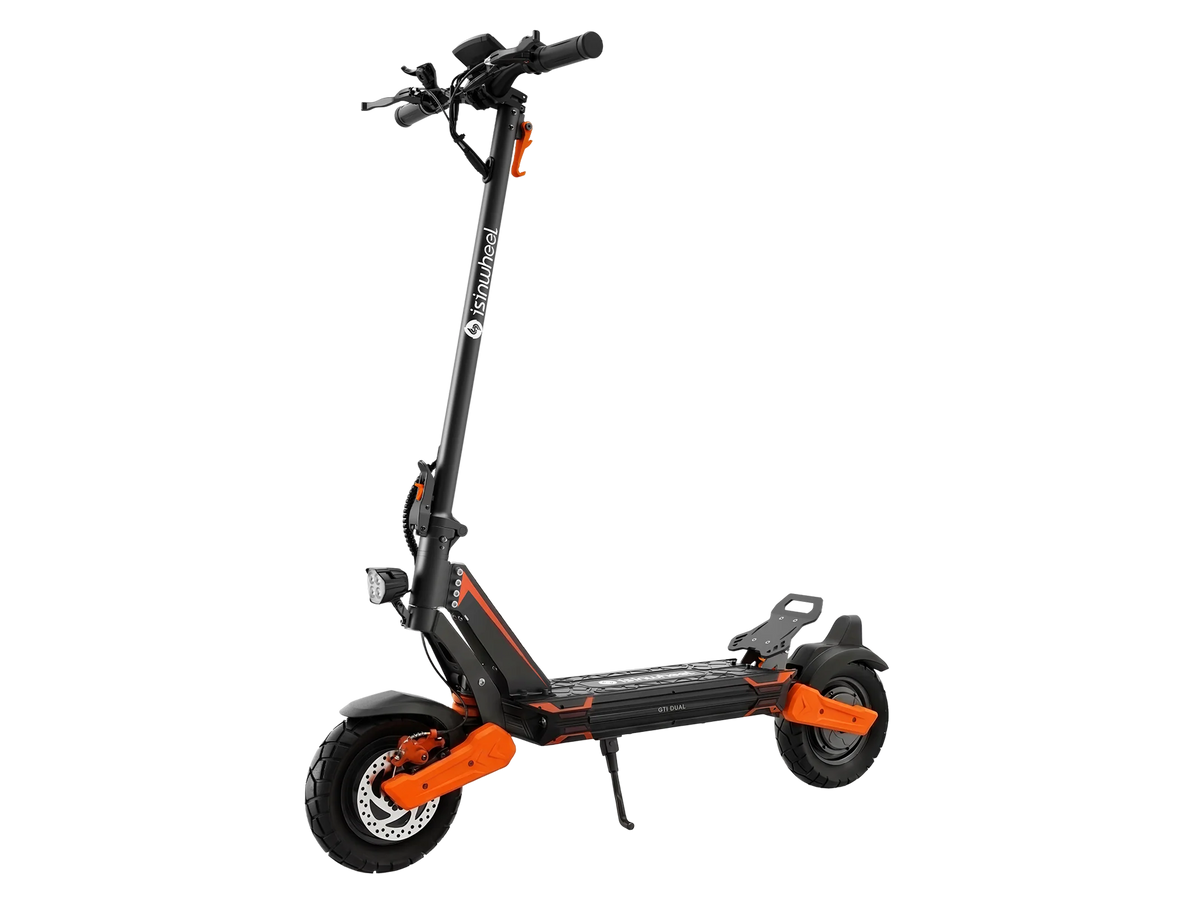
- Why it stands out
- 800W motor capacity
- Up to 21 miles of range
- 28+ MPH top speed
- 48V 10Ah battery
- Best for
- Mixed surface riding
- Riders stepping beyond commuter-only use
- Weekend exploration on lighter terrain
- What to watch
- Range is shorter than GT2 and GT2 Pro, so route planning matters more on longer outings
5. GT2 Pro for real off-road headroom
GT2 Pro is the strongest pick here for beginners who want a scooter they can grow into instead of replace quickly. It adds the stability, tire size, suspension, and braking confidence that matter more once you ride dirt roads, gravel, broken pavement, or park trails. The compromise is size and storage burden, so it fits best if you have space and genuinely plan to use its capability.
- Key specs to check
- 11-inch pneumatic off-road tires
- Dual hydraulic suspension
- EABS plus disc braking
- Turn signals and a wide 7.5-inch deck
- Best for
- Forest trails
- Gravel paths
- Broken pavement and country-road riding
How to choose between a commuter scooter and an off-road electric scooter
Start with your actual surface mix
If eight out of ten rides happen on pavement, a commuter scooter is usually the better beginner buy. The S Nova, S Nova Pro, S9 Pro, and S10Max are easier to justify when your real life means sidewalks, bike lanes, apartment access, school runs, or errands. Once gravel, rough park paths, and broken suburban surfaces become normal, the GT line starts to make more sense.
Buy enough scooter for next season, not just this week
A beginner electric scooter should feel confidence-building, but that does not always mean buying the slowest model. If your route is getting longer, includes hills, or will likely expand into weekend recreation, starting one tier up can prevent a fast upgrade cycle. The sweet spot is choosing enough battery, braking, and comfort for the next 6 to 12 months without jumping into an oversized platform you will hate carrying.
Do not ignore storage and charging friction
Ownership problems are often boring problems. A lighter scooter is easier to bring into an apartment, office, or classroom, while a bigger scooter is easier to live with if you have garage access or first-floor storage. On the battery side, CPSC notes that some recalled electric scooters posed fire and burn hazards related to battery issues, so careful charging habits and reputable product verification matter as much as ride specs.
Beginner scenarios that make the decision easier
Apartment rider with a short commute
You will usually be happier with S9 Pro or S Nova than with a larger off-road electric scooter. Daily carrying, hallway storage, and quick setup matter more than maximum output. If your route is under moderate commuter distance and mostly paved, lighter urban-focused geometry tends to get used more often.
Suburban rider dealing with rough pavement
This is where S Nova Pro, S10Max, or GT1 become more interesting. Bigger tires, more suspension support, and stronger reserve power help the scooter stay calmer over patchy pavement and longer connectors. If your “commute” already feels half recreational and half utility, you may be closer to GT territory than you think.
Weekend explorer using park paths and gravel
Choose a true off-road electric scooter if those rides are the point, not the exception. GT2 and GT2 Pro are the better match when dirt roads, gravel paths, and uneven surfaces are part of the plan. For safety, CPSC reported an estimated 79,300 e-scooter injuries treated in emergency departments in 2024, which is a good reminder to size your scooter around control and stability, not just speed.
Conclusion
The best beginner electric scooter is the one that matches your weekly surface mix before it matches your wish list. For city-first use, S Nova, S Nova Pro, S9 Pro, and S10Max cover a clear ladder from basic urban commuting to longer-distance green commuting solutions. If your routes regularly include gravel, dirt, rough pavement, or outdoor adventure use, GT1, GT2, and GT2 Pro give you progressively more mixed-surface confidence.
FAQ
How do I select an electric scooter for outdoor adventures and rough terrain for $800 or less?
For outdoor adventures and rough terrain on an $800 budget, focus on an off-road electric scooter with 10-inch or larger pneumatic tires, dual suspension, strong brakes, and enough motor power to handle dirt, gravel, and uneven paths without feeling unstable. In this price range, prioritize ride control and durability over top speed, and look for practical electric scooter safety features like bright lights, a solid frame, and water resistance. Before buying, check the real-world range, weight capacity, hill-climbing ability, and whether replacement tires or other electric scooter accessories are easy to get.
What’s the best-value electric scooter for light off-road exploration under $800?
For light off-road exploration under $800, the best-value pick is an entry-level off-road electric scooter with wider tires, stronger suspension, and enough motor torque for dirt paths, gravel, and uneven park trails. In Isinwheel’s lineup, that usually means prioritizing a larger, more rugged model over lightweight commuter scooters like the S9 Pro, which are better suited to pavement and last-mile city riding. Look for electric scooter safety features such as reliable disc braking, solid battery range, and stable handling, since those matter more off-road than ultra-light portability. If you plan to split time between city streets and weekend trails, a mid-size Isinwheel electric scooter with off-road-friendly tires will give you the best balance of price, comfort, and durability.
What should I look for in a commuter scooter versus an off-road scooter for beginners?
For a beginner commuter scooter, prioritize a comfortable ride on pavement, moderate speed, lighter weight, easy folding, dependable brakes, and enough battery range for daily last-mile travel. A scooter for urban commuting should also have practical electric scooter safety features like bright lights, stable tires, and simple controls, making it one of the best electric scooters for commuting. For an off-road electric scooter, look for wider tires, stronger suspension, higher ground clearance, a sturdier frame, and more motor power to handle dirt paths, bumps, and hills.
Is the GT2 Pro too much scooter for a beginner?
No, but it is more scooter than many city-only beginners need. GT2 Pro still works for newer riders because its larger tires, dual hydraulic suspension, and broader braking setup can improve confidence on rough terrain. The real question is whether you will use that off-road capacity enough to justify the extra size and storage burden. If your riding stays mostly urban, a commuter scooter may feel easier to live with every day.
How do I choose between S Nova and S Nova Pro?
Choose S Nova if your rides are shorter, flatter, and mostly city-based, and you want a simpler beginner electric scooter with a lower learning curve. Choose S Nova Pro if you expect longer routes, rougher pavement, or faster growth in your riding routine. The Pro adds more battery, larger 10-inch tires, and stronger performance headroom. In practical terms, S Nova fits “start easy,” while S Nova Pro fits “buy once and grow into it.”
Table of Contents
- Where your beginner electric scooter will actually get ridden
- Top beginner electric scooter picks for 2026
- How to choose between a commuter scooter and an off-road electric scooter
- Beginner scenarios that make the decision easier
- Conclusion
-
FAQ
- How do I select an electric scooter for outdoor adventures and rough terrain for $800 or less?
- What’s the best-value electric scooter for light off-road exploration under $800?
- What should I look for in a commuter scooter versus an off-road scooter for beginners?
- Is the GT2 Pro too much scooter for a beginner?
- How do I choose between S Nova and S Nova Pro?


Share:
Beginner’s Guide to Electric Scooters: Commuting and Off-Road Use Compared