


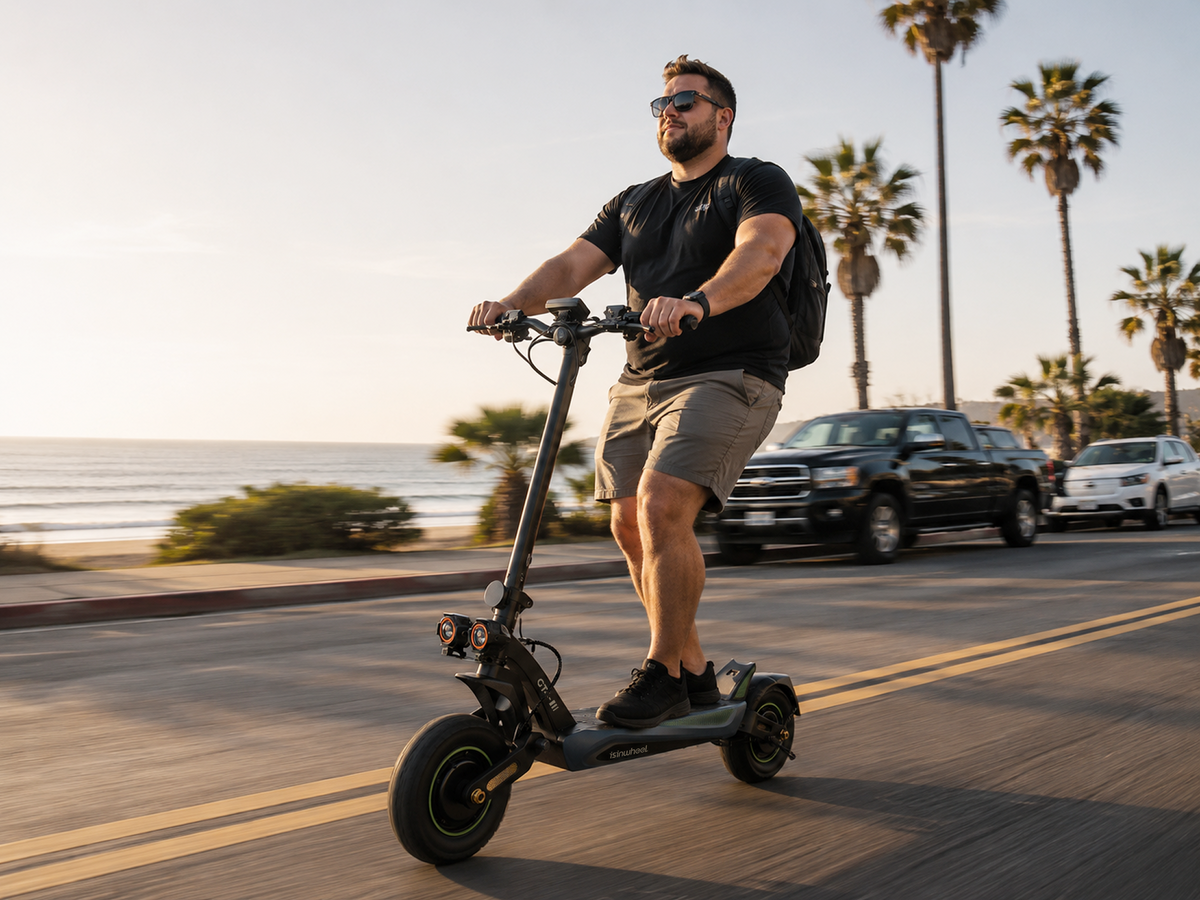
Does your route really call for an off-road electric scooter?

Many scooters look trail ready in photos, yet that rugged styling can fall apart once you hit washboard gravel, broken pavement, loose dirt, or repeated curb-height impacts. If you buy the wrong build, you usually feel it fast: sketchy traction, harsh ride quality, nervous braking, and parts that wear sooner than expected. The better way to judge an off-road electric scooter is to start with the route you actually ride, then check whether the hardware matches that abuse level.
A commuter scooter vs off-road scooter decision gets easier when you stop focusing on looks and start focusing on terrain. If your week is mostly smooth bike lanes and city streets, lighter commuter priorities may win. If your regular ride includes gravel cut-throughs, steep driveways, potholes, park paths, or uneven access roads, you need a true electric scooter for rough terrain. Within the iSinwheel High-Performance Collection, GT2 and GT2 Pro fit lighter mixed-terrain use, while GT1 Dual and GT4 Dual move toward more demanding off-road work.
Start with the tires, because that is where off-road grip begins

A scooter earns off-road credibility at ground contact first. Larger pneumatic tires absorb chatter better than hard commuter-style setups, and they roll over loose or broken surfaces with less deflection. That matters whether you want an electric ride for outdoor adventure or simply more control on rough shortcuts during a weekday commute.
What to check
- Tire size: bigger usually means better rollover on trail chatter
- Tire type: pneumatic tires are more forgiving than solid tires
- Tread intent: off-road or all-terrain patterns help on loose ground
- Surface match: gravel and dirt demand more tire than smooth pavement
Brand examples that show the difference
- GT2: 11-inch off-road pneumatic tires
- GT2 Pro: 11-inch pneumatic off-road tires
- GT1 Dual: 10-inch off-road pneumatic tires
- GT4 Dual: 12-inch off-road tires
GT2 is a good example of a stronger single-motor scooter that still takes tire setup seriously, using 11-inch off-road pneumatic tires for better comfort and control on mixed terrain. GT4 Dual pushes farther with oversized 12-inch tires, which is the kind of spec that starts to matter when your route gets faster, rougher, or more unpredictable.
Suspension tells you whether the scooter can stay settled
A lot of product pages promise comfort, but off-road use is really about control after the first hit and the fifth hit, not just the first impression. Real suspension hardware helps the tires stay planted and keeps the deck from bouncing you off line when the ground changes quickly.
What to look for
- Front and rear suspension, not vague comfort language
- Hydraulic or swing-arm designs for repeated bump control
- Clear hardware descriptions instead of generic “shock absorbing” claims
Stronger signals in this lineup
- GT2 Pro lists front and rear dual hydraulic suspension
- GT4 Dual lists dual swing arm suspension
- GT1 Dual highlights dual suspension for city and off-road use
If you expect rough roads only once in a while, GT2 Pro is a practical middle ground because it combines 11-inch pneumatic tires with front and rear dual hydraulic suspension. If your riding is consistently harsher, GT4 Dual’s dual swing arm suspension is the more serious clue that the scooter is meant to stay composed instead of merely feeling padded.
Match motor output to hills, load, and loose surfaces

Motor numbers matter most when climbing demand, rider weight, and poor traction stack together. A single-motor scooter can work well for mixed use, but a dual-motor scooter starts to make more sense when you want stronger launches on inclines, more support on loose ground, or faster recovery after speed drops.
Use this quick filter
- Occasional gravel, broken pavement, moderate hills: strong single motor may be enough
- Frequent climbs, loose dirt, heavier rider load: dual motors become more useful
- Weekend trail riding at higher speeds: prioritize power and control together
How the iSinwheel models separate
- GT2: 1000W motor, up to 28+ mph, 35% climbing ability
- GT2 Pro: 1200W motor, up to 32 mph, up to 38 miles
- GT1 Dual: 800W x 2, 2-wheel drive, 0-20 mph in 3.5 seconds, up to 35% climbing ability
- GT4 Dual: 1200W x 2, up to 45 mph
If your riding is urban commuting plus occasional gravel shortcuts, GT2 or GT2 Pro may be the smarter fit. If you already know you want steeper climbs, quicker acceleration, or more demanding terrain support, GT1 Dual or GT4 Dual is the more believable off-road direction.
Braking hardware matters more than headline speed
Top speed gets attention, but braking is what decides whether a rough-terrain scooter feels safe when the surface changes under you. On loose dirt, wet pavement, or downhill sections, stronger brake hardware gives you more control over weight transfer and stopping distance. The CPSC warns that e-scooter injuries can include head trauma and recommends wearing a helmet and protective gear.
What to prioritize
- Hydraulic disc brakes for stronger, more consistent stopping feel
- Front and rear braking, not minimal single-end setups
- Layered systems such as electronic plus disc braking
Examples worth noting
- GT2: front and rear hydraulic disc brakes
- GT4 Dual: hydraulic disc brake setup
- GT1 Dual: EABS plus disc brake, with a triple braking system
A fast scooter without serious brakes is not an off-road build. It is just a fast scooter. That is why braking should be treated as a safety threshold, not a bonus feature.
Check support terms before you treat a scooter as a long-term buy
Higher-impact riding puts more stress on parts, so after-sales support matters. iSinwheel’s support FAQ says scooters carry a 12-month warranty for quality-related issues handled with replacement parts, and the same FAQ says average order fulfillment is 1 business day with 2-5 business days shipping time. The return and exchange request page says customers submit a three-step request and should expect instructions within 1-3 business days after submission.
Before you buy, confirm
- Warranty scope for scooter models
- Shipping timeline to your address
- Return or exchange request steps
- How parts support is handled
Quick safety and readiness checks
Before any off-road ride, slow down and do the basics. A recent CPSC micromobility report shows injuries tied to e-scooters and related products remain a real safety issue, so the route and your setup both matter.
- Wear a properly fitted helmet and terrain-appropriate protective gear
- Reduce speed on gravel, wet pavement, and unfamiliar descents
- Check tire pressure, brake feel, and lights before every ride
- Match scooter capability to your skill level
- Verify local electric scooter rules before off-road or mixed-use riding
Common rough-terrain problems and the usual fix
| Problem | Likely Cause | Fix |
|---|---|---|
| Harsh, bouncy ride | Light-duty tires or suspension | Move to bigger pneumatic tires |
| Weak climbing | Not enough motor output | Choose stronger or dual motors |
| Nervous stopping | Brake system too basic | Prioritize hydraulic braking |
| Fast range drop | Hills and loose surfaces | Buy more battery headroom |
Conclusion
Determining whether you truly need an off-road electric scooter comes down to honest evaluation of your daily terrain. While single-motor models like the GT2 and GT2 Pro offer an ideal middle ground for urban streets and occasional gravel shortcuts, demanding conditions demand a purpose-built setup. If your route features steep hills, loose dirt, or severe impacts, dual-motor options like the GT1 Dual and GT4 Dual provide the necessary traction, dual suspension, and stopping power to keep you in control.
Ultimately, off-road performance relies on hardware—specifically large pneumatic tyres, dual hydraulic suspension, and responsive hydraulic brakes—rather than top-speed claims. Before taking on rougher paths, ensure you have the right protective gear, understand local riding regulations, and account for ongoing maintenance support. By matching your scooter's true capabilities to the abuse level of your route, you can enjoy a safer, smoother, and more durable ride.
FAQ
1. How do I know if I need a dual-motor scooter like the GT1 Dual or GT4 Dual?
If your regular route includes steep hills, loose gravel, off-road trails, or heavy payload demands, a dual-motor scooter is essential. Dual motors provide superior traction, instant acceleration, and consistent torque on inclines, preventing power loss where single-motor scooters usually struggle.
2. Are off-road electric scooters suitable for daily city commuting?
Yes, but with trade-offs. Models like the GT2 and GT2 Pro handle city streets with exceptional comfort thanks to their pneumatic tyres and hydraulic suspension. However, off-road models are generally heavier and less portable than standard commuter scooters, making them trickier to carry up stairs or onto public transit.
3. Why are pneumatic tyres preferred over solid tyres for rough terrain?
Pneumatic (air-filled) tyres offer significantly better shock absorption, road grip, and surface flexibility than solid tyres. On uneven ground, gravel, or wet pavement, large pneumatic tyres cushion the ride and keep the scooter planted, drastically reducing vibration and rider fatigue.
4. What routine maintenance should I expect for an off-road scooter?
To maintain an off-road scooter exposed to heavy impacts and severe vibrations, you should regularly check tyre pressure and tread wear, inspect brake responsiveness and pad wear on hydraulic systems, tighten frame bolts and suspension hinges, and wipe down the body after muddy rides to safeguard electrical components.
5. What warranty and after-sales support does isinwheel offer for high-performance models?
isinwheel provides a 12-month warranty covering quality-related issues, supported by replacement parts. Orders are typically processed within 1 business day with fast standard shipping, and dedicated support is available to assist with maintenance inquiries or exchange requests.
Table of Contents
- Does your route really call for an off-road electric scooter?
- Start with the tires, because that is where off-road grip begins
- Suspension tells you whether the scooter can stay settled
- Match motor output to hills, load, and loose surfaces
- Braking hardware matters more than headline speed
- Check support terms before you treat a scooter as a long-term buy
- Quick safety and readiness checks
- Common rough-terrain problems and the usual fix
- Conclusion
-
FAQ
- 1. How do I know if I need a dual-motor scooter like the GT1 Dual or GT4 Dual?
- 2. Are off-road electric scooters suitable for daily city commuting?
- 3. Why are pneumatic tyres preferred over solid tyres for rough terrain?
- 4. What routine maintenance should I expect for an off-road scooter?
- 5. What warranty and after-sales support does isinwheel offer for high-performance models?



Share:
Name-Brand Batteries vs Generic Cells in Electric Rideables: Is the Premium Worth It?