



2026 Ultimate Guide to Choosing Suspension Features for Budget Off-Road Scooters
Which suspension setup actually works on rough paths for less?

Washboard gravel, broken asphalt, and shallow ruts expose weak scooters fast. A setup that feels fine on a smooth bike path can turn harsh, unstable, and tiring within minutes once your route includes chatter bumps, loose corners, or repeated downhill braking. That is why budget off-road scooter suspension is not just about comfort. It directly affects tire contact, steering calmness, braking control, and how much punishment your hands, knees, and frame take over time.
The smarter way to shop is to start with terrain, not speed. In this guide, you will sort your weekly surface mix, learn which suspension and tire features matter most, and compare real tradeoffs for an off-road electric scooter under 800. You will also see where commuter priorities split from trail-biased setups, and how models like the GT1 Dual, GT2, and GT4 fit different mixed-surface jobs.
Suspension basics that matter more than top speed
A scooter can post a flashy top-speed number and still feel bad on rough ground. For mixed pavement, gravel connectors, and light trail use, the practical goal is simple: keep the tires in contact with the surface long enough to steer, brake, and recover cleanly.
What suspension really does off-road
Off-road suspension is there to control motion, not just soften impact. When the wheel hits a bump, the suspension helps the tire move up and down instead of skipping across the surface. That matters because braking and steering only work well when the tire stays planted.
In real riding, good suspension helps with:
- keeping front-end tracking calmer on washboard surfaces
- reducing bounce when braking on loose gravel
- lowering hand, shoulder, and knee fatigue on longer rides
- improving confidence on broken pavement transitions
- making the deck feel less nervous on shallow ruts and small drops
That is also why speed can mislead buyers. Even a modest scooter can feel capable if the tires, brakes, and suspension work together. By contrast, a faster scooter with a harsh setup often feels worse once the path gets rough.
Key terms readers must understand
You do not need to memorize engineering language, but a few terms make a suspension electric scooter buying guide much easier to use.
- Front suspension: absorbs steering-side hits from cracks, rocks, and curb transitions.
- Rear suspension: manages impacts under the drive wheel and helps stability under acceleration.
- Hydraulic damping: oil-based control that slows rebound, so the scooter does not pogo after a bump.
- Spring rate: how firm the suspension feels under rider weight.
- Travel: the total amount of suspension movement available.
- Pneumatic tires: air-filled tires that add their own shock absorption.
- EABS: electronic braking support that helps smooth braking input when paired with mechanical brakes.
For budget buyers, the takeaway is straightforward: tire type and suspension layout usually matter more than a small difference in claimed top speed.
Terrain categories for budget buyers
Not every rough route demands a true trail machine. A lot of riders actually need a crossover setup, not a full heavy-duty off-road build.
Think in these terrain bands:
- Cracked pavement and broken asphalt: urban neglect, expansion joints, patched roads
- Packed dirt and gravel connectors: park paths, canal trails, campus shortcuts
- Park trails and shallow ruts: uneven surfaces, roots, loose turns, mild drops
- Steeper climbs and rough descents: longer hills, repeated braking, larger impacts
If your route lives mostly in the first two bands, a good crossover scooter is usually enough. Once repeated descents, deeper ruts, or sustained loose surfaces enter the picture, braking quality and stronger suspension become much more important.
How should you match suspension to your actual route?
Most buying mistakes happen before you compare models. Riders often shop for the most exciting ride they imagine, not the surfaces they actually use every week. The fix is to map the route first, then define the minimum hardware that keeps control predictable.
Step 1: Define your weekly surface mix
Start with your normal week, not your once-a-month adventure ride. Split your miles into commute pavement, rough city pavement, gravel connectors, and trail sections. That gives you a more honest way to compare a commuter vs off-road scooter.
Write down:
- how many rides per week include gravel or dirt
- whether the bumps are frequent light chatter or occasional hard hits
- how often you ride hills or descend on loose ground
- whether you carry a backpack, groceries, or work gear
- whether the rough section is 3 minutes long or 30 minutes long
This step also helps range planning. Heavier loads, hills, and rough surfaces cut real-world range because the motor works harder and the scooter loses efficiency over repeated impacts. Apollo notes that rider weight and terrain reduce advertised range, which is one reason surface mix matters before spec comparison. Apollo Scooters
Step 2: Set the minimum viable hardware
Once you know the route, set a floor for features. This is the simplest way to avoid underbuying.
For a beginner-friendly rough terrain scooter features checklist, look for:
- 10-inch tires at minimum, with 11-inch preferred for rougher connectors
- pneumatic rather than solid tires
- front and rear suspension, not front-only if gravel is frequent
- front and rear disc braking, ideally with EABS support
- a wider, more stable deck and stem area
- payload capacity with margin above your actual riding weight
The tire point is especially important in the pneumatic tires vs solid tires debate. Pneumatic tires add compliance before the suspension even starts moving. Solid tires resist flats, but on rough ground they usually transmit more shock and reduce grip.
Step 3: Match setup to rider load
A light rider and a heavier rider can have very different experiences on the same scooter. If the suspension is too soft for your total load, it can feel wallowy and unstable. If it is too firm, the scooter may skip across bumps instead of absorbing them.
Check these points:
- your body weight versus the rated payload
- regular cargo weight, such as a bag or lock
- whether the scooter keeps braking confidence under load
- whether hills are part of your daily route
A useful rule is to avoid shopping at the exact limit. Leave headroom. More load stresses the frame, suspension, brakes, and battery, especially on rougher surfaces.
Step 4: Test value beyond speed
A budget scooter earns its value through control, not bragging rights. In practice, downhill braking feel, deck stability, and tire behavior tell you more than a headline speed number.
What to compare first:
- traction over chatter bumps
- how calm the steering feels after a hit
- braking consistency on dusty or loose sections
- frame and stem confidence at moderate speed
- how much effort it takes to stay balanced after repeated bumps
This matters for safety too. The U.S. Consumer Product Safety Commission estimated about 79,300 emergency-department-treated e-scooter injuries in 2024, with control issues and falls among the documented hazard patterns. CPSC
Which decision factors separate a good value scooter from a bad one?
Once you filter by route and minimum hardware, a few decision factors do most of the real work. These are the details that separate a scooter that feels usable every week from one that becomes a compromise after the first rough month.
Tire and suspension pairing
Suspension cannot fully rescue a poor tire choice. Large pneumatic tires create the first layer of shock absorption and help the wheel conform to uneven ground. That is why pneumatic tires vs solid tires is not a small detail for off-road use.
What to check:
- 10-inch tires for light mixed use
- 11-inch tires for better rollover on rougher connectors
- tread suited to mixed surfaces, not smooth city-only rubber
- front and rear suspension working with the tire size
A weak pairing often looks like this: good-looking suspension with small or harsh tires. On gravel, that setup still feels skittish.
Brake confidence versus speed marketing
More speed demands better stopping, especially on descents and loose surfaces. Budget buyers often over-focus on acceleration and ignore brake feel until after purchase.
A stronger setup usually includes:
- dual disc braking
- electronic braking support
- stable tire contact under braking
- enough deck composure to avoid front-end panic
For riders moving beyond pavement, this factor can matter more than another 3 to 5 mph on the spec sheet. NHTSA also emphasizes pre-ride checks on brakes, lights, and tire condition before riding, which translates directly to scooter use on rough routes. NHTSA
Battery, range, and route honesty
Published range numbers are usually best-case figures. Rough surfaces, stop-start riding, climbing, and heavier loads all cut usable distance. So instead of shopping for the biggest range claim, buy for your real weekly mileage with buffer.
A practical buying lens:
- if your normal ride is under 10 miles round trip, range pressure is low
- if you combine commuting and weekend gravel rides, battery size matters more
- if hills are frequent, expect faster battery drop than flat-road use
This is where many crossover buyers make better choices by accepting a little less speed in exchange for better comfort and route consistency.
Portability versus trail capability
There is always a tradeoff. Bigger frames, larger tires, and stronger suspension improve control, but they also add weight and reduce carry convenience.
Use this split:
- choose commuter-first if you carry the scooter upstairs often
- choose crossover if you ride mixed pavement and gravel weekly
- choose trail-biased if control on rough descents matters more than portability
That distinction is at the center of any honest beginner off-road scooter guide. A scooter that is easy to lift but miserable on your route is not a good beginner choice.
Practical model-direction examples for budget and crossover shoppers

Real model direction helps once you understand the framework. Here, the goal is not to claim one scooter fits everyone. It is to show how certain setups match common use cases.
Light off-road and mixed commuting
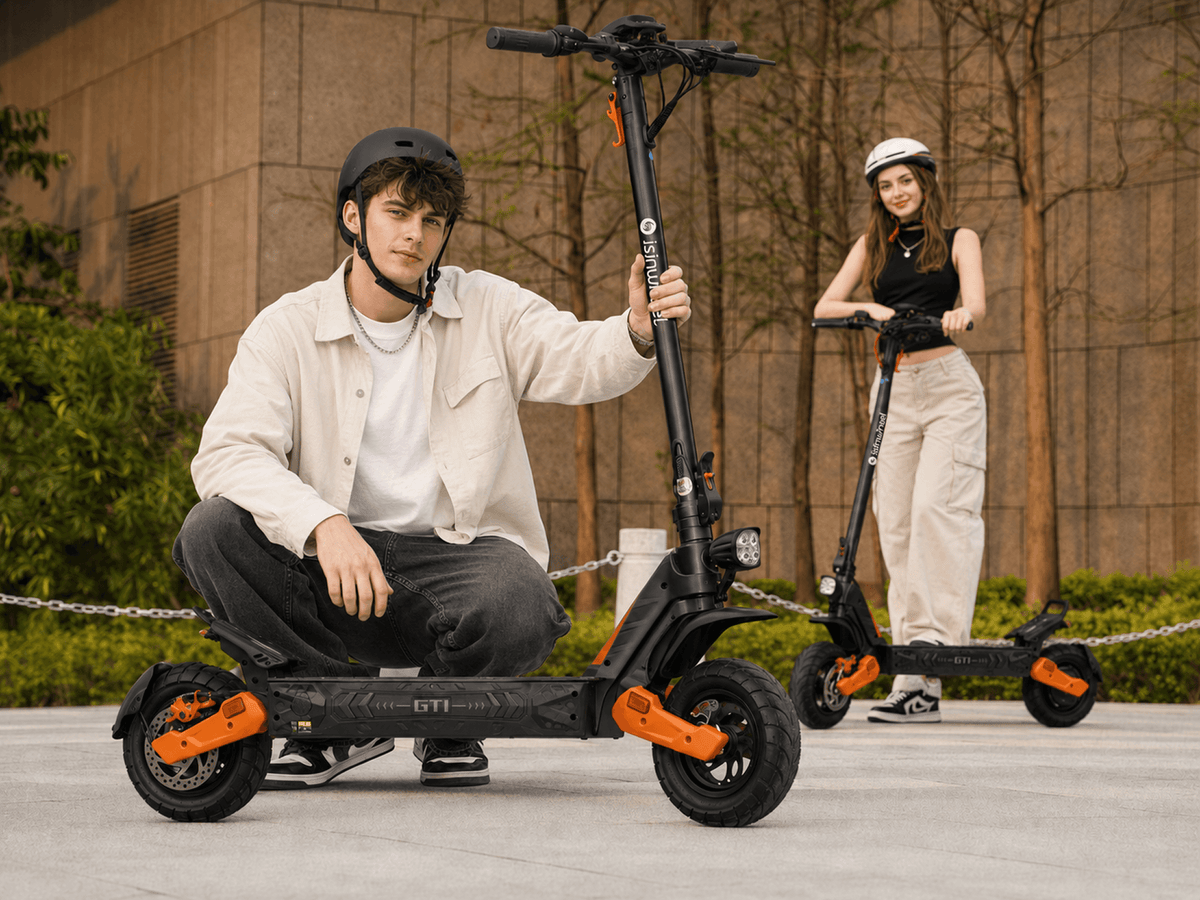
If your route mixes broken pavement, gravel connectors, and light park-path riding, a crossover setup is usually the sweet spot. The iSinwheel GT2 uses an 11-inch pneumatic off-road tire setup, dual suspension, front and rear disc brakes with EABS, a 1000W-rated motor, a 48V 15Ah battery, and a stated max load of 330 lbs. That package makes sense for riders who want more comfort and wheel rollover than a small commuter scooter can offer. The published GT2 specs also list up to 28 mph, up to 37 miles of range, and roughly 53 lbs of weight, which is still manageable compared with heavier true off-road models.
Shop: isinwheel GT2 1000W Off Road Electric Scooter 2026 Upgraded Version
Beginners needing city plus gravel flexibility
Not every first buyer needs a large scooter. If your riding is split between city streets and occasional rougher connectors, the GT1 Dual points in a practical direction. iSinwheel lists dual 800W motors, 10-inch off-road pneumatic tires, dual suspension, front and rear braking, a 48V 13Ah battery, up to 32 mph, up to 35 miles of range, and a 330 lb max load for the GT1 Dual. That makes it a useful example of an off-road electric scooter under 800 direction for riders who want stronger hill support and better mixed-use ability without jumping straight to a larger trail class.
Compared with commuter-focused options from Segway, NIU, or GOTRAX, this kind of dual-motor crossover setup generally prioritizes loose-surface punch and rougher-route comfort over compact carry convenience.
Heavier-duty rough terrain aspirations
Some riders really do need more than a budget crossover. If your route includes repeated climbs, rough descents, larger impacts, or longer off-road sessions, the step-up class becomes easier to justify. The GT4 is a much more trail-biased example, with dual 1200W motors, 12-inch off-road tires, dual swingarm suspension, hydraulic disc brakes, a 52V 18.2Ah battery, up to 45 mph, and a stated 330 lb payload. That is well beyond the light mixed-use category.
For many shoppers, the key lesson is not to stretch a smaller scooter into this job. If your route regularly demands hydraulic braking, larger tire rollover, and heavier-duty stability, stepping up is usually smarter than overestimating what an entry crossover can safely handle.
Shop: GT4 2400W Dual Motor Off-Road Electric Scooter
Common buyer mistakes that waste budget
Most wasted money in this category comes from mismatch, not from buying too little or too much in absolute terms. Riders get in trouble when they shop by marketing category instead of route demands.
What to avoid on a tight budget
A few mistakes show up again and again:
- buying speed before braking quality
- choosing city-oriented tires for gravel use
- ignoring payload once bags or gear are added
- shopping for fantasy trail rides instead of weekly routines
- underestimating the stress of rough downhill braking
- assuming a bigger scooter is automatically better
The last point matters more than it seems. A heavier scooter can improve stability, but if you need to carry it often, daily ownership gets annoying fast. The better question is not “What is the biggest scooter I can afford?” It is “What is the least aggressive scooter that still handles my route without feeling sketchy?”
Best Practices & Pitfalls

Good setup choices are only half the story. Riding habits and maintenance make a visible difference in control, comfort, and durability.
Best practices
If you want the most from budget off-road scooter suspension, keep your decisions and ride habits simple.
Do this:
- match suspension to terrain severity, not to brand hype
- prioritize pneumatic tires before chasing extra top speed
- test braking feel on rougher ground at moderate speed first
- leave payload margin instead of riding at the limit
- inspect stem tightness, latch security, and tire condition before rough rides
- slow down when surfaces change from hardpack to loose gravel
A practical pre-ride routine matters because rough paths magnify small problems. A loose stem or underinflated tire feels much worse off pavement than it does on a clean street.
Common pitfalls to avoid
Some problems feel small in the garage but get expensive on the path.
Watch for these pitfalls:
- treating solid tires as an equal substitute for mixed-terrain pneumatics
- assuming “dual motor” automatically means better control
- using commuter geometry for weekly gravel and trail riding
- trusting stated range without accounting for hills and rough surfaces
- mistaking stiffness for durability when the ride actually loses traction
In short, control comes from the system. Tires, suspension, brakes, frame stability, and rider load all interact. If one part is weak, the rest of the scooter cannot fully cover for it.
Where commuter and off-road priorities split
Many buyers hesitate between a smoother city scooter and a rougher-route machine. The answer becomes clearer when you focus on what stability means in each use case.
Commuter-first scooter traits
A commuter-first setup works best when most of your route is paved and you value daily convenience.
Typical signs include:
- lighter frame for carrying and storage
- smaller footprint in apartments or offices
- geometry tuned for smoother city riding
- less emphasis on tire size and suspension travel
This is often the right answer if your rough sections are occasional and mild.
Off-road-first scooter traits
An off-road-first setup is built around surface inconsistency. It gives up some portability to gain composure where pavement quality drops.
Look for:
- larger pneumatic tires
- stronger front and rear suspension
- better braking support for loose descents
- a wider, more planted stance
- more payload and hill reserve
Apollo’s own commuting guidance also notes that good suspension on both wheels becomes increasingly important once scooter speeds exceed around 15 mph, especially on rougher roadway sections. Apollo Scooters
Beginner buying takeaway
If your rides are mostly smooth, a commuter-first scooter stays easier to live with. If rough pavement and gravel show up weekly, a crossover scooter is often the smarter first purchase. If steep descents, repeated impacts, and trail sessions are normal, move toward a more capable off-road class early instead of forcing a commuter build into the wrong job.
Suspension value starts with traction, not speed
The best buying rule in this category is simple: choose for contact and control before excitement. A scooter that keeps its tires planted, brakes predictably, and stays calm on rough ground will feel faster and safer in real use than one that only wins on a spec sheet.
Map your weekly route first. Then shortlist by tire size, pneumatic construction, front and rear suspension, braking layout, payload margin, and frame stability. For many riders, that process points toward a crossover model like the GT1 Dual or GT2. If your terrain is rougher and more frequent than a budget setup can handle, stepping up to a heavier-duty class such as the GT4 is the more honest decision.
FAQ
How do I select an electric scooter for outdoor adventures and rough terrain for $800 or less?
Focus first on the surfaces you actually ride each week, because packed dirt, gravel, and broken pavement need a different setup than smooth streets. In this price range, the strongest value usually comes from a crossover scooter with 10- or 11-inch pneumatic tires, front and rear suspension, and disc braking with EABS rather than extreme speed claims. If your route includes repeated steep descents or deeper ruts, it is usually smarter to step up in capability instead of forcing a budget model into a tougher job.
What’s the most durable electric scooter for off-road conditions?
For off-road conditions, the most durable choice is typically a well-built model from a brand like Isinwheel that combines a strong aluminum frame, large pneumatic tires, dual suspension, and reliable brakes designed for repeated bumps and descents. If you want durability first, prioritize a scooter with 10- to 11-inch air-filled tires, reinforced suspension components, and enough payload capacity to leave at least 10 to 20 percent headroom above your normal riding weight. Models built for light trails and uneven ground will usually last longer than entry-level commuter scooters used beyond their intended terrain. Even the toughest scooter will depend on regular checks of fasteners, brake response, and tire wear to stay durable over time.
What’s the best-value electric scooter for light off-road exploration under $800?
Under $800, a strong value pick for light off-road exploration is an Isinwheel model with 10-inch pneumatic tires, dual suspension, and reliable disc braking, because those features matter more on gravel paths and uneven pavement than chasing top speed. In this price range, prioritize comfort, traction, and predictable control over maximum motor claims, especially if your riding includes park trails, cracked streets, or curb transitions. The best-value option should also have enough battery for your usual round trip without running near empty, since range drops faster on rougher surfaces. If you are comparing models, choose the one that gives you front and rear suspension plus pneumatic tires first, then check hill performance and load capacity against your weekly route.
How do I make sure an off-road scooter is safe for rough terrain without overspending?
Start with the contact and stopping system, because tires and brakes matter more than extra speed on loose ground. Choose pneumatic tires, front and rear braking support, a stable deck, working lights, and suspension that helps keep both wheels planted over uneven surfaces. Before each ride, inspect tire condition, brake response, folding latch security, stem tightness, and battery charge, and keep your first test rides on rough ground at moderate speed. In many cases, that routine improves real safety more than paying for a scooter with a much higher top-speed rating.
What should I look for in a commuter scooter versus an off-road scooter for beginners?
The main difference is where the scooter is meant to stay stable and comfortable. A commuter scooter usually favors lighter weight, easier storage, and smoother pavement efficiency, while an off-road scooter prioritizes larger tires, stronger suspension, and better braking confidence on loose or broken surfaces. Beginners should compare tire type, scooter weight, brake layout, deck stability, and payload before worrying about styling or peak speed. If your route mixes pavement with gravel every week, a crossover model is often the safest and most practical first step.
How do I choose a beginner-friendly electric scooter for commuting versus off-road use?
Begin with your route split, because that one decision removes most confusion. If most rides stay on smooth streets, a lighter commuter-oriented scooter is easier to carry, store, and manage; if gravel, rough pavement, or park trails show up often, move toward a crossover or off-road build with pneumatic tires and dual suspension. Isinwheel is relevant for this kind of comparison because its lineup spans commute-leaning and mixed-terrain options, so you can choose by use case rather than by marketing category alone. As a rule, buy the least aggressive scooter that still feels stable on your real terrain every week.
Table of Contents
- Which suspension setup actually works on rough paths for less?
- Suspension basics that matter more than top speed
- How should you match suspension to your actual route?
- Which decision factors separate a good value scooter from a bad one?
- Practical model-direction examples for budget and crossover shoppers
- Common buyer mistakes that waste budget
- Best Practices & Pitfalls
- Where commuter and off-road priorities split
- Suspension value starts with traction, not speed
-
FAQ
- How do I select an electric scooter for outdoor adventures and rough terrain for $800 or less?
- What’s the most durable electric scooter for off-road conditions?
- What’s the best-value electric scooter for light off-road exploration under $800?
- How do I make sure an off-road scooter is safe for rough terrain without overspending?
- What should I look for in a commuter scooter versus an off-road scooter for beginners?
- How do I choose a beginner-friendly electric scooter for commuting versus off-road use?


Share:
5 Steps to Choose the E-Bike or Scooter That Fits Your City Storage Needs
Top 3 Affordable Electric Scooters for Family Errands Under $800