


Introduction
You pick a route that looks fine on a map, then you hit the first long hill, a cracked patch of asphalt, and a crowded sidewalk corner. Suddenly, your "easy" commute turns into pushing, wobbling, or arriving sweaty and late. That is why beginners often bounce between Electric Scooters and Electric Bikes, and why "Best electric scooters for commuting" lists can feel confusing when your real problem is hills.
If you choose wrong, you usually pay twice: first with wasted money and second with daily frustration (slow climbs, short range, uncomfortable riding, or storage headaches). This guide gives you a practical way to compare scooters for urban commuting vs. a seated e-bike, understand battery and motor specs, and build green commuting solutions that actually match your hills. Next, you will learn the fundamentals, then apply them to your own route with step-by-step modules.
Official Site: Isinwheel
Core Foundations
Electric Scooters vs. Seated e-bikes: what changes in daily use
If your commute includes elevators, tight hallways, or mixed transit, portability tends to decide everything. Electric Scooters usually win on quick folding and small footprint, which helps with last-mile delivery style moves like "ride, carry, store, repeat." A seated e-bike (or a seated scooter that rides more like a mini bike) tends to win when you care about comfort, stability, and long time-in-saddle.
For beginners, the big difference is body position and balance demands. Standing scooters ask more from your ankles and core because micro-adjustments keep you stable over bumps. Seated riding spreads the load across the seat and pedals (on e-bikes) or seat and deck (on seated scooters), so your body fatigue usually drops on longer or hillier trips.
Hill climbing basics: watts tell only part of the story
Before you shop for "1200W" or "500W," treat hill climbing as a system, not a single number. Motor wattage helps, but your actual climbing experience depends on torque at low speed, controller current limits, gearing (for e-bikes), and how much voltage sag happens under load. The same rider can see very different results on the same hill just by changing tire pressure or carrying a heavy backpack.
A simple beginner rule: steep hills punish weak torque, and long hills punish small batteries. If your commute has repeated climbs, your battery has to deliver high power for minutes at a time without overheating or dropping voltage too far.
Battery and range: how to translate specs into real commuting distance
Range numbers are usually optimistic because they assume flat terrain, light rider load, and moderate speeds. On hills, the battery drains faster because the motor must fight gravity continuously. Battery specs are easier to compare when you think in watt-hours (Wh): voltage (V) times capacity (Ah) roughly equals stored energy.
For example, a 48V 18.2Ah battery stores about 874Wh (48 x 18.2). That is a strong starting point for eco-friendly transportation alternatives that include hills, because you have more energy to spend on climbs and headwinds.
Urban commuting fundamentals: safety, storage, and the "two stops" test
Before obsessing over top speed, run the "two stops" test: can you brake confidently twice in a row on your steepest downhill without panic? Hill commutes are downhill commutes too, and braking heat builds quickly. Lighting and signaling matter more in cities because drivers and pedestrians are unpredictable at intersections.
Also, treat storage as a daily constraint. If you cannot store your ride securely at work and at home, an anti-theft plan becomes your real purchase, and the vehicle becomes a liability.
Application Modules
Assessing Your Commute Terrain
The fastest way to choose between Electric Scooters and E-bikes is to measure your route like a technician, not like a hopeful buyer. First, identify your "worst 10%" section: the steepest sustained hill, the roughest pavement block, and the busiest intersection segment. Your vehicle must handle those reliably, because that is where beginners quit.
Next, separate hills into two types:
- Short steep punch: 10 to 60 seconds
- Long steady climb: 2 to 10+ minutes
Short steep punch demands strong low-speed torque, while long steady climbs demand battery capacity and cooling. If your route has both, you want a platform that stays stable at low speed (when you are climbing slowly) and still feels planted on the way down.
Finally, look at the surface and weather reality. Pneumatic tires (air-filled) help on cracked asphalt, brick, and patched roads because they absorb vibration. Water resistance matters if you ride after rain, but it does not mean you can ride through deep puddles. Plan for predictable, repeatable performance, not heroic one-off rides.
Prioritizing Portability vs. Comfort
Most beginners try to solve hills with raw power, then realize their bigger problem is daily livability. If you carry your ride up stairs, store it in an apartment corner, or combine it with trains, portability can matter more than an extra few miles of range. That is why classic standing Electric Scooters still dominate last-mile mobility solutions.
Comfort becomes the winner when your ride time is long or your route is rough. Seated riding reduces fatigue, which helps you keep better control on descents and in traffic. If you arrive tense, your decision quality drops at intersections, and that is where accidents happen.
Use this quick decision split:
- Choose portability-first if you must carry it weekly
- Choose comfort-first if you ride 30+ minutes daily
- Choose stability-first if your roads are rough or wet
A seated scooter design can sit in the middle: more comfortable than a standing scooter, but still more compact than many full-size e-bikes. That is a practical green commuting solution when you live in a small space but face hills.
Understanding Battery and Motor Specs
Specs should answer one question: "Will this climb my hill at a safe, controllable speed without killing the battery?" Start with battery energy and voltage, then look at motor rating, then look at tires and braking. For beginners, the best clue is whether the product is built as a commuter system (brakes, suspension, lighting, load capacity), not just a motor strapped to a deck.
A helpful conversion is watt-hours (Wh). It lets you compare Electric Scooters vs. Electric Bikes more fairly. A higher Wh battery can maintain speed on climbs, support heavier riders, and reduce daily charging stress. Lithium-ion Battery Technology also benefits from staying out of deep discharge cycles, so more capacity can mean better long-term durability.
The content brief mentions IEEE, but for commuting decisions, the more useful lesson is the concept: power metrics must be measured consistently, and real performance depends on the full system (motor, controller, battery, and load).
Brand example: iSinwheel H7Pro for hill-focused commuting

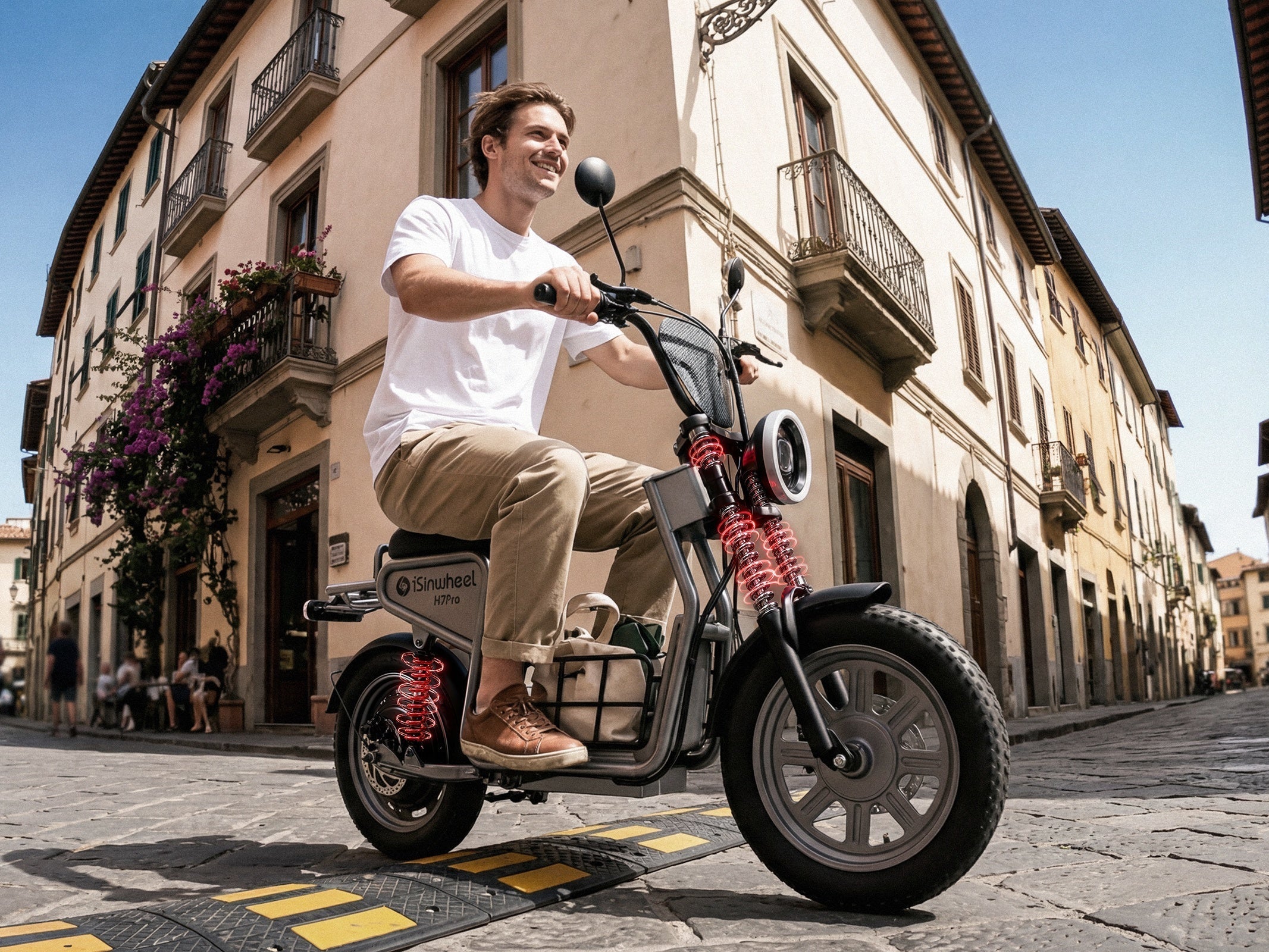
If your primary need is hills plus comfort, a seated, high-power commuter scooter can be a clean fit. The iSinwheel H7Pro is built around a 1200W motor, a 48V 18.2Ah battery, and 16-inch pneumatic fat tires (listed as 16 x 4). The product page also calls out up to 43 miles max range, IPX4 water resistance, EABS plus disc braking, and dual hydraulic suspensions, which are all commuter-relevant because hills demand stability and confident braking. (isinwheel.com)
From a practical standpoint, the H7Pro packaging also reflects "ready to commute" thinking: the box list includes NFC cards (unlock), mirrors, windshield, spare inner tire, tire pump, and tools. That matters because beginners often underestimate how quickly tires and fasteners become part of ownership on rough city streets. (isinwheel.com)
Shop: isinwheel H7Pro 1200W High-End Commuting Electric Scooter with Seat
Safety Features and Regulations
Safety is where "beginner" and "hills" collide. You need braking redundancy, visibility, and predictable handling at low speed. On steep descents, small weaknesses feel big: a vague brake lever, dim headlight, or twitchy steering becomes stressful fast. Start by prioritizing:
- Dual braking or brake plus electronic braking
- Bright headlight plus rear light
- Turn signals or clear hand-signal ability
- Stable tire contact (larger pneumatic tires help)
Next, confirm how your local area treats micromobility. Some cities restrict where scooters can ride (bike lane vs. street vs. sidewalk), and speed limits can be different for scooters and e-bikes. The NHTSA explains how traffic safety rules and state-level regulations affect motorized two-wheel vehicles, which is a useful starting point when you are trying to understand what applies in your area. (global.niu.com)
Competitor context (allowed): what NIU typically emphasizes
Since you listed Niu as a competitor to include, here is a fair, non-sales comparison lens. NIU commuter-style kick scooters in the KQi line often highlight practical safety and usability features like lighting, braking systems, water resistance, and hill-climb ratings around 20% on certain models/series. For example, NIU marketing for the KQi 200 series mentions IPX5 water resistance, a halo headlight, turn signals, and a front drum plus rear e-brake system, along with up to 20% slopes. (global.niu.com)
The takeaway is not "which is better." The takeaway is what to compare: hill rating, braking type, water resistance, and visibility features are commuter essentials for sustainable electric vehicles in real city traffic.
Selection/Decision Guide
Your goal is to pick a vehicle that you will actually ride five days a week. Use a decision framework based on commute reality, not hype. Start with distance, then hills, then storage, then safety. Only after that should you care about top speed.
Step 1: Commute distance and charging cadence
If your daily round trip is short, you can prioritize portability and quick handling. If your round trip is longer, you want battery capacity that leaves a buffer so you do not arrive home at 5% every day. That buffer reduces battery stress and makes green commuting solutions more reliable.
Step 2: Hill intensity and rider load
Use your steepest sustained climb as the benchmark. If you are heavier, carry cargo, or face long climbs, prioritize torque-capable setups (often higher power and higher voltage). Also, check the max load rating so handling stays stable under real commuter weight.
Step 3: Storage and theft reality
If you cannot bring it inside, assume you need serious locking, tracking, and an anti-theft routine. For many beginners, this alone pushes them toward lighter Electric Scooters or toward workplace indoor storage policies.
Quick Comparison Table
| Scenario | What matters most | Better fit | Trade-off |
|---|---|---|---|
| 1-2 miles, mixed transit | Carry, fold, store | Standing scooter | Less comfort |
| 3-8 miles, moderate hills | Range, control | Seated scooter/e-bike | More storage space |
| Long steep climbs daily | Torque, cooling | Seated e-bike or high-power seated scooter | Heavier setup |
| Rough pavement, potholes | Tires, suspension | Larger pneumatic tires | More weight |
| High theft area | Indoor storage plan | Portable scooter | Smaller wheels |
Common Pitfalls to Avoid
Beginner commuters usually fail from planning mistakes, not from lack of courage.
- Overbuying speed, underbuying brakes: hills create downhill heat and panic stops.
- Believing the advertised range without a buffer: hills and wind can cut range sharply.
- Ignoring storage constraints: if parking is annoying, you will stop riding.
- Skipping fit and posture: discomfort leads to poor control and risky riding.
- Forgetting accessories: a lock, a pump, and basic tools are commuter necessities.
Conclusion
A good hill commute feels boring in the best way: you climb without drama, descend with control, and arrive consistently every day. To get there, classify your route first (distance, hill type, surface), then choose between portability-first Electric Scooters and comfort-first Electric Bikes or seated platforms. Once you match battery energy, torque-capable power delivery, and commuter safety features, eco-friendly transportation becomes a habit instead of a weekend experiment.
If you want one next step, measure your steepest sustained hill and your round-trip distance, then use the decision guide table to narrow your shortlist.
FAQ
What motor power is needed for steep city hills?
For steep city hills, you want enough motor power to maintain a controllable climbing speed without overheating or stalling. A common beginner target is a higher-rated commuter motor for sustained climbs, but the more important factor is torque delivery at low speed and the controller current limit. Your rider weight, cargo, and tire pressure can change real hill performance as much as the watt rating. If your hill is long, prioritize battery energy (Wh) too, because power draw stays high for minutes. After you buy, validate with a real-world test on your steepest hill at a safe speed, not in a top-speed mode.
How does battery capacity affect my daily commute?
Battery capacity determines how much energy you can spend on hills, headwinds, and frequent stop and go starts. A larger capacity reduces the chance that a voltage sag will make your scooter or e-bike feel weak near the end of the ride. It also lets you keep a buffer, which makes your range more consistent day to day. In practice, hills can make a commute consume far more energy than the same distance on flat ground. If you charge every night, a bigger battery can still help by reducing deep discharge cycles and improving long-term usability.
Are seated electric scooters legal in bike lanes?
Legality depends on your state and city rules, because many places classify vehicles by top speed, motor power, and whether they have pedals. Some jurisdictions treat seated scooters similar to stand-up scooters, while others treat them closer to mopeds due to seating and performance. You should check how your local code defines "electric scooter" and where it is allowed to ride (bike lane, roadway, or prohibited zones). If bike-lane access is essential, prioritize models with speed-limiting modes and strong lighting so you can ride predictably with cyclists. When in doubt, assume the strictest rule set until you confirm the local definition.
What are the key safety features to look for?
Key safety features include reliable braking, strong lighting, and stable tires that maintain grip on imperfect pavement. For braking, look for a primary mechanical brake plus a secondary braking method, and make sure the lever feel is consistent on repeated stops. For visibility, prioritize a bright headlight, rear light, and ideally turn signals or a clear signaling plan. Larger pneumatic tires and suspension help you stay stable when you hit cracks, potholes, or wet paint lines. Finally, anti-theft features like app locks or NFC unlock can reduce casual theft risk, but they should never replace a real physical lock strategy.
How do I maintain my electric scooter or e-bike?
Basic maintenance is mostly about tires, brakes, and fasteners, because those change how the vehicle handles on hills. Check tire pressure weekly, since low pressure reduces range and can make steering feel unstable. Inspect brakes for consistent bite and adjust or service them if lever travel increases or stopping distance grows. Tighten key fasteners (stem, handlebar, seat hardware) on a schedule, especially if you ride rough streets. Keep the battery charged in a routine way and store it in moderate temperatures when possible. If anything feels suddenly different on a downhill, stop and diagnose before continuing.
What is the difference between an e-bike and a seated electric scooter for commuting?
An e-bike typically uses pedals and gearing to add human power, which can make long hills more manageable and reduce battery drain. A seated electric scooter usually relies fully on motor power and tends to have a simpler ride interface, but it may be heavier and more scooter-like in handling. E-bikes often feel more stable at bicycle speeds and can integrate better with bike-lane culture, depending on local rules. Seated scooters can be appealing if you want comfort without pedaling and prefer a more compact footprint than many e-bikes. Your best choice depends on whether you want exercise contribution, how steep your route is, and where you can legally ride.
Table of Contents
- Introduction
- Core Foundations
- Application Modules
- Assessing Your Commute Terrain
- Prioritizing Portability vs. Comfort
- Understanding Battery and Motor Specs
- Safety Features and Regulations
- Selection/Decision Guide
- Conclusion
-
FAQ
- What motor power is needed for steep city hills?
- How does battery capacity affect my daily commute?
- Are seated electric scooters legal in bike lanes?
- What are the key safety features to look for?
- How do I maintain my electric scooter or e-bike?
- What is the difference between an e-bike and a seated electric scooter for commuting?


Share:
Understanding Value in Off-Road Electric Bikes
Electric Scooter vs E-Bike: Which Is Easier to Store in the City?