



Why Choose iSinwheel? Exploring the Features That Make Its Electric Rides Stand Out
Is iSinwheel the right match for the way you actually travel?

Plenty of electric rides look good on a product card, yet the real test starts when your route includes a train connection, a steep block, a tight apartment hallway, or a daily campus run that happens in all kinds of weather. Pick the wrong model, and you may end up with too little range, more weight than you want to carry, or speed and power that feel like overkill. That is why iSinwheel electric rides make the most sense when you judge them by your real trip first, not by hype.
What stands out here is range across categories. iSinwheel says it was founded in 2018 around intelligent short-distance transportation, and its current U.S. store spans electric scooters, electric bikes, electric skateboards, and accessories rather than a single scooter line. That wider lineup matters if you are comparing a foldable commuter option against a seated urban bike without bouncing between unrelated sellers. Shop: iSinwheel
Shop: iSinwheel
Who tends to get the most value from the brand
- Riders handling short urban trips, neighborhood errands, and campus travel
- First-time buyers who want a beginner-friendly electric scooter option
- Commuters comparing portability against range and hill performance
- Shoppers who want one store to compare scooters and bikes side by side
- Buyers focused on smart personal electric mobility with practical value
Where the brand fits best
iSinwheel is easiest to recommend when your goal is everyday mobility, not luxury signaling. Its About page frames the brand around cost-performance and affordable green transportation, while the storefront now includes entry scooters, stronger commuter scooters, and e-bikes added after the company expanded into that category in 2023. In plain terms, why choose iSinwheel often comes down to whether you want usable features and multiple ride formats without starting at the premium end of the market. Actual range and top speed still vary by rider weight, terrain, temperature, riding mode, and maintenance, so max figures should be treated as test-condition numbers rather than guaranteed daily results.
Why iSinwheel electric rides make sense for everyday commuting
The fastest way to judge iSinwheel electric rides is to stop looking for one “best” model and start matching the vehicle type to your route. A foldable scooter solves one set of problems. A bike solves another. Once that part is clear, the lineup becomes much easier to read.
Match the ride type to the trip you really take
If your daily pattern includes sidewalks to bike lanes, a short office commute, or a last-mile connection with transit, a scooter often gives you the easiest storage and portability. If your route is longer, hillier, or better suited to a seated position, an electric bike can be the better fit.
What to do
- Choose a scooter for shorter city trips and easier storage
- Choose a bike for longer mileage and more seated comfort
- Check whether you need to carry the ride upstairs
- Think about where you will charge it at home or work
- Match speed and power to your current confidence level
What to watch
- Do not buy for max speed alone
- Do not assume max range equals your daily range
- Do not ignore folded size or net weight
- Check local state and city rules before riding on public streets
A rider replacing quick car trips around town may prefer a compact scooter. A student moving between apartment, class, and part-time work may also lean scooter for easier parking. By contrast, a rider covering longer blocks every day may find an electric bike for urban transportation more natural. That category breadth is one reason the brand is useful: it lets you compare form factors inside one ecosystem instead of guessing across several unrelated brands.
Look at the commuter lineup as a progression, not a single headline model
A lot of shoppers only notice the flashiest model. The better move is to read the lineup as tiers. That shows whether the brand can serve you now and still make sense if your commute changes later.
A simple way to think about the tiers
- Entry commuter: lighter-duty city riding and first ownership experience
- Mid-range commuter: longer routes, better comfort, stronger acceleration
- Performance-leaning: more demanding terrain, stronger power, larger tires
Current examples from the store
- S9 Pro: 350W motor, 19-mile max range, 19 MPH top speed
- S10Max: 1000W motor capacity, 37-mile max range, 28+ MPH top speed
- S Nova Pro: 1000W max power, 38-mile max range, 28+ MPH top speed
- GT2: 1000W rated power, 37-mile max range, 28 MPH top speed
- GT4 Dual: dual 1200W motors, 50-mile max range, 45 MPH top speed
That spread is the practical answer to why choose iSinwheel if you do not want to outgrow a brand after your first purchase. The store gives you a visible step-up path from a simple electric scooter for commuting to stronger commuter and off-road-capable options, while the e-bike side signals that iSinwheel is building a broader mobility lineup rather than staying locked into one product type.
How to read iSinwheel’s features like a real commuter
Specs only matter if you can translate them into ride feel, storage reality, and route fit. The useful question is not “Which model has the biggest number?” It is “Which number changes my actual day?”
Turn motor, range, and tire specs into real-world benefits

On a product page, motor output, tire size, suspension, and braking can look abstract. In daily use, those details affect whether the scooter feels calm or twitchy, whether rough pavement is tolerable, and whether your route needs a charging cushion by the end of the week.
What each spec usually means for you
- Motor output: stronger hill support and better acceleration
- Range: more commute buffer, fewer charging interruptions
- Tires: larger pneumatic tires usually feel smoother on cracked pavement
- Suspension: less fatigue on rough city streets
- Brakes and lights: more confidence in traffic and low-light riding
- Folding design: easier storage in apartments, offices, and car trunks
Common mistake
- Treating “max range” as your normal weekly result
For example, the S9 Pro is positioned as a compact commuter with a 350W motor, up to 19 miles of range, a 19 MPH top speed, and an easy folding setup. It also lists 8.5-inch solid honeycomb tires, EABS plus a rear disc brake, turn signals, and a 27.5-pound net weight, which makes it easier to understand as a short-trip or beginner model rather than a long-route machine. The S10Max moves the conversation toward daily commuting comfort with 10-inch pneumatic tires, dual suspension, a 15Ah battery, up to 37 miles of range, and a 330-pound max load. In other words, the numbers begin to map to rider type instead of just marketing scale.
Safety and trust signals matter as much as speed
A bigger motor is not automatically the smartest buy. Safety basics, battery confidence, and route realism matter more over time, especially if you are buying your first commuter electric ride.
What to check before you buy
- Headlight, brake light, and turn signal setup
- Brake type and whether it combines mechanical braking with EABS
- Tire style for your route surface
- Published load limit
- Water-resistance rating if you ride in mixed conditions
- App controls only if they solve a real need
The CPSC estimates 698,500 micromobility-related emergency department injuries in the United States from 2017 through 2024, and it estimated 79,300 e-scooter injuries in 2024 alone. That does not mean you should avoid these products. It means fit, braking, visibility, and rider behavior deserve a larger role in the buying decision. Likewise, CPSC has continued highlighting lithium-ion battery safety concerns in 2026, so it is smart to charge with the correct equipment, store the product responsibly, and inspect for damage after impacts.
Product examples that show where iSinwheel stands out
The easiest way to understand the brand is to look at a few models that represent different commuter needs. You do not need the full catalog. You need clear examples that show the jump from starter ride to stronger daily-use machine.
Entry-friendly pick for short trips: S9 Pro
The S9 Pro makes sense for riders who want a straightforward entry point into value electric mobility brand territory without jumping into a heavier, faster scooter on day one. iSinwheel lists a 350W motor, 19-mile max range, 19 MPH top speed, aluminum-alloy frame, IP54 water resistance, app support, and three-step folding. That combination fits neighborhood errands, first-mile and last-mile use, and short commutes where portability matters more than aggressive performance.
Best fit
- First-time scooter owners
- Campus and neighborhood riders
- People storing the scooter in small spaces
- Commuters with shorter and flatter routes
What to watch
- The 220-pound max load may be limiting for some riders
- Solid tires reduce flat worries but can feel firmer than pneumatic tires
- It is better for shorter urban use than longer hill-heavy routes
Everyday commuter step-up: S10Max and S Nova Pro
Once your route gets longer or rougher, the mid-range models become more compelling. The S10Max is positioned as a more serious commuter with a 1000W motor capacity, up to 37 miles of range, 28+ MPH top speed, 10-inch pneumatic tires, dual suspension, turn signals, and a wide deck with a 330-pound max load. The S Nova Pro lands in a similar commuter lane with 1000W max power, up to 38 miles of range, 28+ MPH top speed, dual suspension, front and rear disc brakes, app locking, and an anti-theft-oriented bell mount design.
Why these models matter
- They show iSinwheel is not limited to basic starter scooters
- They add more range cushion for regular commuting
- They move comfort forward with pneumatic tires and suspension
- They create a clear upgrade path for riders leaving entry tier
Higher-power option for stronger terrain: GT2 and GT4 Dual

For riders dealing with steeper climbs, rougher surfaces, or a stronger performance target, the GT line is where iSinwheel changes character. The GT2 lists a 1000W rated motor, 48V 15Ah battery, up to 37 miles of range, 28 MPH top speed, 11-inch off-road pneumatic tires, disc brakes with EABS, app and NFC locking, and a 330-pound max load. The GT4 Dual pushes much further with dual 1200W motors, up to 50 miles of max range, a 45 MPH top speed, 12-inch off-road tires, and hydraulic disc brakes on current store materials.
Who these are for
- Riders with mixed pavement and rougher terrain
- Buyers who need stronger hill support
- Experienced riders seeking more output and larger tires
Common mistake
- Buying a performance tier model when your real route only needs commuter-level specs
The e-bike category adds a real brand advantage
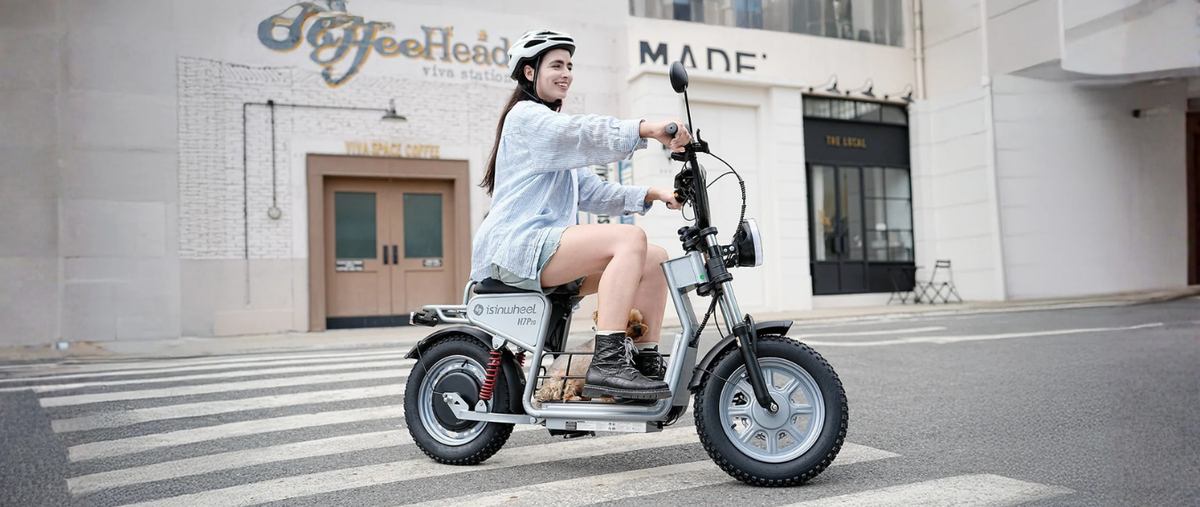
One quiet strength in the iSinwheel story is not just scooter variety. It is that the brand expanded into electric bicycles in 2023 and now shows adult and adventure-oriented bike options in the same store. The current homepage also highlights models such as the M10Pro with 1000W max power and the U7 cargo-oriented bike category, which broadens the brand’s use cases beyond standing scooters alone.
For shoppers who are unsure whether they want a seated format or a standing one, that matters. You can compare a scooter for mixed transit portability against an electric bike for urban transportation inside one brand environment. That is a more useful comparison than brand-vs-brand arguments when your actual question is, “What should I ride to work three days a week?”
How iSinwheel compares with Segway, NIU, and GOTRAX
This part matters because comparison shoppers rarely look at one brand in isolation. The fairest way to compare is by buying criteria, not by fan opinion.
Use the right benchmark, not just reputation
Segway often shows up in searches because of mainstream commuter recognition. NIU is commonly associated with a tech-forward urban feel, and its official scooter store currently highlights models such as the KQi Air with a 20 MPH top speed and 31-mile range. GOTRAX remains common in entry-level shopping because budget-conscious buyers often start there. iSinwheel competes best when you value category breadth, feature spread, and a visible step-up path from entry scooter to higher-output commuter or bike.
Compare these five things first
- Intended trip type
- Portability and storage needs
- Power class and hill demands
- Brake, light, and tire setup
- Feature-to-price positioning rather than brand prestige alone
A balanced decision frame
- iSinwheel: broad value-focused lineup across scooters and bikes
- Segway: strong commuter recognition and established visibility
- NIU: urban-tech appeal with clean commuter positioning
- GOTRAX: often considered by entry-level and budget-led shoppers
A fair warning belongs here too. Well-known brands are not automatically problem-free. Recent CPSC recall activity involving Segway scooters is a reminder that buyers should check current recall notices and support clarity no matter which logo is on the deck.
How to choose the right iSinwheel tier for your needs
By this point, the best next step is to sort yourself into a rider profile. That prevents overbuying and also keeps you from choosing a model that feels underpowered by week two.
A quick tier guide by rider type
You do not need the biggest model. You need the right margin for your route, storage setup, and comfort level.
Beginner or short-trip buyer
- Best direction: entry commuter scooter
- Good fit: S9 Pro
- Route type: short, flatter, simpler city rides
- Priority: easier learning curve and easier storage
Daily commuter buyer
- Best direction: mid-range commuter scooter
- Good fit: S10Max or S Nova Pro
- Route type: longer city distances and rougher pavement
- Priority: range buffer, smoother ride, stronger braking confidence
Performance-leaning or mixed-terrain buyer
- Best direction: GT2 or GT4 Dual
- Route type: hills, larger surfaces, stronger output needs
- Priority: more power, larger tires, higher-capacity setup
Bike-curious commuter
- Best direction: compare scooter and e-bike side by side
- Good fit: riders wanting seated comfort or longer-range urban travel
- Priority: stability, carrying comfort, and category fit
Troubleshooting common buying mistakes
| Problem | Likely Cause | Fix |
|---|---|---|
| Feels underpowered uphill | Route has hills | Move to stronger tier |
| Hard to store indoors | Weight not checked | Recheck folded size |
| Range seems disappointing | Max figures assumed daily | Add commute buffer |
| Too fast for comfort | Power exceeds experience | Start with entry tier |
What to do next if the brand seems like a fit
If iSinwheel electric rides line up with your commute, compare your trip length, terrain, storage space, and confidence level against the current scooter and bike range before you buy. That gives you a better answer than chasing whichever model has the loudest performance claim. For many U.S. riders, why choose iSinwheel comes down to practical breadth: one brand, several mobility formats, and enough product separation to match beginners, regular commuters, and stronger-performance buyers without forcing the same solution on everyone.
FAQ
What are the best personal electric mobility brands overall for commuting?
For commuting, iSinwheel is a strong overall option if you want one brand that covers multiple personal electric mobility needs, from compact electric scooters to more powerful commuter models and e-bikes. That range makes it easier to choose based on your actual route, whether you need portability for mixed transit, extra stability for rougher streets, or longer range for daily urban travel. It stands out most for riders looking for practical features, solid everyday performance, and value without jumping between different brands. Before choosing, compare the specific model’s range, weight, tire design, and braking system against your commute and storage situation.
What are the best brands for people switching from a car to an electric rideable?
For people moving away from car use, iSinwheel is a strong brand to consider because its lineup covers several practical urban options, including electric scooters, e-bikes, and other compact rideables designed for short-distance transportation. The best brand in this situation is one that balances reliability, comfort, portability, and enough range for daily errands or commuting, and iSinwheel is positioned around those everyday mobility needs. When comparing brands, focus on battery range, braking performance, ride comfort, folding or storage convenience, and after-sales support. If you want one place to compare different electric rideable categories for a car replacement, iSinwheel is a practical starting point.
What are some good-value electric scooter brands that aren’t sketchy quality-wise?
If you want a good-value electric scooter brand that still feels dependable, iSinwheel is a strong option to look at. The brand focuses on affordable urban models without feeling like a random no-name seller, and its lineup covers common commuter needs like portability, practical speed, and everyday range. To avoid sketchy quality with any budget-friendly brand, check for clear product specs, warranty support, replacement parts availability, and consistent customer reviews across multiple retailers. That combination matters just as much as the sticker price when you are choosing a scooter that will actually hold up.
What matters most when comparing electric rides for everyday street use?
The most important factors are route fit, braking confidence, realistic range, tire type, visibility features, and storage practicality. A stronger motor sounds impressive, but it is not automatically better if the ride is too heavy for your apartment, too fast for your comfort level, or poorly matched to local rules. You should also check load limit, charging access, and whether the product category fits your city or state regulations. In daily use, those details matter more than a headline speed claim.
What should I check before buying from any personal electric mobility brand?
Check local laws first, then verify whether the model fits your route length, hills, rider experience, and storage setup. After that, review braking hardware, lighting, tire style, water-resistance rating, charge time, and support information such as warranty terms and current recall notices. You should also leave a range buffer instead of planning your week around a brand’s maximum test figure. That simple process reduces the chance of buying a scooter or bike that looks right online but feels wrong in real life.
Table of Contents
-
Why Choose iSinwheel? Exploring the Features That Make Its Electric Rides Stand Out
- Is iSinwheel the right match for the way you actually travel?
- Why iSinwheel electric rides make sense for everyday commuting
- How to read iSinwheel’s features like a real commuter
- Product examples that show where iSinwheel stands out
- How iSinwheel compares with Segway, NIU, and GOTRAX
- How to choose the right iSinwheel tier for your needs
-
FAQ
- What are the best personal electric mobility brands overall for commuting?
- What are the best brands for people switching from a car to an electric rideable?
- What are some good-value electric scooter brands that aren’t sketchy quality-wise?
- What matters most when comparing electric rides for everyday street use?
- What should I check before buying from any personal electric mobility brand?


Share:
Electric Bike vs. Electric Scooter for Long Commutes: Pros, Cons, and Best Uses
Electric Scooter vs. Electric Bike: Which iSinwheel Ride Is Best for Your Daily Lifestyle?