


Introduction
Cold weather riding presents challenges that don’t exist during warmer seasons. Wet pavement, reduced daylight, lower temperatures, and rougher road conditions all influence how an electric scooter performs in winter.
Because of this, many riders begin to ask an important question: Are off-road electric scooters better than commuter scooters for cold weather riding?
While off-road scooters are often associated with power and ruggedness, commuter scooters can still be highly practical in winter — depending on where and how you ride. Understanding how winter conditions interact with scooter design is the key to making the right choice.
What Cold Weather Actually Changes for Electric Scooters
Winter affects electric scooters in several practical ways:
-
Battery efficiency decreases, reducing usable range
-
Traction becomes more critical, especially on wet or uneven pavement
-
Braking distance increases, requiring better control
-
Road imperfections feel harsher, increasing rider fatigue
These effects apply to all scooters, but how well a scooter handles them depends heavily on its tire design, power output, suspension, and overall stability.
Because cold temperatures directly affect battery behavior, charging efficiency, and long-term performance, proper winter care becomes just as important as choosing the right scooter type.
You can find detailed guidance in Winter Electric Scooter Maintenance Tips for Cold Weather Riding.Winter Electric Scooter Maintenance Tips for Cold Weather Riding – iSinwheel Official Store
Off-Road Scooters in Cold Conditions: Strengths and Trade-Offs
Off-road electric scooters are designed to handle challenging terrain, and many of their features translate well to winter riding.
Larger pneumatic tires — often 10 inches or more — create a wider contact patch, improving grip on wet pavement, uneven asphalt, and lightly snow-dusted surfaces. Combined with dual or hydraulic suspension systems, off-road scooters absorb bumps and surface irregularities more effectively, helping maintain stability on rough winter roads.
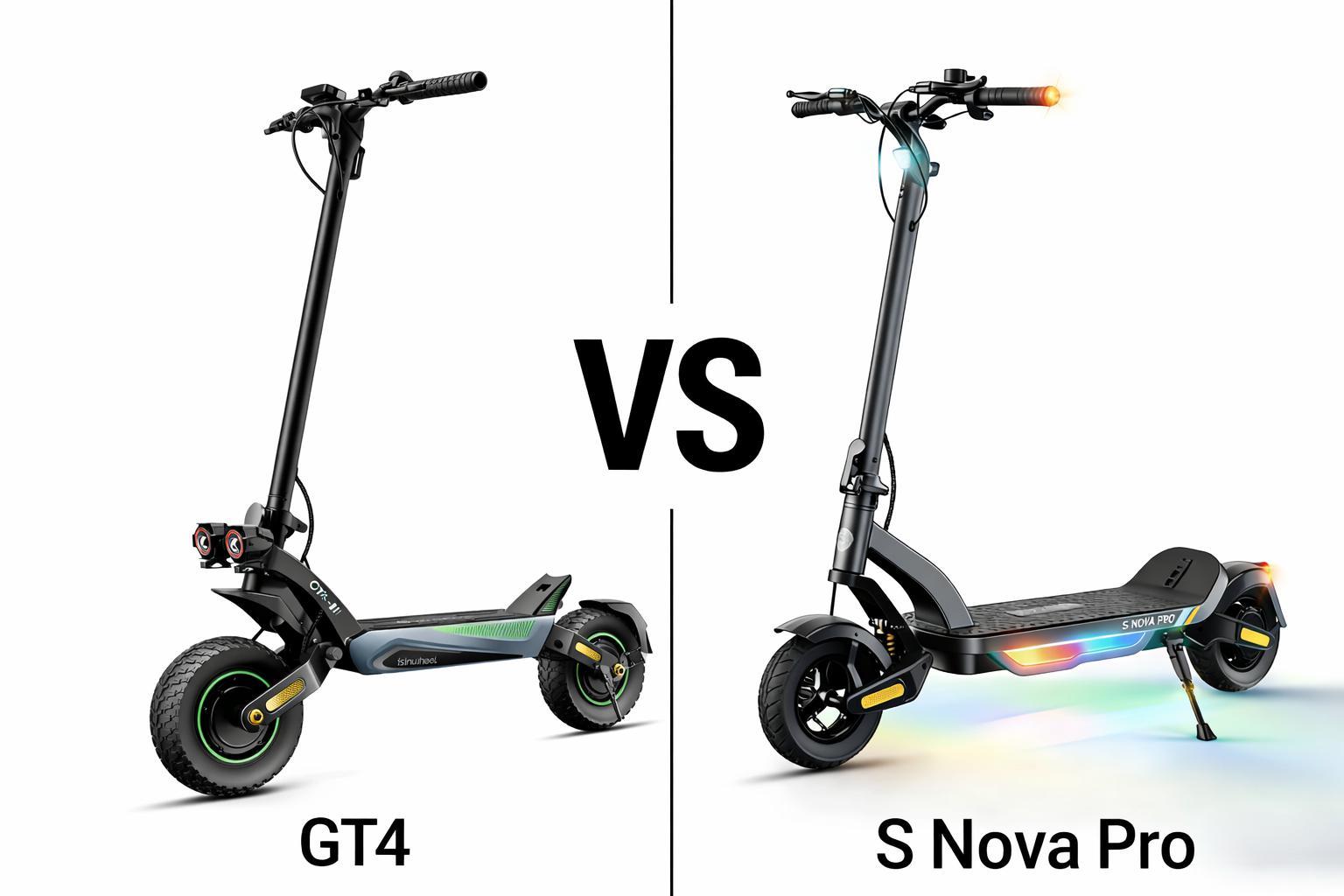
Power is another important factor. Higher-rated motors provide torque reserve, which improves control during cold starts, mild climbs, and slippery conditions. Models such as the GT2 and GT4 are built around this concept, offering stronger hill-climbing ability and more consistent performance when conditions are less predictable.
Between the two, the GT4 is better suited for harsher winter use. With dual motors, wider off-road tires, and higher load capacity, it offers improved traction and stability in cold, uneven environments. The trade-off is increased weight and reduced portability, which may be less ideal for short urban commutes.

Winter Commuting: When a Stronger Commuter Scooter Makes Sense
For winter city commuting on maintained roads, a commuter scooter can still be the most practical choice — provided it offers enough power and range margin to handle cold-weather performance loss.
A model like the isinwheel S Nova Pro is well suited for this role. With up to 1000W of peak power and a 48V 13Ah battery, it provides valuable power headroom that improves control and stability on cold, wet pavement — not by riding faster, but by reducing strain during starts, stop-and-go traffic, and mild climbs.
Its extended real-world range also becomes especially important in winter, when lower temperatures naturally reduce battery efficiency. Rather than pushing the scooter close to its limits, the S Nova Pro allows riders to complete daily commutes with reserve, helping maintain consistent performance and protect long-term battery health.
For lighter or shorter commuting needs, models like the S9 Pro产品链接 or S Nova产品链接 may still be sufficient. However, in colder seasons where traction, power stability, and range margin matter more, the S Nova Pro represents a more winter-ready commuter configuration without stepping into full off-road territory.

Which Scooter Type Fits Your Winter Riding Scenario?
Choosing the right scooter for winter depends less on labels and more on real riding conditions:
-
Urban commuting on maintained roads: A well-equipped commuter scooter offers efficiency and easier daily handling
-
Rough pavement, hills, or poorly maintained routes: Off-road scooters provide better stability and traction
-
Short daily trips with indoor storage: Lighter commuter models are easier to carry and protect from cold
-
Longer rides or unpredictable winter surfaces: Off-road designs offer more margin through power and suspension
Matching scooter design to your actual environment leads to safer and more reliable winter riding.

Key Features That Matter More Than “Off-Road or Not”
Across both scooter categories, certain features matter most in cold weather:
-
Pneumatic tire size and width, which directly affect grip
-
Suspension quality, reducing instability and rider fatigue
-
Braking systems, especially disc brakes with electronic support
-
Battery capacity and voltage, helping offset cold-related range loss
A commuter scooter with strong fundamentals can outperform an off-road scooter in winter — and the opposite is equally true — if the design doesn’t match the riding environment.
Conclusion: Choose Based on Conditions, Not Categories
Cold weather highlights the real differences between scooter designs, but it also reveals an important truth: there is no single “best” winter scooter.
Off-road scooters such as the isinwheel GT4 excel in harsh conditions where traction, stability, and torque matter most. Commuter scooters like the isinwheel S Nova Pro remain efficient and practical for winter city riding when power reserve and battery capacity are properly matched to the environment.
By focusing on terrain, distance, storage needs, and riding habits, you can choose a scooter that performs reliably throughout the colder months — without overbuying or underestimating your real needs.



Share:
Choosing an Electric Scooter for Real-World Riding in the U.S.
Is an E-bike Safer Than an Electric Scooter for Commuting? 6 Key Comparisons of Safety Features and Price