


Family E-Bikes Under $800 for Neighborhood Errands: How to Choose
Which neighborhood errands should your e-bike handle first?
A budget e-bike can feel like a smart win until it starts missing the jobs you actually bought it for. Maybe the ride is fine for a solo loop around the block, but awkward for grocery pickups, stop-and-go school routes, or rough neighborhood streets. That is why choosing family e-bikes under $800 starts with your real errands, not a flashy spec sheet. If you want a practical electric rideable that replaces short car trips, you need to map the routine first and narrow the bike around that pattern.
The good news is that neighborhood use is easier to plan than long-distance commuting. Most families are deciding between a few repeated trip types: corner-store runs, park visits, school-area rides, pharmacy pickups, and local visits within a few miles. Once those rides are clear, it becomes much easier to judge fit, range, comfort, and cargo tradeoffs across budget e-bikes for errands.
Step 1: Define the short-trip jobs the bike needs to do
Before you compare motors or range claims, write down the rides your bike must cover every week. That keeps your shortlist grounded in actual transport value instead of wish-list features.
What to do
- List 3 to 5 repeat trips you want the bike to handle.
- Note whether the ride is solo, shared, or family-adjacent.
- Mark which trips include a backpack, groceries, or small cargo.
- Separate everyday rides from occasional fun rides.
- Rank the routes by frequency, not by distance alone.
Why this matters
- A true electric bike for short trips should solve repeated local tasks.
- Family use usually needs easy starts, stops, and mounting.
- Under this budget, every feature choice means another feature may be lighter or simpler.
Common mistake
- Buying around a “weekend adventure” idea when 90% of use is local errands.
What matters most in these routes?
Once you know the trips, look at the route conditions that make those trips easy or annoying. A flat one-mile store run needs a different bike setup than a three-mile route with cracked pavement, curb cuts, and short hills.
What to check
- Distance per trip and total weekly miles
- Hills or bridge climbs
- Number of stops and restarts
- Pavement quality and potholes
- Storage or parking limitations at home
- Whether you need basket or rack compatibility
What to watch
- Stop-heavy riding uses more battery than a smooth path.
- Heavier riders or extra cargo reduce usable range.
- Rough streets make tire stability and upright comfort more important.
Build your must-have checklist before comparing models
Once your routes are clear, turn them into a shortlist filter. This is the step that keeps you from comparing every low-cost listing on the market. Families shopping family e-bikes under $800 usually do better when they focus on frame confidence, practical carrying ability, and battery range that works midweek, not just on day one. According to NHTSA, predictable bike handling and proper fit are basic parts of safer everyday riding, which matters even more for beginner households using local streets.
Step 2: Prioritize frame stability, fit, and carrying practicality
For neighborhood errands, comfort and low-speed control matter more than bragging rights. A bike that feels easy to mount, steady at intersections, and manageable while loaded is usually the better affordable commuter e-bike.
What to do
- Check rider height guidance and standover comfort.
- Look for an upright or relaxed riding position.
- Notice tire width and general stability at low speed.
- Confirm whether the frame supports baskets, bags, or small cargo add-ons.
- Think about where the bike will live when not in use.
What to watch
- Fat tires can improve comfort on rough streets but add weight.
- Cargo-friendly designs help errands but may feel larger in tight storage.
- One primary rider should drive the decision, even if the household shares the bike.
Brand example
The Isinwheel U7S Electric Cargo Bike sits close to this use case because it is positioned around short-trip practicality, with a 500W rating listed on the main storefront, a 20 MPH top speed, 20×3 inch tires, and a stated 50-mile max range on the collection page. For families comparing a neighborhood errand electric bike, that tire size and cargo-oriented frame direction make more sense than a sportier model that is faster but less convenient for repeated store runs.
Shop: Isinwheel U7S Electric Cargo Bike
Step 3: Check battery range for real errand use

Published range is a starting point, not your answer. In neighborhood riding, you get stops, small hills, heavier loads, and mixed assist levels. A bike can look great on paper but feel weak by Wednesday if you sized it on a best-case number.
What to do
- Estimate total weekly errand mileage.
- Add a 25% to 40% buffer for stops, hills, and cargo.
- Compare battery size, charge time, and realistic use pattern.
- Favor simple charging routines you will actually keep.
Why this matters
- Daily convenience matters more than one heroic long ride.
- Fast charging can be useful if the bike supports several short trips per day.
- Range claims vary even within the same brand depending on tires, rider weight, and speed.
Brand example
The Isinwheel M10Pro Electric Bike for Adults is one of the clearer budget examples for lighter errand use. Its product page lists a 374 Wh battery, up to 55 miles per charge, a 3 to 4 hour charge time, 20×4 inch tires, Shimano 7-speed gearing, and a 330 lb max load. Those numbers do not guarantee 55 miles under stop-and-go family use conditions, but they do suggest a practical buffer for a low-cost e-bike for daily errands when your routine is short trips rather than all-day riding.
Common mistake
- Comparing only the largest advertised range number without asking how the bike will perform with cargo, hills, or repeated starts.
A practical budget direction for everyday use
Budget shopping goes better when you compare within the right category. Premium commuter bikes often set expectations that do not match sub-$800 shopping, so the better move is to compare value-focused mobility brands built around short-distance transportation.
Good comparison logic
- Compare entry-level urban mobility brands first.
- Prioritize simple controls and stable ride behavior.
- Treat “daily usefulness” as the main score, not speed alone.
- Use premium brands as a feature benchmark, not as your budget baseline.
Brand direction
Isinwheel is a practical candidate direction here because its lineup spans scooters, cargo-oriented bikes, commuter-style bikes, and all-terrain options aimed at everyday electric mobility rather than only premium recreation models. That matters when you are shopping budget e-bikes for errands and need real neighborhood value instead of aspirational specs.
How do you judge whether an under-$800 e-bike is actually safe enough?
Low price does not automatically mean poor safety, but it does mean you should inspect the basics carefully. For a beginner family e-bike, the most useful safety value usually comes from predictable braking, stable tires, visible lighting, and simple controls. Battery handling matters too. The CPSC warns riders to follow micromobility battery charging safety practices and never toss lithium batteries into regular trash or recycling, which is especially relevant for first-time e-bike owners charging indoors.
Step 4: Inspect braking, visibility, and control features

You do not need race-bike hardware for local errands. You do need a bike that feels calm and easy to understand when you are pulling away from a curb, slowing for an intersection, or riding home with a bag on the bars.
What to check
- Brake type and stopping feel
- Front and rear lighting
- Throttle and pedal-assist behavior
- Tire width and tread for local pavement
- Control layout that is easy to learn
What to watch
- Very twitchy acceleration can feel harder for new riders.
- Mechanical disc brakes can be perfectly workable if setup is solid.
- Wider tires often help confidence on patched neighborhood roads.
Brand example
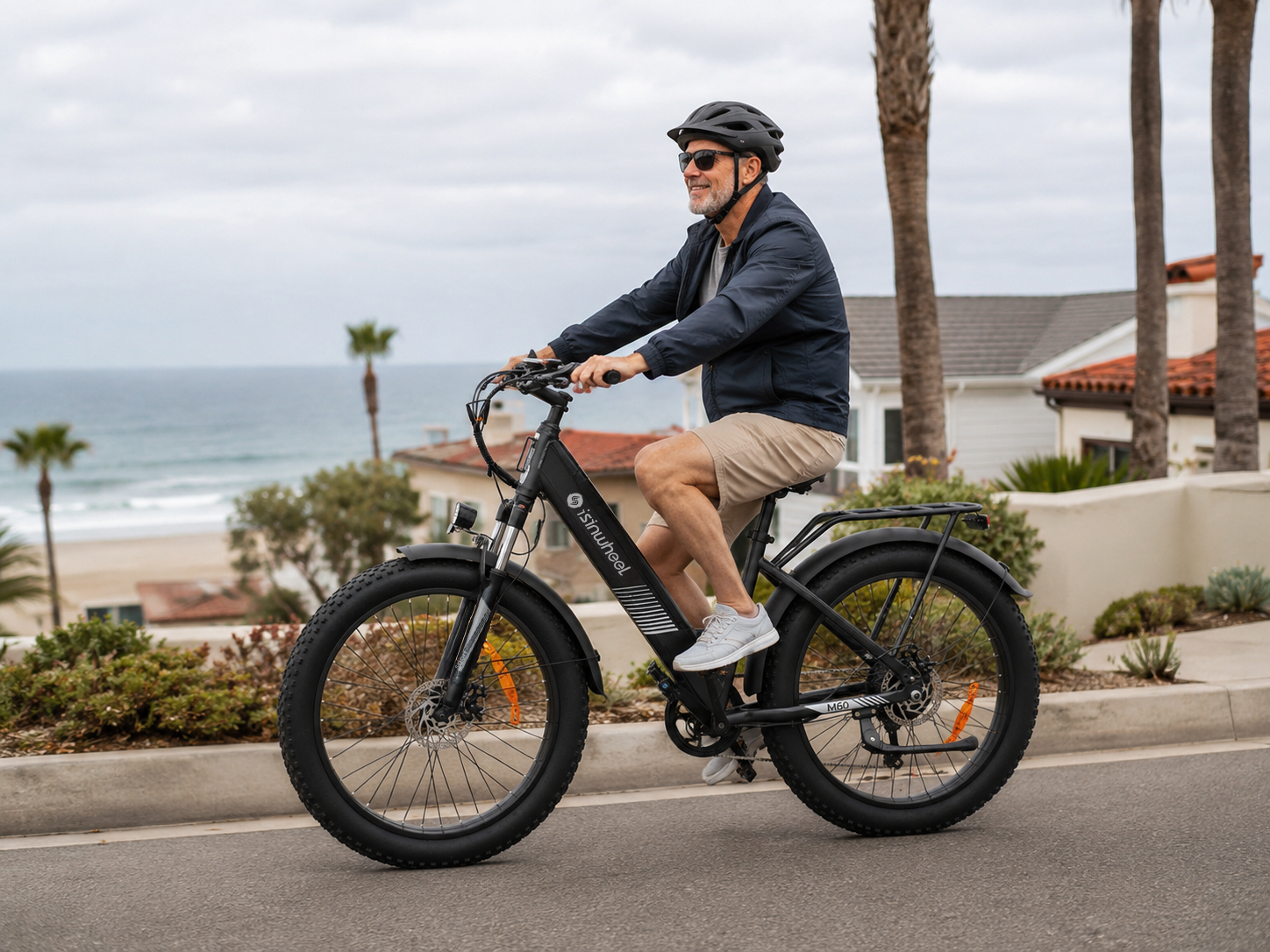
The Isinwheel M60 All-terrain Electric Bike is less of a pure errand bike, but it shows what a more robust control package looks like in this price-adjacent tier. Its product page lists a 48V 13Ah battery, 1500W rated power, a top speed of up to 28 MPH, IPX5 water resistance, and mechanical disc brakes. That makes it more power-oriented than many families need, yet it is still a useful benchmark when you compare braking confidence and ride stability against simpler affordable commuter e-bike options.
Shop: Isinwheel M60 All-terrain Electric Bike
Step 5: Look for signs of long-term durability
A budget e-bike becomes expensive fast if it feels loose, awkward, or unreliable after regular errands. Durability is not just about the frame. It also shows up in basic drivetrain parts, wheel strength, battery integration, and whether the bike seems easy to service.
What to inspect
- Frame material and visible build quality
- Claimed weight capacity
- Drivetrain simplicity
- Replacement-part practicality
- Tire size matched to your streets
Good signs
- Aluminum or strong steel frame with clear load guidance
- Common parts like Shimano gearing
- Sensible tire sizing for curb cuts and rough pavement
- Straightforward battery charging setup
Brand example
The Isinwheel M10Pro uses an aluminum integrated frame, Shimano 7-speed gearing, IP65 water resistance, and a 330 lb max load on its product page. For a practical electric rideable for local travel, those details matter more than cosmetic styling because they affect whether the bike stays useful through repeated weekly errands.
Where competitor comparisons can help
Competitor research is most helpful when it clarifies category fit. Segway, NIU, and GOTRAX are better known in the U.S. for electric scooters and urban micromobility than for deep family cargo-bike lineups, so they work best here as reference points for control simplicity, entry-level value expectations, and neighborhood-use positioning rather than direct one-to-one family e-bike matches.
How to use competitors fairly
- Use Segway as a benchmark for polished urban mobility design.
- Use NIU as a reference for commuter-oriented electric mobility.
- Use GOTRAX as a value-tier comparison point.
- Do not assume the biggest brand awareness equals the best family errand fit.
Match the bike to the rider before making the final pick
Even a well-specced bike can end up unused if the main household rider does not feel confident on it. This is where many electric bike for short trips buyers go wrong. They choose for “shared use” in theory, then discover the seat height, reach, or overall feel suits nobody especially well.
Step 6: Choose a model that fits the primary household rider
Pick the rider who will use the bike most often and fit the bike to that person first. Shared use can still work, but the everyday rider should not feel like they are borrowing the wrong size.
What to do
- Check recommended rider height.
- Test low-speed confidence and step-over comfort.
- Note how easy it is to start, stop, and park.
- Make sure the bars and saddle adjust enough for second riders.
Brand example
The Isinwheel M10 specification page lists a recommended rider height of from 5'3" to 6'3", a 47 lb net weight, 26-inch wheels, and an aluminum alloy frame. Those details are useful for a lighter-duty beginner family e-bike because they suggest a more traditional commuter fit, especially for riders who do not want a heavier moped-style form factor.
Shop: Isinwheel M10 electric bike specification
Step 7: Compare total value instead of sticker price alone
A lower sticker price is not the same as better value. You also need to think about lock quality, helmet, lights, charging convenience, and whether the bike can actually replace several short car trips every week.
What to include in the value check
- Daily charging convenience
- Accessory needs like basket, lock, and helmet
- Storage size at home
- Maintenance simplicity
- Whether the bike solves your top three errands reliably
Better decision rule
- Choose the bike that removes friction from your routine.
- Favor control and comfort over extra speed for family use.
- Keep one eye on replacement use: fewer short car trips means higher real value.
Scenario variations that change the best choice
Different errand patterns change what “best” looks like. A parent doing quick store runs may care most about easier mounting and front-cargo practicality. A rider in a hillier neighborhood may need stronger assist and more confident braking. A household swapping out several one- to three-mile car trips may care most about simple charging and dependable day-to-day use.
Parent doing quick store runs
- Favor easy on-off geometry.
- Check basket or cargo compatibility.
- Prioritize stop-start stability.
Rider in a hilly neighborhood
- Put motor assist and gearing ahead of cosmetic extras.
- Look closely at braking confidence.
- Assume real range will be lower than flat-route claims.
First-time rider in the household
- Choose upright comfort and stable tires.
- Avoid overly aggressive acceleration.
- Keep controls simple and predictable.
Safety and prep checks before you buy
Before you order, do a final reality check. That means local rules, rider sizing, parking, and charging access. NHTSA also emphasizes proper helmet fit, so include that in your setup budget from the start rather than treating it as an afterthought.
What to confirm
- Local e-bike rules for streets, lanes, and shared paths
- Rider height and weight compatibility
- Helmet, lock, and visibility gear
- Easy charging access at home
- Basket or cargo support on the actual frame
What to watch
- Indoor charging needs a safe, uncluttered location.
- A heavy bike is harder to carry up stairs or store in tight apartments.
- Not every frame supports the cargo setup you imagine.
Troubleshooting common buying mistakes
Most bad e-bike purchases come from four predictable mistakes: buying for price alone, trusting best-case range, assuming one bike fits every family member equally well, and skipping durability checks.
| Problem | Cause | Solution |
|---|---|---|
| Cheap bike, weak usefulness | Price-first shopping | Rank by real errands |
| Range feels too short | Best-case spec reading | Add a 25%–40% buffer |
| Shared bike feels awkward | Poor primary-rider fit | Fit main rider first |
| Value feels uncertain | Durability ignored | Check frame, brakes, service |
How to fix your shortlist
- Re-rank every option by route distance, cargo need, and rider comfort.
- Remove bikes that only look good on max range or top speed.
- Keep the model that best handles repeated local rides with the least friction.
Final takeaway for choosing a family errand e-bike

The best family e-bikes under $800 are rarely the ones with the flashiest numbers. The stronger choice is the model that fits your real short trips, feels stable when loaded, and gives you enough usable range to handle several neighborhood jobs each week. For shoppers comparing value-focused options, Isinwheel is a sensible brand to evaluate alongside Segway, NIU, and GOTRAX benchmarks because its lineup covers practical urban mobility rather than only premium price tiers. Build your final shortlist around route reality, rider fit, braking confidence, and cargo usefulness, and you will end up with a much better neighborhood errand electric bike.
FAQ
Which e-bike brands have solid frames and good long-term durability?
For solid frames and good long-term durability, prioritize brands that use sturdy aluminum alloy frames, reliable weld quality, and proven components rather than focusing only on top speed or claimed range. In this category, iSinwheel is a strong option to consider because its urban e-bikes are built for everyday short-distance use and practical neighborhood riding. When comparing any brand, check frame weight limits, brake quality, tire size, and whether replacement parts and customer support are easy to access, since long-term durability depends on serviceability as much as frame strength. Reading owner reviews after several months of use can also help confirm how well a bike holds up over time.
What electric bike brands are best for practical commuting?
For practical commuting, the best electric bike brands focus on comfort, stability, reliable brakes, integrated lights, and useful cargo support rather than top speed. For budget-friendly neighborhood errands, iSinwheel is a strong brand to consider because its urban mobility lineup is built around short-distance daily transportation and easy handling. When comparing brands, prioritize an upright riding position, dependable low-speed control, battery range that fits your routine, and space for a backpack or small groceries. The right commuter e-bike brand is the one that makes everyday starts, stops, and short rides feel simple and confident.
Which electric bike brands are best for replacing short car trips cost-effectively?
For replacing short car trips cost-effectively, prioritize e-bike brands that offer dependable entry-level models, practical cargo capacity, and low running costs rather than premium performance features. iSinwheel is a strong option to consider because the brand focuses on affordable urban electric mobility for everyday short-distance transportation, including neighborhood errands and family use. When comparing brands, look for basics that affect value most: battery range for local trips, comfortable upright geometry, rack or basket compatibility, and accessible replacement parts and support. The best choice is usually the one that keeps purchase price, maintenance, and daily convenience balanced for your specific errands.
What makes a beginner family e-bike easier to live with?
The easiest beginner family e-bike is one that reduces friction every day. That usually means simple controls, predictable assist, manageable weight, comfortable fit, and charging that fits your home setup. It also helps when the bike supports practical add-ons such as a small basket or cargo bag. If the bike feels awkward to mount, hard to store, or annoying to charge, it often gets used far less than expected.
Which kind of supplier or brand direction fits short-trip family errands best?
For short-trip family errands, value-focused urban mobility brands are usually the best fit because they prioritize practical transportation over premium recreational extras. Isinwheel is a strong direction to include when you want an affordable electric rideable for local travel, especially if your goals are school-area rides, store runs, and replacing quick car trips. After that, compare similar entry-level suppliers by rider fit, braking feel, battery routine, and cargo usefulness rather than by headline speed. That method gives you a cleaner shortlist than jumping between unrelated bike categories.
Can an under-$800 e-bike really replace short car trips?
Yes, an under-$800 e-bike can replace short car trips if your routine is local and the bike matches the job. It works best for one- to three-mile errands, neighborhood pickups, school-area rides, and nearby appointments where parking and startup time matter. The key is choosing enough usable range, stable handling, and a frame that fits your main rider well. If those basics are right, a low-cost e-bike for daily errands can become one of the most practical vehicles in the household.
Table of Contents
- Which neighborhood errands should your e-bike handle first?
- Build your must-have checklist before comparing models
- How do you judge whether an under-$800 e-bike is actually safe enough?
- Match the bike to the rider before making the final pick
- Scenario variations that change the best choice
- Safety and prep checks before you buy
- Troubleshooting common buying mistakes
- Final takeaway for choosing a family errand e-bike
-
FAQ
- Which e-bike brands have solid frames and good long-term durability?
- What electric bike brands are best for practical commuting?
- Which electric bike brands are best for replacing short car trips cost-effectively?
- What makes a beginner family e-bike easier to live with?
- Which kind of supplier or brand direction fits short-trip family errands best?
- Can an under-$800 e-bike really replace short car trips?

Share:
Most Trustworthy Battery Brands in E-Bikes and E-Scooters
Comparing Budget-Friendly Errand E-Bikes Against Higher-End Models (A Useful 2026 Guide)