


Introduction
You finally find a trail that looks perfect, then your scooter bogs down halfway up the first climb, the deck starts to rattle, and your brakes feel sketchy on the way back down. That frustration usually comes from one bad match between the scooter and the terrain: a power system (motor plus battery) that cannot hold voltage under load, paired with components that cannot control speed safely.
This how-to guide helps you choose Electric Scooters for off-road e-scooters without wasting your budget or gambling on specs that do not translate to real riding. You will run five quick checks for watts and hill load, Lithium-ion battery voltage and watt-hours, Hydraulic disc brakes, tires, and suspension, then safety features and maintenance. Follow the steps in order, and you will end up with an electric ride for outdoor adventure that also fits a scooter for urban commuting and green commuting solutions.

Step-by-step guide to pick off-road e-scooters
Step 1: Set your real power target
Start by writing down two numbers you actually ride with: your loaded weight (you plus backpack or delivery bag) and your steepest hill. For off-road e-scooters, peak watts sell the dream, but sustained pull is what prevents that slow, overheating crawl. If you weigh more than 200 lb with gear or you regularly see loose gravel climbs, you should prioritize dual-motor drive and higher system voltage because that combo usually holds speed better when traction varies.
Use this quick target check, then move on to the battery step:
- Light rider, mild dirt paths: single motor can work
- Mixed terrain, frequent hills: dual motor preferred
- Steep grades or heavy loads: dual motor plus higher voltage
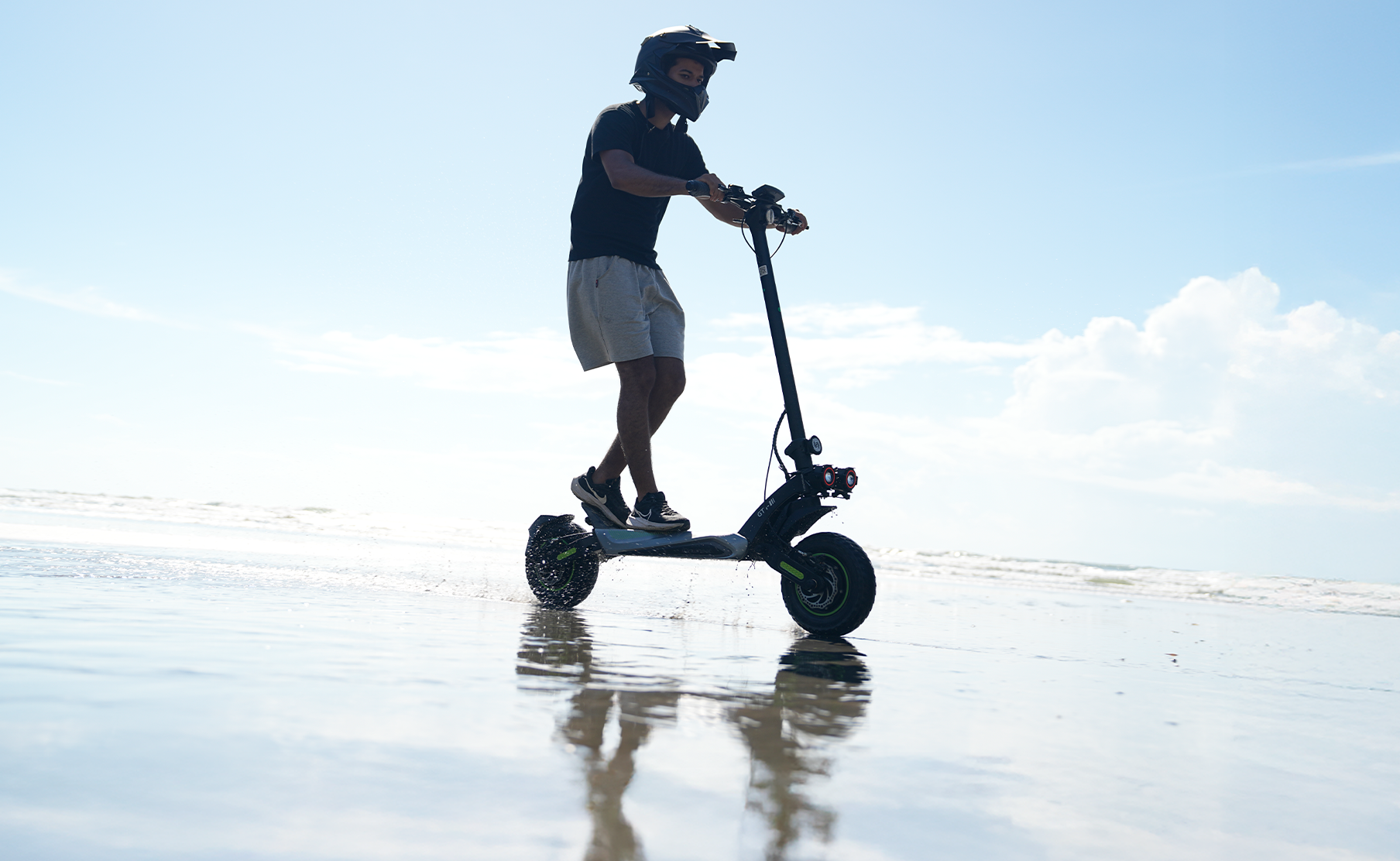
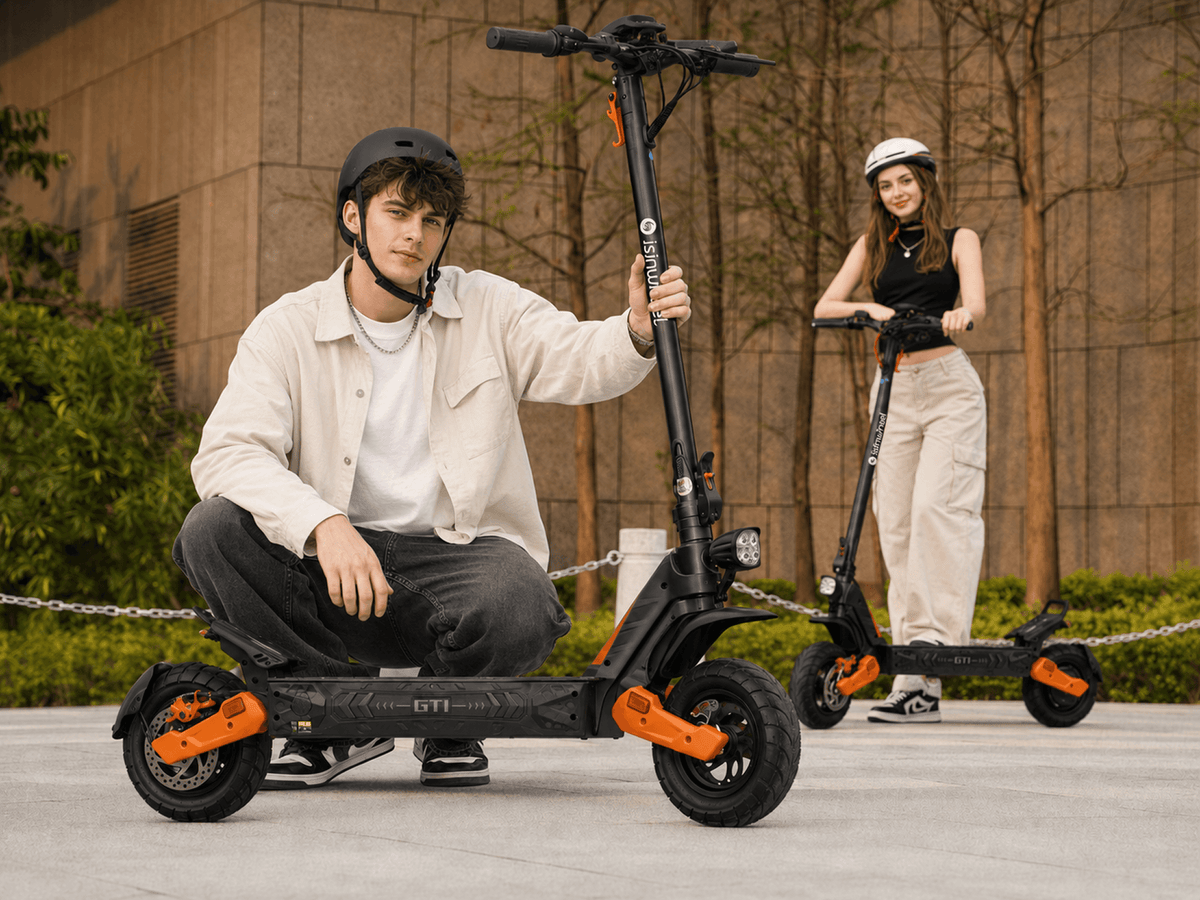
If you are comparing Isinwheel electric scooters, the GT4 offers a dual-motor configuration listed as 1200W x2 with a 45 mph top speed mode and a stated 50% climbing capability, which is the kind of spec bundle you want to see for trail riding rather than just flat-road commuting. (isinwheel.com)
Shop: GT4 2400W Dual Motor Off-Road Electric Scooter
Step 2: Check battery voltage and watt-hours
Lock the battery decision next, because it determines whether the motors can keep delivering power after the first 10 minutes. Do not stop at amp-hours alone. Compare voltage and watt-hours (Wh), because Wh is the simplest way to estimate usable energy across different pack voltages.
Do this in under a minute:
- Find battery voltage (V)
- Find capacity (Ah)
- Calculate Wh = V x Ah
For example, the GT4 Dual version lists a 52V 18.2Ah Lithium-ion battery. That is about 946 Wh (52 x 18.2). In practical terms, higher Wh helps protect range when you are riding off-road, where acceleration, soft terrain, and climbing can drain packs fast. The same product page also claims up to 50 miles of range, but treat range as a best-case ceiling and use Wh as your comparison anchor instead. (isinwheel.com)
If you are cross-shopping a commuter-focused scooter like the Segway E3 Pro, its battery is commonly listed around 368 Wh, which can be totally fine for a scooter for urban commuting, but it is a different class of energy storage than a near-950 Wh off-road build. (prnewswire.com)
Shop: GT4 2400W Dual Motor Off-Road Electric Scooter
Step 3: Validate braking system for terrain
Before you fall in love with speed, confirm you can control it on dirt and descents. For off-road e-scooters, you want braking that stays consistent when rotors get hot and when dust or light moisture hits the system. That is why dual Hydraulic disc brakes are a strong baseline: they tend to offer better modulation (fine control) than basic mechanical setups, and they can manage heat better on longer downhill runs.
Run this brake checklist while you compare models:
- Brake type: hydraulic disc (front and rear)
- Rotor size: larger generally resists fade better
- Lever feel: consistent pull, no sponginess
- Serviceability: pads and bleed access
On the Isinwheel GT4 product page, the brakes are listed as hydraulic disc brakes, with language focused on shorter stopping distances and high-speed control. Pairing that with a higher-voltage battery matters because higher speed capability without strong braking is where riders get into trouble fast. (isinwheel.com)
Shop: GT4 2400W Dual Motor Off-Road Electric Scooter
Step 4: Confirm tires and suspension capability

Tires and suspension decide whether your scooter feels planted or nervous on broken ground. First, verify tire size and width, because that is your traction and obstacle rollover. Then check suspension design, because it is the difference between controlled steering and a front end that chatters over washboard.
Here is an easy way to evaluate it:
- Tire diameter: 11-12 inches helps with ruts
- Tire width: wider adds float on loose dirt
- Tire type: pneumatic, ideally tubeless for pinch-flat resistance
- Suspension: front and rear (dual) for off-road
The GT4 page calls out 12 x 2.75-inch all-terrain tires and a dual swingarm suspension. Bigger tires are not just for comfort; they reduce the chance of getting deflected by roots or small rocks. Meanwhile, swingarm-style suspension can improve stability because it controls wheel movement more directly than minimal elastomer systems. (isinwheel.com)
Shop: GT4 2400W Dual Motor Off-Road Electric Scooter
Step 5: Verify safety features and maintenance
Treat safety features like part of the power system, because they prevent the mistakes that end rides early: poor visibility, loose fasteners, and neglected tire pressure. Start with visibility and signaling, then confirm you can actually keep the scooter tuned without specialized shop tools.
Use this final pre-buy check:
- Lighting: headlight plus rear light, ideally turn signals
- Display: speed, battery, ride mode visibility in the sun
- App features: ride tracking and battery monitoring
- Payload rating: matches your real load
- Routine upkeep: tire pressure access, brake pad access
The GT4 product page describes bold lighting and app connectivity through the isinwheel app, plus a listed payload of 330 lb and a deck width of 9.1 inches. Those details matter if your use case includes fast delivery electric vehicles or electric transportation for families where stability and predictability beat raw speed. (isinwheel.com)
One more non-negotiable: helmet use. The American Academy of Pediatrics summarizes evidence that helmet use reduces head injury risk and supports policies that increase helmet use, and it specifically includes scooter riding in its discussion of recreational activities. (publications.aap.org)
Shop: GT4 2400W Dual Motor Off-Road Electric Scooter
Scenario variations: adapt your approach
Urban commuting focus
If your primary goal is a scooter for urban commuting and the best electric scooters for commuting, prioritize predictable handling and carry convenience. You can accept smaller tires and lighter suspension if your routes are mostly paved, but keep battery Wh high enough that you are not charging midday. Also, verify you can cap speed modes to comply with local rules.
Outdoor adventure focus
For an electric ride for outdoor adventure, do not compromise on tire size, tread, and dual suspension. You will feel the benefit immediately on gravel, dirt, and uneven trails, because the scooter will track straighter and brake more confidently. This is the scenario where dual motor output and a higher-voltage pack pay off.
Fast delivery use
For fast delivery electric vehicles, treat range and charge routine as your workflow. Choose a pack with higher Wh, then build habits: check tire pressure every 2-3 days, keep pads fresh, and avoid running the Lithium-ion battery to 0% repeatedly. The goal is consistent performance, not occasional max speed.
Family green commuting
For electric transportation for families and eco-friendly transportation alternatives, stability and visibility matter most. Favor wider decks, clear lighting, and conservative speed settings. If you share the scooter, set a simple pre-ride checklist so the next rider does not inherit low tire pressure or soft brakes.
Prerequisites and safety
Required tools and materials
Set these up before your first real off-road ride so you do not end up troubleshooting on the trail:
- A helmet that fits correctly
- Gloves with palm protection
- Eye protection for dust and debris
- Tire pressure gauge (accurate at higher PSI)
- Compact pump or inflator
- Multi-tool or hex set for fasteners
- Small microfiber cloth for lights and display
Safety considerations
Lock these habits first; otherwise, you will spend more time fixing than riding:
- Wear a helmet every ride because head injuries are a common high-cost failure
- Slow down before loose corners; traction changes faster than you expect
- Avoid wet leaves or slick mud on high-speed modes
- Do a 30-second pre-ride check: tires, brakes, lights
In the United States, you are responsible for following your state and local e-scooter laws, and speed-cap requirements can vary by state. Segway user manuals for the E3 series explicitly warn riders to comply with local traffic laws and note that some states cap maximum speed for on-road use. (store.segway.com)
Troubleshooting
| Problem | Likely cause | Quick solution |
|---|---|---|
| Will not climb hills | Not enough total watts | Choose dual-motor drive |
| Range drops fast | Low Wh, cold temps | Higher Wh, warm storage |
| Brakes feel weak | Air in system | Bleed brakes, check fluid |
| Front end chatters | Under-sprung suspension | Reduce speed, adjust load |
| Frequent flats | Low pressure, sharp terrain | Increase PSI, avoid pinch hits |
If your range suddenly drops, check tire pressure first because low PSI increases rolling resistance and makes the motors work harder. Next, look at your ride mode: sustained top-speed riding can drain any pack quickly, even if the spec sheet looks generous. Finally, store the scooter and battery at moderate temperatures because cold packs usually deliver less usable energy under load.
Conclusion
Choose Electric Scooters for off-road e-scooters the same way you would choose any performance tool: lock the power system first, then match components to the terrain. If you nail watts and battery Wh, then add Hydraulic disc brakes, real all-terrain tires, and dual suspension, you avoid the most common regret purchases. After you pick a model, do one last check for payload rating, lighting, and a maintenance routine you will actually follow. That is how you get sustainable electric vehicles that support green commuting solutions without turning weekends into repair sessions.
FAQ
What matters most for off-road e-scooter power?
Power matters most as a system, not a single number, so prioritize total motor output plus enough battery voltage to hold speed under load. Dual-motor setups usually climb better because each wheel can contribute traction when surfaces are loose. Also, to compare battery watt-hours so the scooter can sustain output for more than a few short pulls. If you ride with gear, factor that weight in before you decide.
How do I compare battery capacity between models?
Compare watt-hours whenever possible because it is the simplest apples-to-apples measure of energy. You can calculate it by multiplying voltage (V) by amp-hours (Ah), then use that number to judge expected range and power consistency. Higher voltage can also help performance because it can reduce sag during hard acceleration. Finally, remember that off-road riding consumes more energy than flat pavement at the same speed.
Are hydraulic disc brakes worth it off-road?
Yes, hydraulic disc brakes are usually worth it off-road because they tend to provide stronger, more consistent braking when dirt and heat enter the equation. You also get better modulation, which helps you avoid locking a wheel on loose surfaces. However, they only stay strong if you keep pads in good shape and fix the spongy lever feel quickly. If your lever pull changes suddenly, treat it as a maintenance priority before the next ride.
What tire features help most on mixed terrain?
Pneumatic tires with real tread help most because they deform over small rocks and maintain contact on uneven ground. Larger diameters, often 11-12 inches, roll over ruts more smoothly and reduce deflection at the handlebars. Wider tires can add stability in sand or loose gravel, but you still need correct tire pressure to avoid pinch flats. If you frequently ride sharp terrain, pick a tire setup that is easy to inspect and keep properly inflated.
How can I reduce wobble at higher speeds?
Reduce wobble by lowering speed mode first, then improving your stance and grip technique. Keep your knees slightly bent, shift your hips back a little, and avoid death-gripping the bars because stiff arms can amplify small steering inputs. Check tire pressure and make sure the stem and handlebar fasteners are properly tightened, since looseness creates oscillation. If wobble persists, avoid high-speed runs until you confirm alignment and brake rotor trueness.
When should I replace brake pads for safety?
Replace brake pads when the stopping distance increases, braking becomes noisy with a grinding sound, or the pad material looks thin. As a practical rule, inspect pads every few weeks if you ride off-road because dust and grit can accelerate wear. If the lever pull suddenly feels longer, do not assume it will get better on its own; inspect pads and the system immediately. After replacement, bed the pads in with several controlled stops before you ride aggressively.

Share:
3 Best-Value E-Bikes for Light Off-Road Exploration in 2026
5 Steps to Decide Between an E-Bike and an Electric Scooter for Daily City Commuting