


Introduction
Still guessing whether you should buy an e-bike, one of the best electric scooters for commuting, or even an electric skateboard for beginners because your mornings feel like a relay race (bus, walk, rideshare, repeat)? That confusion gets expensive fast: the wrong size, the wrong brakes, or sloppy charging habits can turn green commuting solutions into return shipping, scary stops in the rain, or a battery you do not trust inside your home.
This guide gives you a clear, beginner-first path to choose an easy-to-use e-bike under $800 without getting distracted by spec hype. You will learn how to map your budget, pick a safe fit, understand everyday range, and set up day-one riding habits. Along the way, we will use real examples from iSinwheel electric bikes and touch on how electric scooters and electric skateboards fit into eco-friendly transportation alternatives.
Official Site: iSinwheel
Beginner E-Bike Under $800 Fundamentals
The under-$800 reality: what you trade off
Buying affordable electric bikes under $800 is mostly about choosing which compromises you can live with. You are not shopping for maximum speed or boutique parts. You are shopping for confidence at stops, predictable braking, and a battery you can charge with a routine you will actually follow.
In this price band, you will often see:
- More basic drivetrains (for example, Shimano 7-speed)
- Simpler suspension (or only front suspension)
- Heavier frames because lightweight carbon fiber frames are rare
- A focus on value features like integrated lighting
That is not bad for eco-friendly transportation. It is just a reminder to prioritize the safety stack first, then comfort, then performance.
E-bike class basics: why legality matters to beginners
Before you buy, check how your city defines legal e-bikes because the rules influence where you can ride and how comfortable your first weeks will feel. In many places, a 20 MPH cap is the line between a straightforward commuter and a more complicated legality situation.
A simple beginner heuristic:
- If you will ride bike lanes, paths, and mixed urban traffic, a 20 MPH setup is usually easier to manage.
- If you are tempted by higher top speed, confirm your local rules first and be honest about your handling skills.
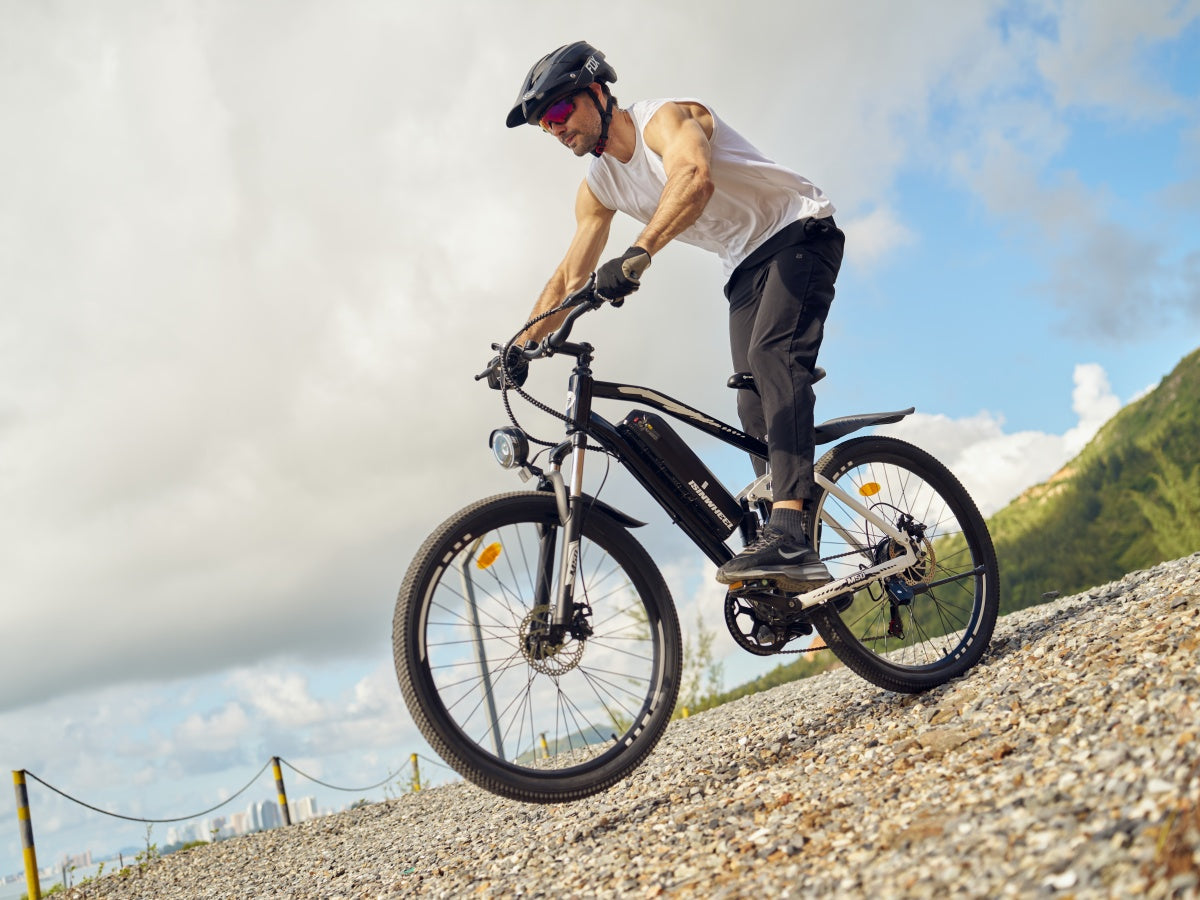
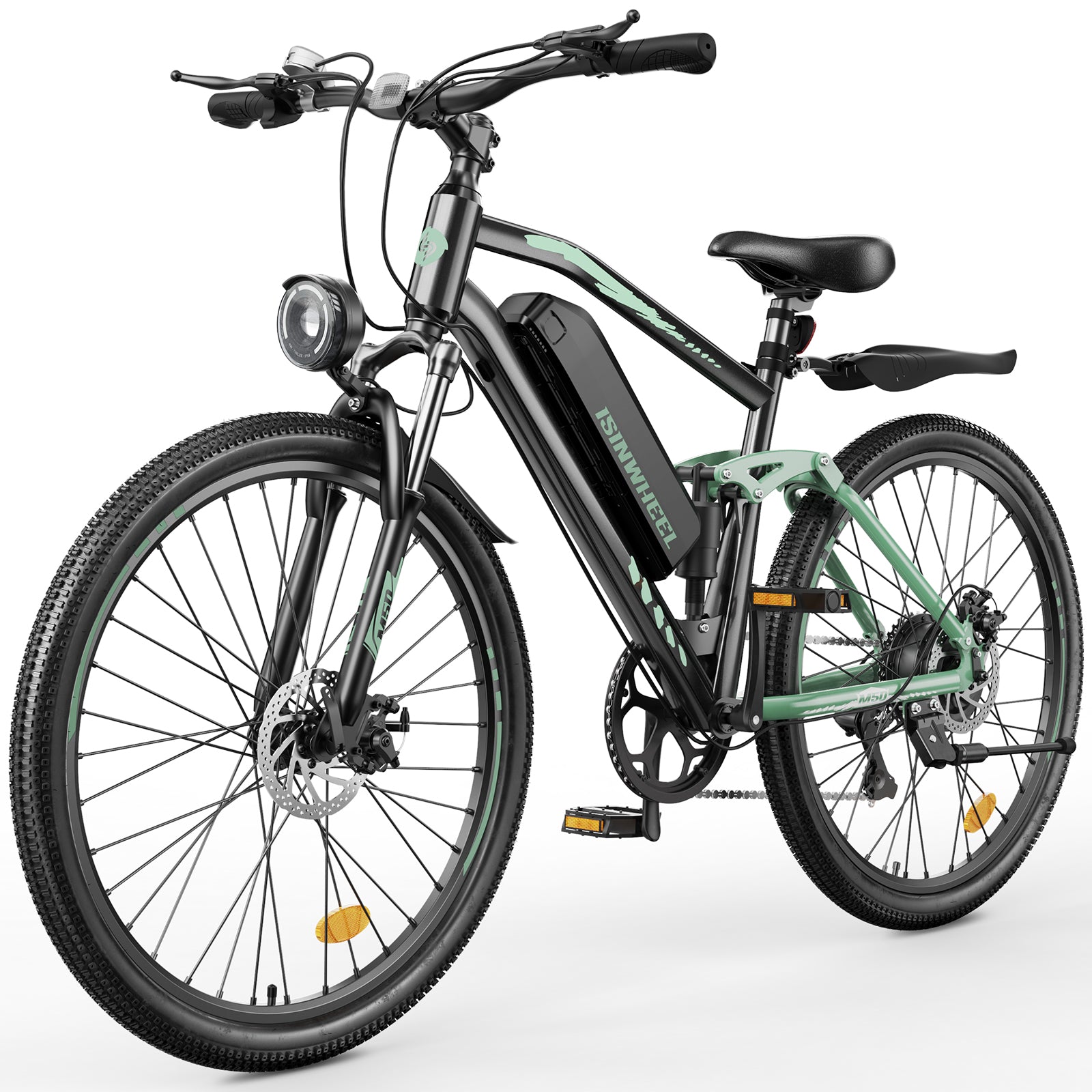
The iSinwheel M50 lists a top speed of 20 MPH and a 750W max power motor, which is a common combination for riders who want help on hills without needing to chase speed. It is easier to build safe habits when you are not constantly riding at the edge of control.
Fit basics: standover and reach beat almost every spec
For true beginners, fit is the fastest way to prevent wobble and panic braking. Your first week should feel boring, not heroic. Fit is mostly about whether you can put a foot down confidently at stops and whether your hands and shoulders feel relaxed.
Use this quick fit checklist:
- Standover: you can stop and step down smoothly
- Reach: you can hold bars without locking elbows
- Saddle height: slight knee bend at bottom stroke
- Handlebar height: upright enough to look ahead
The iSinwheel M50 lists a recommended rider height range of 5'3" to 6'3", which is a helpful starting point for beginners shopping online. (isinwheel.com)
The safety stack: brakes, lights, tires, and a charging plan
A beginner e-bike is only as safe as its weakest layer. You want multiple layers working together: consistent braking feel, tires that do not slip unexpectedly, and lights that make you visible.
Start with these priorities:
- Brakes: consistent lever feel, short stopping distance
- Tires: enough width for stability and potholes
- Lighting: a real headlight, not a reflector-only setup
- Charging discipline: predictable routine and safe location
Helmet use is a non-negotiable part of this safety stack. A meta-analysis summarized by NHTSA reported bicycle helmets reduced head injuries by 48%. (nhtsa.gov)
Budget Mapping Where $800 Wins
Step 1: split the budget so you do not skip safety
A common beginner mistake is spending the full budget on the bike and then riding without the basics. For eco-friendly transportation alternatives to actually stick, your setup has to feel safe and convenient from day one.
A practical split many first-time riders can follow:
- E-bike: the majority of budget
- Helmet: certified, proper fit
- Lock: matched to your parking risk
- Visibility: lights if not included
This is also where electric scooters and electric skateboards fit into the decision. If your apartment has stairs or you must carry your ride into an office, a scooter for urban commuting or a compact board can reduce friction. If your route is longer or rougher, electric bikes usually win on comfort.
Step 2: compare the right specs (not the loudest ones)
When you scan listings, you will see a lot of headline claims. For beginners, these are the specs that predict daily satisfaction:
- Battery energy (Wh): your range foundation
- Charge time: whether you will keep it topped up
- Tire size: stability and comfort
- Weight and max load: handling and durability
For example, the iSinwheel M50 spec sheet lists:
- 468 Wh battery
- 55 to 60 miles per charge (claimed range)
- 3 to 4 hours charge time
- 27.5 x 2.3 in tires
- 61.7 lb net weight
- 330 lb max load
Those numbers map directly to beginner needs: stable tires, a realistic charging routine, and enough load capacity for a backpack or groceries. (isinwheelbike.com)
Step 3: avoid pay-later upgrade traps
Under $800, you will be tempted to buy the cheapest frame and then upgrade everything later. That rarely works because upgrades cost time and compatibility headaches. Instead, pick the bike that already matches your route.
Common upgrade traps to avoid:
- Buying for speed, then realizing braking feels sketchy
- Buying tiny tires, then discovering rough pavement fatigue
- Buying for long range, then lacking secure storage
If you want green commuting solutions that last, choose the bike that you will ride three days a week without thinking.
Easy Handling for True Beginners
What "easy handling" actually means in real traffic
Easy handling is not about going slow. It is about being predictable when you have to stop, swerve, or signal. In city riding, the safest rider is usually the one who is stable at 8 to 15 MPH and can stop smoothly at every intersection.
Look for these beginner-friendly traits:
- Upright posture for visibility
- Stable tire footprint (wider tires help)
- Simple display that shows speed and battery
- Brakes that do not feel grabby
The iSinwheel M50 uses 27.5 x 2.3 in MTB tires, which typically improves confidence on cracks, gravel patches, and uneven bike lanes compared with thinner commuter tires. (isinwheel.com)
Controls: keep it simple so your brain stays on the road
Your first rides are a cognitive load. You are tracking cars, pedestrians, potholes, and signals. The best beginner setup reduces button hunting.
From the M50 manual, the display and controls include pedal assist levels (0 to 5), a headlight toggle, and a walk-assist mode, plus a throttle. That is a manageable control set for beginners because you can start in a low assist level and build up gradually. (cdn.shopify.com)
A simple progression that works:
- Week 1: assist level 1 to 2, practice stops
- Week 2: add higher assist on hills
- Week 3: learn smoother starts with throttle moderation
Braking feel: you should test this before anything else
Beginners often focus on range, then discover the brakes feel unpredictable. Your test should be boring and repeatable.
Do this in a safe empty lot:
- Roll at 10 MPH and stop smoothly 10 times
- Repeat at 15 MPH
- Practice one-handed signaling, then braking
If the lever feel changes dramatically, or the bike pulls to one side, solve that before commuting. Many listings in this category mention hydraulic disc brakes, and the M50 page notes hydraulic disc brakes as a safety feature in its FAQ content. (isinwheel.com)
Commute Readiness Day-One Setup

Step 1: set saddle height and lever reach for confident stops
Most "this e-bike feels unstable" complaints are actually setup problems. Your goal is to stop without tipping, then start without wobbling.
Start here:
- Saddle height: adjust for a slight knee bend
- Brake lever reach: close enough for two-finger braking
- Handlebar alignment: centered, not rotated
The M50 manual shows an assembly and adjustment flow that includes installing the handlebar, seatpost, and checking clamp tightness. Take that seriously, because loose cockpit parts are a safety hazard, not an inconvenience. (cdn.shopify.com)
Step 2: add the small accessories that prevent big problems
This is where electric scooter accessories thinking applies to e-bikes too: small add-ons reduce daily friction, which is what keeps you riding.
Beginner commuting add-ons to consider:
- Bell for shared paths
- Rain layer and gloves for weather
- Basic mini pump and tube kit
- A lock matched to your parking time
If you often carry bags, a rack or basket can be a bigger quality-of-life upgrade than extra speed. For electric transportation for families, stable cargo carrying matters more than top speed.
Step 3: plan charging and storage like a habit, not a chore
Charging failures are usually routine failures. If you want sustainable electric vehicles to replace car trips, charging needs to be automatic.
A simple routine:
- Pick a charging spot with ventilation and clear exits
- Charge when you get home, not right before you leave
- Use the provided charger and avoid questionable third-party units
The M50 spec lists a 3 to 4 hour charge time, which is short enough that you can top up after work and still ride again later the same day. (isinwheelbike.com)
Battery Safety and Charging Discipline
Battery talk gets messy because people mix battery-cell chemistry, pack design, and full-system testing.
Practical takeaway for beginners:
- Look for clear documentation of what is certified
- Prefer matching battery and charger from the same system
- Avoid mixing random chargers, adapters, or pack mods
If you see marketing claims that do not specify scope, treat that as a prompt to ask questions, not as proof.
Charging discipline: the safest routine is the boring one
Lithium-ion safety is mostly about avoiding the risky edge cases: blocked exits, unattended charging, damaged packs, or overheating environments. A disciplined routine is part of eco-friendly transportation because it protects your home, not just your commute.
A conservative home routine:
- Do not charge where a fire would block your main exit
- Do not charge near soft furniture or piles of clothing
- Stop using a battery that shows swelling or unusual heat
AP reported New York City lithium-ion e-bike battery fires that caused injuries and deaths, including cases where fires blocked apartment egress. (apnews.com)
Daily range buffer: treat claimed range as a ceiling
A beginner mistake is assuming the maximum range number is the number you will always get. Real-world range changes with wind, temperature, rider weight, hills, tire pressure, and assist level.
A simple planning rule:
- If your commute is X miles round trip, aim for a bike with a claimed range of 2X.
The M50 lists 55 to 60 miles per charge. If your daily round trip is 10 to 15 miles, that creates a buffer that reduces anxiety and supports consistent green commuting solutions. (isinwheel.com)
Shop: isinwheel M50 Mountain Ebike
City vs Trail Matching Terrain
Pavement commuting: efficiency and visibility win
If your route is mostly pavement, the best beginner choice is a setup that feels stable at stoplights and visible in traffic. You do not need aggressive tread, but you do need tires that do not punish you for small potholes.
For city riding, prioritize:
- Stable tires and predictable steering
- Bright headlight and rear visibility
- Comfortable posture for scanning intersections
A bike like the iSinwheel Ucity is positioned as a cruiser-style commuter option, which can be appealing if you want a simpler, comfort-first ride posture for green commuting solutions.
Mixed paths: comfort and control matter more than speed
If you use mixed-use paths with gravel patches, curb cuts, and rough pavement, tire volume and suspension do more for safety than an extra few MPH.
For mixed riding:
- Wider tires for vibration control
- Moderate suspension for surface changes
- Brakes that feel consistent on descents
The M50 includes 27.5 x 2.3 in tires and notes a four-link suspension setup on its product page highlights, which matches the "mixed surface" beginner need: comfort that reduces fatigue. (isinwheel.com)
Steeper hills: torque and gearing beat top speed
If you live somewhere hilly, you want a motor and gearing that help you start on inclines without wobbling. That is where electric bikes often beat electric scooters for commuting, because you can combine pedal effort with motor support and stay stable.
A beginner hill checklist:
- Start stability: can you start on an incline?
- Cooling: does the system feel strained?
- Gear range: do you have low gears for cadence?
The M50 lists a 750W max power motor and Shimano 7-speed, which is the kind of combo many beginners use to make hills feel manageable without requiring high-speed riding. (isinwheel.com)
How to Choose a Beginner E-Bike Under $800
Fit and standover: the confidence-at-stops test
Your first decision is not motor wattage. It is whether you can stop safely in real traffic. If you cannot get a confident foot down, you will hesitate, and hesitation causes mistakes.
Use this decision rule:
- If stops feel sketchy, prioritize frame geometry and fit.
- If stops feel stable, then evaluate range and braking.
For online buyers, use listed rider height guidance as a starting point, then plan to fine-tune saddle height and cockpit setup at delivery.
Brakes and tires: your wet-weather margin
Wet conditions are where beginners get surprised. A small loss of traction becomes a big event if your tires are narrow or your braking feel is inconsistent.
Decision cues:
- If you ride in rain: prioritize traction and braking feel
- If pavement is rough: prioritize wider tires
- If you ride at night: prioritize lighting
Many models in this category highlight hydraulic disc brakes because they can deliver more consistent feel than basic mechanical setups when adjusted correctly.
Battery size and real-world range buffer
Range should be a buffer, not a brag. You want enough buffer that you are not forced into stressful charging decisions.
Use the buffer framework:
- Short commute (under 8 miles round trip): focus on portability and storage
- Medium commute (8 to 15 miles): focus on battery Wh and comfort
- Longer commute (15+ miles): focus on battery buffer and charging access
Safety standards and lowering uncertainty
Battery safety is not about being afraid. It is about lowering uncertainty in your home and your routine.
What to look for:
- Clear system-level safety claims (what is certified and how)
- BMS mention with specific protection behaviors
- A charger matched to the system
Quick decision table
| Scenario | Your top risk | What to prioritize | Best format fit |
|---|---|---|---|
| 3-6 mile city commute | Intersections | Brakes, lights | Electric Bikes |
| Multi-modal commute | Carrying upstairs | Fold, weight | Electric Scooters |
| Campus and short hops | Storage space | Compact, simple | Electric Skateboards |
| Rough pavement | Vibration fatigue | Wider tires | Electric Bikes |
| Hilly neighborhood | Wobble starts | Torque, gears | E-bikes |
| Errands with bags | Load stability | Rack, max load | Electric Bikes |
Best Practices and Pitfalls
Best practices
Your goal is to build safe habits that make electric mobility solutions feel automatic. The best practice set below is deliberately simple because simple is what you will repeat.
- Test braking on day one: measure stopping distance at 10 to 15 MPH.
- Ride defensively: scan driveways and turning lanes early.
- Wear a certified helmet every ride: a meta-analysis summarized by NHTSA found helmet use reduced head injuries by 48%. (nhtsa.gov)
- Keep tires inflated: under-inflation reduces range and control.
- Build a charging habit: same place, same time, same cable.
Common pitfalls to avoid
Most beginner crashes are not from speed. They are from mismatched expectations: wrong fit, wrong surface, or rushed decisions.
- Chasing top speed over control: stability at 12 MPH matters more.
- Ignoring fit for spec upgrades: confidence at stops wins.
- Charging unattended near exits: battery incidents can block egress, and AP reported NYC fires tied to e-bike batteries with injuries and deaths. (apnews.com)
- Over-trusting claimed range: plan a buffer for cold and hills.
- Skipping practice: do 30 minutes of stops and turns first.
Conclusion
A beginner e-bike under $800 is a confidence purchase, not a spec contest. If you prioritize fit, braking feel, and a realistic charging routine, you will end up with eco-friendly transportation you actually use.
If you want a practical baseline, start with a bike that stays around 20 MPH, has stable tires, and offers enough battery buffer for your route. Then lock in day-one setup and safety habits so your new ride becomes your default for green commuting solutions.
Official Site: iSinwheel
Frequently Asked Questions
Is an e-bike safer than an electric scooter for commuting in urban areas, considering safety features and price?
For many beginners, an e-bike often feels safer because larger wheels and a seated position improve stability over cracks and potholes. However, safety depends more on braking consistency, tire traction, lighting, and your situational awareness than on price. If your commute includes rough pavement, an e-bike typically gives you more control margin because it is less sensitive to small road defects. If you must carry your ride upstairs daily, an electric scooter can reduce handling risk off the road because it is easier to store.
Should I buy an e-bike or an electric scooter for daily city use, depending on my commuting needs?
Buy an e-bike if your route is longer, rougher, or more hill-heavy because pedaling plus assist helps you manage effort while staying stable. Buy an electric scooter if your commute is short and you need compact storage at work, on transit, or in a small apartment. If you frequently stop at lights and need confident foot-down stability, many beginners find e-bikes easier because the stance is familiar.
Should I choose an e-scooter or an e-bike for commuting in the city, considering value for money?
Value is highest when the vehicle matches your route without forcing you into upgrades or workarounds. If you can ride an e-bike comfortably with a good fit, the added comfort and stability can pay off quickly in daily use. If you will not ride because storage is annoying, a scooter can deliver better real-world value even if specs look lower. Compare the full setup cost: helmet, lock, and any extra lighting or weather protection you will need.
What are the pros and cons of using an e-scooter versus an e-bike for commuting in the city?
Electric scooters are usually easier to store and carry, which makes them strong for apartments and multi-modal trips. Their main downside is that small wheels demand more attention to pavement seams, potholes, and wet surfaces. Electric bikes are typically steadier and more comfortable for longer rides, especially on rough roads or with hills. The downsides for e-bikes are weight, storage footprint, and sometimes more assembly and maintenance. If your city riding includes frequent stops, many beginners prefer the predictable stop-and-start posture of an e-bike.
Which is easier to control: an e-bike or an electric scooter for a beginner commuter?
Most beginners find e-bikes easier to control because the steering and balance feel like a normal bicycle, and the larger tires smooth out small road problems. Scooters can be simple too, but they require more active balance because your stance is narrower and the wheels are smaller. Control also depends on braking feel and throttle response, so a test ride or a controlled parking-lot session matters.
Which vehicle is easier to store and park in the city, considering convenience and space?
A folding electric scooter is usually the easiest option for tight apartments, under-desk storage, and bringing the ride indoors. A folding e-bike can work well too, but it is typically heavier and bulkier to carry through doors and up stairs. A standard-frame e-bike often needs secure indoor parking or a robust outdoor lock strategy, which can be a deal-breaker for some city living situations. Electric skateboards are the easiest to store, but they require more balance skill and offer less comfort on rough pavement. Your best choice is the one that fits your daily storage reality, not just your route.
Are electric skateboards a good eco-friendly transportation option for beginners?
Electric skateboards can be a fun eco-friendly transportation alternative for short trips, but they are not the easiest starting point for most commuters. Beginners need to manage balance, braking, and road-surface scanning at the same time, and small obstacles can be more punishing than on bikes. If you choose this route, start with low-speed modes, practice controlled braking, and avoid wet roads until you have strong control. Consider protective gear beyond a helmet, such as wrist guards, because beginners often catch themselves with their hands. For longer commutes or rough pavement, electric bikes and electric scooters are usually more forgiving.
How can I estimate real-world e-bike range for commuting without getting misled by marketing?
Assume the published maximum range is a best-case ceiling, not what you will get every day. Real-world range drops with higher assist levels, heavy rider plus cargo, cold temperatures, strong headwinds, and under-inflated tires. A practical approach is to plan using 50% to 70% of the claimed number as your comfort range until you have your own data. Track two weeks of rides and note battery use per mile so you can set a reliable buffer. If you want stress-free commuting, choose a battery that gives at least 2x your daily round-trip distance.
Table of Contents
- Introduction
- Beginner E-Bike Under $800 Fundamentals
- Budget Mapping Where $800 Wins
- Easy Handling for True Beginners
- Commute Readiness Day-One Setup
- Battery Safety and Charging Discipline
- City vs Trail Matching Terrain
- How to Choose a Beginner E-Bike Under $800
- Best Practices and Pitfalls
- Conclusion
-
Frequently Asked Questions
- Is an e-bike safer than an electric scooter for commuting in urban areas, considering safety features and price?
- Should I buy an e-bike or an electric scooter for daily city use, depending on my commuting needs?
- Should I choose an e-scooter or an e-bike for commuting in the city, considering value for money?
- What are the pros and cons of using an e-scooter versus an e-bike for commuting in the city?
- Which is easier to control: an e-bike or an electric scooter for a beginner commuter?
- Which vehicle is easier to store and park in the city, considering convenience and space?
- Are electric skateboards a good eco-friendly transportation option for beginners?
- How can I estimate real-world e-bike range for commuting without getting misled by marketing?



Share:
4 Best Budget-Friendly Beginner Scooters for Commuting and Best Electric Scooters Under $500
5 Steps to Select an Electric Scooter for Outdoor Adventures and Rough Terrain 2026