


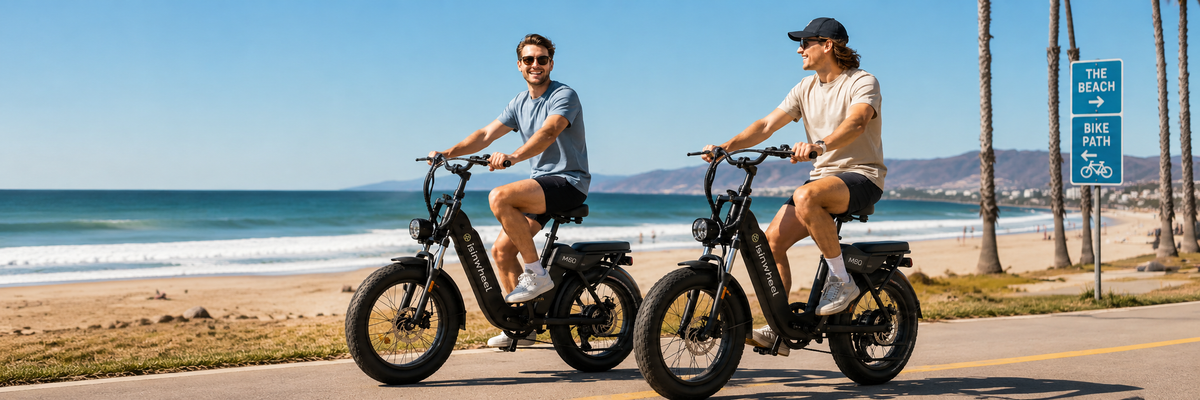
Electric Bike vs. Electric Scooter for Long Commutes: Pros, Cons, and Best Uses
Which commute problems are you actually trying to solve?

If you are comparing an electric bike vs. electric scooter for long commutes, the fastest way to decide is to start with your pain point, not the vehicle. A long ride usually becomes annoying for one of four reasons: distance, hills, storage, or handoff friction with trains, buses, elevators, and office entry. In Isinwheel’s lineup, that usually means the bike side makes more sense when your route is longer and more repetitive, while the scooter side makes more sense when your ride includes frequent carrying, folding, or tight storage. That split is especially clear once you compare the M10Pro and M60 e-bikes against Isinwheel’s scooter category, which is built around commuter-friendly portability and quick urban transitions.
A wrong match does more than make your ride less fun. It can leave you arriving tired, charging too often, or dealing with awkward parking every single day. That is why long-commute buyers should begin with daily round-trip miles, expected ride time, and whether the vehicle must come indoors. If your route is mostly door-to-door and over 30 minutes each way, comfort and battery headroom start to matter more than compactness. If your route mixes sidewalks, train platforms, and office hallways, foldability can beat raw range even when the bike looks stronger on paper.
Start with these four decision filters
- Distance: Longer daily mileage usually favors the e-bike.
- Comfort: Seated pedaling is easier to sustain than standing.
- Storage: Scooters are easier to fold, stash, and carry indoors.
- Terrain: Hills and rough pavement usually feel calmer on bigger bike tires.
Why Isinwheel e-bikes usually win the distance question

For a true long commute electric bike setup, Isinwheel’s bikes are easier to justify because they combine a seat, pedals, and bigger ride platforms with stronger range claims. The M10Pro is listed with up to 55 miles of range, a peak 1000W motor, 20 x 4-inch fat tires, Shimano 7-speed gearing, and a 330-pound max load. The M60 steps up with a 48V 13Ah battery, up to 105+ miles claimed range, a 1500W rated motor, 28 mph top speed, 26 x 4-inch tires, and a 330-pound max load. In plain terms, those specs give you more margin for longer loops, hills, and repeated weekday riding.
That does not mean every commuter needs the bigger machine. It means bikes generally ask less from your body over time. You are seated, you can vary effort with pedal input, and the longer frame tends to feel more familiar if you already know how to ride a bicycle. On broken pavement, the larger wheels and fat tires also help smooth out surface chatter that feels more noticeable on small-wheeled stand-up scooters. For riders who care about endurance more than apartment convenience, the e-bike side is simply a better match for the job.
When an Isinwheel scooter is the smarter daily tool
A long commute electric scooter can still be the better fit when your route is not purely about mileage. Isinwheel’s scooter collection is positioned around smart urban mobility, daily commuting, and models that range from lighter commuter use to higher-power all-terrain riding. The key advantage is not that a scooter beats a bike on comfort. It usually does not. The advantage is that a scooter is faster to fold, easier to bring into elevators, and less frustrating when you need to transition between riding and carrying several times a day.
That matters more than many buyers expect. If you live in a walk-up apartment, store your vehicle under a desk, or use transit for one leg of the trip, the scooter format can save time at both ends of the ride. The tradeoff is physical fatigue. Standing for longer sessions puts more work on your legs, wrists, and attention, especially on rough pavement. CPSC also notes that e-scooters have small tires, so uneven surfaces and obstacles can stop them suddenly, which is one reason route quality matters more on a scooter than on a fat-tire bike.
Which setup fits your commute best?

The cleanest way to compare an electric bike vs. electric scooter is to look at the real commuting dimensions side by side. Because this is an internal comparison, the goal is not to pick one universal winner. It is to identify the best fit across Isinwheel’s lineup.
| Dimension | Isinwheel M10Pro | Isinwheel M60 | Isinwheel Scooter Category |
|---|---|---|---|
| Ride format | Seated, pedal assist | Seated, Class 3 style | Stand-up, foldable |
| Claimed range | Up to 55 miles | Up to 105+ miles | Shorter by model |
| Top speed | 22 mph | 28 mph | Varies by model |
| Tire setup | 20 x 4 in | 26 x 4 in | Smaller scooter tires |
| Carrying indoors | Difficult | Hardest | Easiest |
| Office storage | Low convenience | Lowest convenience | High convenience |
| Long-ride comfort | Good | Best | Fair |
| Mixed transit use | Fair | Poor | Best |
| Hill and rough-road calm | Good | Best | Model-dependent |
| Rider familiarity | High for cyclists | High for cyclists | Easy for short trips |
| Limitations | Lower speed ceiling | Heavy, bulky footprint | Reduced long-ride comfort |
Range and battery headroom
If battery margin is your top concern, the M60 is the strongest option in this comparison. Its 48V 13Ah battery and 105+ mile claimed range give it the most room for detours, headwinds, and range loss from colder weather or hilly routes. The M10Pro still works well for moderate long commutes, but its 374 Wh battery and 55-mile claim place it in a different class. Scooters can absolutely handle daily city loops, yet they generally make the most sense when your commute is shorter or when portability matters enough to accept less cushion.
Best fit: M60 for the longest daily mileage, M10Pro for mid-range commuting, scooter for shorter loops with heavy storage needs.
Comfort after 30 minutes on the road
Once your ride stretches past about half an hour, comfort stops being a small preference and becomes a performance issue. The M10Pro and M60 both give you a seated position and fat tires that help absorb chatter from rough city pavement. The M60’s larger 26-inch wheels should feel more settled over mixed surfaces, while the M10Pro’s smaller 20-inch format stays a bit more compact without giving up the wide tire footprint. A scooter, by comparison, keeps you upright and alert in a good way for quick trips, but longer sessions usually create more lower-body fatigue and more constant impact through your hands and knees.
Best fit: M60 if comfort is your top priority, M10Pro if you want a smaller bike with daily stability, scooter only if the ride duration stays modest.
Storage and carrying into buildings
This is the section where scooters usually flip the decision. An e-bike may ride better, but storing it is another story. The M60 weighs 75.9 pounds and has full-size bike dimensions of 74.0 x 46.5 x 25.2 inches, so it is much more of a park-and-lock machine than a carry-it-inside machine. The M10Pro is still far easier to live with than a full commuter motorcycle, yet it remains a bike-sized object with a wide tire footprint. If you need to navigate elevators, office corners, or apartment hallways every day, a foldable scooter is the cleaner answer.
Best fit: Scooter for tight storage, M10Pro if you can secure bike parking, M60 if storage is available and ride quality matters more.
Control for new daily riders
For most adult commuters, the easiest platform to trust at longer distances is still the one that feels familiar. If you already know how to ride a bicycle, both e-bikes are intuitive because the body position, steering rhythm, and braking feel closer to what you already know. The M10Pro also adds Shimano 7-speed gearing, which helps you manage starts, climbs, and cadence in a more natural way. Scooters can be very approachable for short, flat routes, but they demand more attention to pavement seams, potholes, and abrupt surface changes because of their smaller tires and shorter stance.
Best fit: M10Pro for beginners who want a familiar ride, M60 for experienced riders wanting more distance, scooter for short urban practice and last-mile use.
Best fit inside the Isinwheel lineup

This is where the buying decision gets practical. Instead of asking which platform is better in the abstract, ask which Isinwheel model best matches your actual weekday pattern.
For budget-minded long commutes, the M10Pro is the best fit
The M10Pro makes the most sense when you want a real commuting bike without jumping straight to the largest platform. Its up-to-55-mile claimed range, 22 mph top speed, 20 x 4-inch fat tires, IP65 water resistance, 3 to 4 hour charge time, and 330-pound max load create a well-rounded setup for repeated city miles. The smaller wheel size also keeps the bike from feeling as oversized as some long-range fat-tire models. The tradeoff is simple: it does not offer the same speed ceiling or battery headroom as the M60.
Shop: isinwheel M10Pro Electric Bike for Adults
For higher mileage and rougher routes, the M60 is the best fit
The M60 is the choice for riders who do not want to think about range as often. With a 1500W rated motor, 48V 13Ah battery, up to 105+ miles claimed range, 28 mph top speed, IPX5 water resistance, mechanical disc brakes, and 26 x 4-inch tires, it is clearly the more commute-capable machine for longer mileage and mixed road conditions. It should also feel calmer on broken pavement and less stressed by heavier riders or cargo. The tradeoff is bulk: at 75.9 pounds, it is harder to carry, harder to store, and more dependent on reliable bike parking.
Shop: isinwheel M60 All-terrain Electric Bike
For compact urban runs, an Isinwheel scooter is the best fit
A scooter becomes the right answer when your route includes short urban distances, indoor storage, or repeated transit handoffs. Isinwheel’s scooter collection includes commuter-oriented and higher-performance models, but the category’s shared advantage is portability and faster last-mile transitions. That means less time locking outside and less floor space used at home or work. The cost of that convenience is lower long-ride comfort and greater sensitivity to rough pavement, especially when you ride for extended periods.
Shop: Isinwheel Electric Scooters
Practical safety and daily-use notes before you commit
No long-commute vehicle is a good fit if you are forcing it onto the wrong route. NHTSA says riders should choose routes with less traffic and slower speeds when possible, and use gear that improves visibility such as a helmet, bright clothing, reflective gear, and lights in low visibility. That advice matters for both bikes and scooters, but it becomes especially important on a scooter because the smaller profile makes you easier to miss in traffic.
CPSC also recommends always wearing a bicycle helmet for micromobility riding, checking brakes, lights, tires, cables, and frame condition before each ride, and using only the charger provided with or recommended by the manufacturer. The same agency warns consumers not to charge when sleeping or away from home because many lithium-ion battery fires happen overnight. In other words, your commute decision should include where you will charge, how you will store the device, and whether your building setup is realistic for the vehicle you choose. The U.S. Department of Energy also identifies safe infrastructure for biking and shared micromobility as part of the broader transportation shift toward lower-carbon trips, which reinforces the value of matching the machine to the route instead of buying on specs alone. (cpsc.gov)
The practical recommendation for most riders
If your main question is electric bike vs. electric scooter for long commutes, the shortest honest answer is this: long distance usually favors an Isinwheel e-bike, while tight storage and mixed transit usually favor an Isinwheel scooter. Within the bike side, the M10Pro is the best fit for riders who want a more affordable long-commute tool with useful range and a smaller footprint. The M60 is the best fit for higher-mileage riders who want more battery headroom, more speed, and better rough-road composure.
For most people riding longer daily routes, a bike is the more forgiving choice because it supports endurance better over time. For people whose commute includes elevators, office storage, or train transfers, a scooter may save more frustration even if it is not as comfortable over distance. So the next step is simple: map your real round-trip mileage, count how often you must carry or stash the vehicle, and then choose the Isinwheel format that matches your commute pattern instead of the one with the flashiest spec sheet.
FAQ
Should I choose an e-scooter or an e-bike for commuting in the city, considering value for money?
If your commute is longer, repeated five days a week, or includes rough pavement, an electric bike usually gives you better everyday value because you get a seat, pedal support, and more usable comfort over time. In Isinwheel’s lineup, the M10Pro is the more practical value-focused long-commute pick, while the M60 fits riders who need more range and speed headroom. A scooter can still be the smarter value if your trip is shorter and you must carry the vehicle into work or onto transit. The better deal is the one that reduces fatigue and storage friction in your actual routine.
Is an e-bike safer than an electric scooter for commuting in urban areas, considering safety features and price?
In most urban commuting situations, an e-bike is generally safer than an electric scooter because its larger wheels, stronger braking setups, seated riding position, and more stable frame handle potholes, curbs, and rough pavement better. Electric scooters can still be safe for city use, but they depend more on smooth roads, careful speed control, and features like reliable brakes, lights, and good tire grip. Price also matters: scooters are often cheaper upfront, while e-bikes usually cost more but may justify the extra spend if safety, comfort, and daily stability are your main priorities. If your route includes uneven streets or longer distances, the e-bike is usually the safer choice.
Which is easier to control: an e-bike or an electric scooter for a beginner commuter?
For most beginner commuters, an e-bike is usually easier to control. The larger frame, bigger wheels, seated riding position, and more familiar bike-style handling generally make it feel more stable and predictable, especially on longer rides or rough pavement. An electric scooter can feel simpler at very low speeds, but its smaller wheels and standing posture often require better balance and quicker reactions. If you are new to electric commuting and want the gentlest learning curve, an e-bike is often the safer starting point.
What feels easier to control for a beginner commuter?
An e-bike is usually easier for a beginner if that rider already knows how to ride a standard bicycle. The posture feels familiar, the longer wheelbase tends to feel steadier, and pedal input gives you another way to manage starts and hills smoothly. The M10Pro is the easiest entry point in this comparison because it balances bike-like control with manageable everyday specs. A scooter can still be easy to learn for short flat trips, but it asks more from your balance and road scanning.
How does a compact off-road-leaning scooter compare with an e-bike for light adventure rides?
A compact scooter can work for light adventure if your idea of adventure means short mixed-surface rides and you still want easy storage afterward. An e-bike is the better tool when the route gets longer, the ground gets rougher, or you want to stay comfortable for more than 30 to 40 minutes at a time. In Isinwheel’s lineup, the M60 is the stronger endurance option because it pairs bigger tires with much more claimed range and a higher speed ceiling. The tradeoff is that it takes up far more space and is harder to move when you are off the bike.
What should beginners look for in a commuter scooter versus a more rugged scooter?
Beginners should first match the scooter to the route, not to marketing terms like off-road or performance. For commuting, prioritize easy folding, predictable controls, manageable acceleration, and a form factor that works with hallways, transit, and office storage. For rougher surfaces, look for better tire grip, more ride stability, and enough battery capacity that bumps and hills do not cut your usable range too sharply. If most of your week is still urban pavement, a commuter-style scooter is usually the smarter place to start.
Table of Contents
-
Electric Bike vs. Electric Scooter for Long Commutes: Pros, Cons, and Best Uses
- Which commute problems are you actually trying to solve?
- Why Isinwheel e-bikes usually win the distance question
- When an Isinwheel scooter is the smarter daily tool
- Which setup fits your commute best?
- Best fit inside the Isinwheel lineup
- Practical safety and daily-use notes before you commit
- The practical recommendation for most riders
-
FAQ
- Should I choose an e-scooter or an e-bike for commuting in the city, considering value for money?
- Is an e-bike safer than an electric scooter for commuting in urban areas, considering safety features and price?
- Which is easier to control: an e-bike or an electric scooter for a beginner commuter?
- What feels easier to control for a beginner commuter?
- How does a compact off-road-leaning scooter compare with an e-bike for light adventure rides?
- What should beginners look for in a commuter scooter versus a more rugged scooter?



Share:
iSinwheel Electric Scooter Safety Guide: Essential Tips for New Riders