



The Beginner Tire Decision Starts Here

Beginner electric scooter tires matter more than top speed on your first week of riding. Smooth city tires make a city commuter scooter feel calm on pavement, while chunky off-road tires give an off-road electric scooter more bite on gravel, hills, and broken paths. If your route is mostly bike lanes, campus paths, and sidewalk links, the easier choice is usually the smooth-tire commuter setup. If your route includes park trails, rough shoulders, steep climbs, or patched rural roads, the bigger off-road tire starts to make more sense.
Smooth Pavement Feels Easy Until Gravel Appears
A beginner often notices tire differences at the exact moment the surface changes. Clean asphalt rewards a smooth tire because the scooter rolls quietly, turns predictably, and does not pull hard against your hands. However, loose gravel, wet leaves, sand, and raised cracks reduce the contact between tire and ground. That is where a wider, chunkier tread can help the scooter keep direction instead of skating sideways.
For safety context, the CPSC continues to track micromobility injuries across e-scooters and related products, which makes conservative first-ride setup important. Meanwhile, the NHTSA recommends visible gear, a helmet, front lighting, and rear reflectors for small road users, all of which matter when you are learning braking and turning habits.
Wrong Tires Cost Comfort, Control, Confidence
The tire is your first suspension point, your first grip point, and your first warning system. A small pneumatic city tire can soften normal pavement buzz and make low-speed balance feel friendly. A larger off-road pneumatic tire can absorb rougher impacts and add traction, but it also comes with more scooter weight and stronger motor behavior in the GT1 Dual setup.
Use this simple decision rule before comparing specs:
- Choose smooth city tires if 80 percent or more of your route is paved.
- Choose chunky off-road tires if gravel, dirt, hills, or broken pavement appear every ride.
- Choose lower speed modes first if you are nervous, returning to riding, or riding near pedestrians.
- Choose comfort over bragging specs when the scooter is your first electric ride.
S Nova Makes City Riding Feel Predictable
The S Nova is the better first fit for riders who want a scooter for urban commuting, short errands, campus movement, and simple pavement routes. Its 8.5-inch pneumatic tires, dual suspension, front and rear disc brakes, and 49.2-pound aluminum alloy frame give beginners a controlled starting point without making the scooter feel oversized. That balance is useful when you need to roll it into an apartment, lift it into a car trunk, or fold it near a desk.
Smooth City Tire Profile
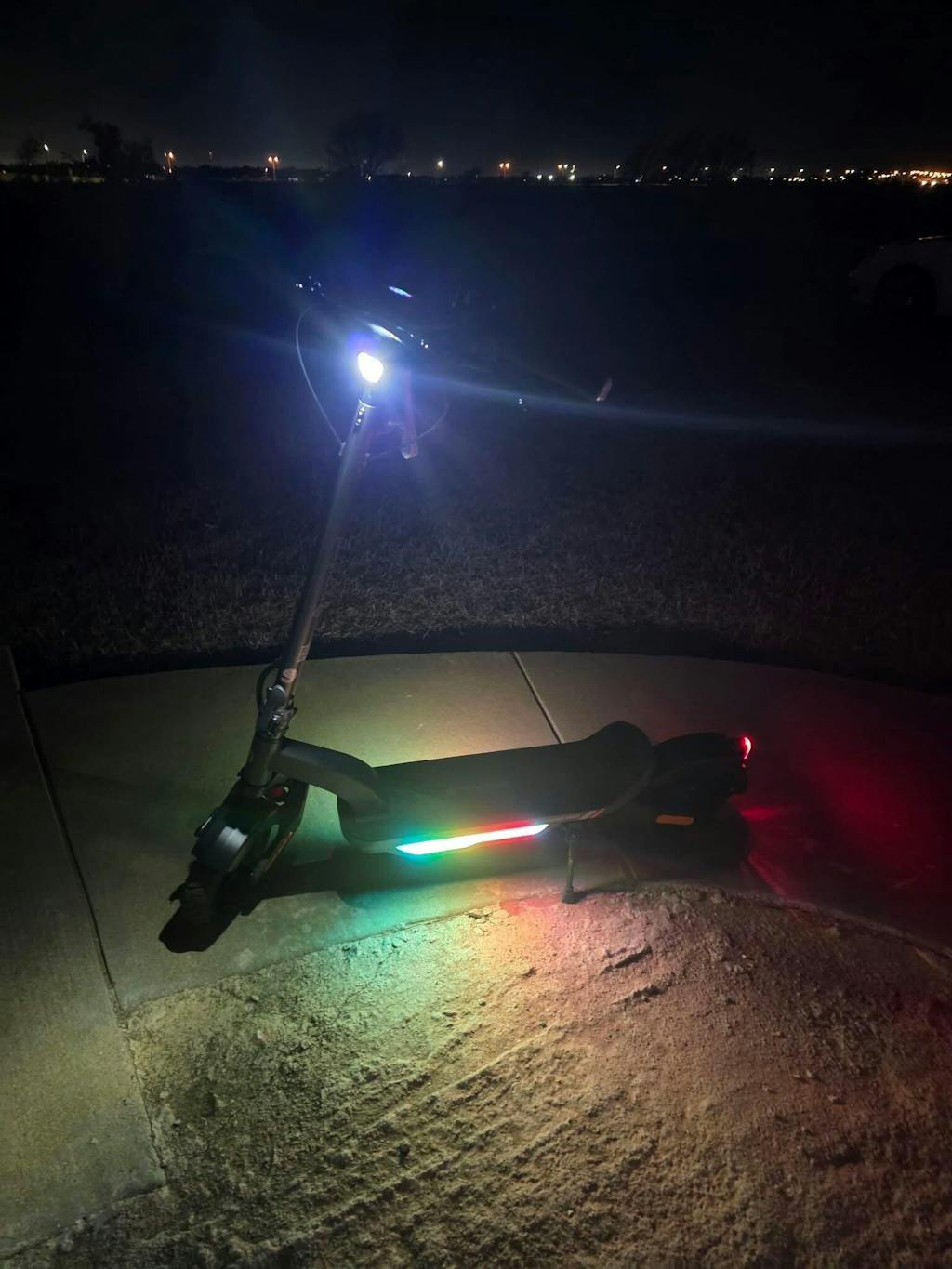
The S Nova uses 8.5-inch pneumatic tires, which means the tires hold air instead of being solid rubber. For beginners, that matters because air volume helps reduce vibration from small cracks, seams, and rough pavement. The scooter lists a 500W rated motor with 600W max power, a 20 MPH top speed, a 19-mile max range, and a 36V 7.8Ah battery. It also includes IPX4 water resistance, app locking, cruise control, ambient lighting, turn lights, and a 264-pound max load.
Shop: S Nova Commuting Electric Scooter
Best For Commutes, Campus, And Sidewalk Links
The S Nova fits a beginner who wants to ride smoothly rather than attack rough terrain. Its listed dimensions are 47.6 by 24 by 48.8 inches, so it has a commuter footprint rather than a large trail-scooter stance. The dual suspension helps when you cross driveway lips, patched asphalt, and small curb transitions, but the tire profile is still mainly built around pavement comfort.
Its main limitation is loose terrain. Light uneven pavement is fine, yet deep gravel, mud, soft dirt, and rocky shortcuts are not the S Nova’s best use case. If your route includes those surfaces every day, you may feel the smaller tire working harder to stay settled.
GT1 Dual Handles Mixed Terrain Better
The GT1 Dual is the stronger fit when your first scooter needs to handle city streets plus rougher weekend routes. It uses 10-inch off-road pneumatic tires, dual 800W motors, dual swing arm suspension, and a heavier 73-pound build. That extra capability helps on hills and uneven paths, but beginners should respect the power difference. This is not the scooter to learn throttle control at full output on a crowded sidewalk.
Chunky Off-Road Tire Profile

The GT1 Dual’s 10-inch off-road pneumatic tires are larger and more aggressive than the S Nova’s city tires. Larger air tires can roll over surface gaps with less drama, and block-style tread can hold better on dirt, gravel, and rough pavement. The GT1 Dual lists 800W times two dual motors, a 32 MPH top speed, a 35-mile max range, a 48V 13Ah battery, and a 330-pound max load. It also lists IPX4 water resistance, app connectivity, headlight, turn light, rear brake light, and EABS plus disc braking.
Shop: GT1 Dual Motor Electric Scooter
Best For Hills, Trails, And Broken Roads
The GT1 Dual gives you more margin when the route gets rough. Its listed 35 percent climbing ability and 45 mm suspension travel make it better suited to hills, trail links, uneven shoulders, and damaged pavement. It also offers riding pace options that include 12 MPH, 18 MPH, 25 MPH, and 32 MPH modes, so a beginner can start conservatively before using the full performance range.
The tradeoff is handling effort. At 73 pounds, the GT1 Dual is much less convenient to carry than the S Nova. Its stronger acceleration can also surprise new riders, especially when turning, climbing, or riding over loose ground.
Which Tire Type Fits Your First Rides?
This comparison is not about which scooter has the biggest numbers. It is about which tire and frame make your real route easier to control. In 2023, shared micromobility systems reached record use across the U.S. and Canada, and the Department of Energy noted that scooter and bike trips were evenly split in that shared-use data. More riders means more varied surfaces, so your first scooter should match where you actually ride.
| Dimension | S Nova Commuting Electric Scooter | GT1 Dual Motor Electric Scooter |
|---|---|---|
| Best Fit | Smooth city commuting | Mixed city and off-road |
| Tire Type | 8.5-inch pneumatic | 10-inch off-road pneumatic |
| Motor Setup | 500W rated, 600W max | Dual 800W motors |
| Top Speed | 20 MPH | 32 MPH |
| Max Range | 19 miles | 35 miles |
| Weight | 49.2 pounds | 73 pounds |
| Climbing Ability | Up to 15 percent | Up to 35 percent |
| Braking | Front and rear disc | EABS plus disc brake |
| Suspension | Dual suspension | Dual swing arm suspension |
| Limitations | Not for deep gravel | Heavier, more powerful |
Pavement Comfort And Daily Control
S Nova: The S Nova is easier to recommend for a beginner who rides mainly on clean pavement. The 8.5-inch pneumatic tires, 49.2-pound frame, and 20 MPH top speed create a calmer learning curve for starts, turns, and braking.
GT1 Dual: The GT1 Dual can still ride pavement well, but its weight and dual-motor power make it feel more serious. It is stable, yet a new rider should use lower modes until braking and throttle control feel natural.
Best Fit: Pick the S Nova if daily control matters more than all-terrain capability. Pick the GT1 Dual only if pavement is mixed with frequent rough sections.
Portability, Storage, And Beginner Handling
S Nova: At 49.2 pounds, the S Nova is more practical for stairs, elevators, office corners, and small apartments. Its commuter size also makes parking and turning in tight spaces easier.
GT1 Dual: At 73 pounds, the GT1 Dual is built more like an adventure machine. It folds, but the extra mass matters when lifting, loading, or carrying it across a lobby.
Best Fit: Choose the S Nova if you regularly carry your scooter. Choose the GT1 Dual if storage is easy and rough-terrain control is more important than lifting comfort.
Speed, Range, And Ride Budget
S Nova: The S Nova gives beginners a useful commuting range without pushing them toward high-speed habits. Its 19-mile max range is enough for many short work, school, and errand routes when charged regularly.
GT1 Dual: The GT1 Dual gives more range, more climbing power, and a much higher performance ceiling. That is useful for longer mixed routes, but it also demands better judgment.
Best Fit: The S Nova is the cleaner beginner value for pavement. The GT1 Dual is the better long-route and rough-surface value when you will actually use its capability.
Best Fit For Beginner Riding Scenarios
Your first scooter should solve your normal week, not your most exciting imagined ride. A city rider who buys too much off-road scooter may end up fighting weight and power every day. A trail-curious rider who buys too little tire may feel nervous whenever pavement ends. Therefore, choose by surface first, then check motor, range, suspension, and storage.
Choose By Surface, Not Spec Hype
- City commuters: Choose the S Nova if your route is bike lanes, neighborhood streets, campus paths, and paved park links. It is the easier Isinwheel fit for predictable beginner riding.
- Mixed-terrain riders: Choose the GT1 Dual if hills, broken pavement, gravel shoulders, and hard-packed dirt appear often. Its larger tires and dual suspension give more control on rougher routes.
- Nervous beginners: Start with smooth city tires first unless rough ground is unavoidable. Lower top speed and lighter handling build confidence faster.
- Heavier riders or cargo users: Compare load rating carefully. The S Nova lists 264 pounds, while the GT1 Dual lists 330 pounds.
- Apartment riders: Weight matters every ride. If you lift the scooter daily, the S Nova is easier to live with.
Safety Habits Before You Upgrade Tires
Tires help, but habits protect you. Check tire pressure before longer rides, because underinflated pneumatic tires feel sluggish, heat up faster, and can pinch more easily against sharp edges. Test both brakes at walking speed before entering traffic. Also, keep night rides conservative, because beginners often overestimate how early drivers can see a small scooter.
For protective gear, the CPSC recommends helmets that meet bicycle helmet standards for scooter users, along with knee and elbow protection. That is especially useful when learning emergency stops, because front-heavy braking can shift your weight quickly.
Conclusion
Key Takeaway And Next Action
Smooth city tires are the best fit for beginner city confidence. The S Nova Commuting Electric Scooter gives you a lighter frame, 8.5-inch pneumatic comfort, 20 MPH top speed, and commuter-friendly handling for paved daily routes. If your riding life is mostly streets, campus paths, and short errands, this is the more forgiving place to start.
Chunky off-road tires are the best fit for mixed-terrain capability. The GT1 Dual Motor Electric Scooter gives you 10-inch off-road pneumatic tires, dual 800W motors, 35-mile range, stronger climbing ability, and a heavier 73-pound adventure build. Choose it when rough pavement, gravel, hills, and longer routes are part of your real week, not just a weekend idea.
Your next action is simple: map your route surface before you compare speed. If most miles are paved, shop the S Nova. If rough sections show up every ride, shop the GT1 Dual and begin in lower riding modes until the scooter feels familiar.
FAQ
How do I select an electric scooter for outdoor adventures and rough terrain for $800 or less?
Choose an outdoor adventure scooter with pneumatic off-road tires, real suspension, strong braking, and controlled speed modes. The Isinwheel GT1 Dual is the stronger candidate for rough terrain because it lists dual 800W motors, 10-inch off-road pneumatic tires, and dual swing arm suspension. Beginners should start in the lowest useful mode, then practice braking on flat ground before climbing hills. If your route is mostly paved, the S Nova is easier to handle and store.
What’s the best-value electric scooter for light off-road exploration under $800?
The best-value direction for light off-road exploration is a scooter with larger pneumatic tires, suspension travel, and enough hill-climbing power for uneven ground. The Isinwheel GT1 Dual fits that use better than a pure city setup because it is built for both city and off-road riding. Its 10-inch tires and 35-mile max range give more room for mixed routes. If light off-road means only occasional park paths, the S Nova may still be enough for a smoother daily commute.
How do I ensure my off-road scooter is safe for rough terrains without spending too much?
Keep an off-road scooter safer by prioritizing tire contact, suspension control, braking condition, lighting, and conservative speed settings. Before each rough ride, check tire pressure, brake response, stem latch security, and visible lights. Spend first on a certified helmet, gloves, basic lights, spare tubes, and brake maintenance rather than speed accessories. On gravel or dirt, bend your knees, keep your arms relaxed, and avoid hard turning while braking.
What should beginners know before switching tire types?
Beginners should know that smooth tires feel more predictable on clean pavement, while chunky tires feel more secure on loose or broken surfaces. A tire switch can change steering feel, rolling noise, braking grip, and range. Larger off-road tires can improve rough-surface confidence, but they may also add weight and reduce the simple commuter feel. Switch tire types only when your normal route regularly includes the surface the new tire is designed for.
How do scooter tires affect maintenance costs?
Scooter tires affect maintenance through air pressure checks, tread wear, puncture risk, and brake load. Pneumatic tires improve comfort, but they need regular inflation and inspection for cuts, thorns, glass, and sidewall damage. Off-road tread can wear faster on asphalt because the tread blocks flex more under load. Beginners should plan for tubes, sealant, brake pads, valve checks, and monthly fastener inspections.
Table of Contents
- The Beginner Tire Decision Starts Here
- S Nova Makes City Riding Feel Predictable
- GT1 Dual Handles Mixed Terrain Better
- Which Tire Type Fits Your First Rides?
- Best Fit For Beginner Riding Scenarios
- Conclusion
-
FAQ
- How do I select an electric scooter for outdoor adventures and rough terrain for $800 or less?
- What’s the best-value electric scooter for light off-road exploration under $800?
- How do I ensure my off-road scooter is safe for rough terrains without spending too much?
- What should beginners know before switching tire types?
- How do scooter tires affect maintenance costs?



Share:
Electric Scooter or E-Bike? How to Decide If One is Right for Me as a Beginner
3 Best-Value E-Bikes for Light Off-Road Exploration in 2026