


How to Choose an Easy-to-Ride Family E-Scooter Under $500
What makes a family e-scooter easy to ride and worth buying?

A family e-scooter under $500 can look simple on the product page and still feel wrong the moment a second rider tries it. One person may think the throttle is too jumpy, another may dislike the stiff ride, and a teen who feels fine on smooth pavement may suddenly feel nervous on rough neighborhood streets. That is why so many “good deal” scooters end up being used less than expected. The real cost is not only money. It is discomfort, low confidence, and a scooter that becomes harder to share across your household.
For most families, an easy-to-ride electric scooter is not the one with the flashiest spec. It is the one that feels stable, brakes predictably, folds without drama, and handles short errands without constant battery worry. In the sections below, you will compare ride ease, family fit, comfort, braking, and real-world value so you can choose a beginner-friendly scooter that actually works for shared daily use.
Which basics matter before you compare models?
If you want a budget family scooter that gets used regularly, you need a few terms straight before you start comparing listings. Otherwise, it is easy to overvalue speed and undervalue comfort, stopping control, and rider fit.
Key terms to define first
Ride ease means how natural the scooter feels in the first few minutes. You can usually judge it by three things: stability at low speed, smooth throttle response, and braking that does not feel sudden. Family use means the scooter may be shared by riders with different heights, confidence levels, and trip types. Budget class, in this guide, means the entry commuter segment where a safe electric scooter for teens and adults should cover short urban or neighborhood trips without moving into premium suspension or long-range pricing.
A practical family e-scooter under $500 should help newer riders feel calm, not challenged. That is why a manageable weight, simple controls, and visible lighting often matter more than raw output.
Core concepts that shape usability
The lower the learning curve, the more likely everyone in the family will actually use the scooter. In practice, that means:
- Predictable braking matters more than headline speed.
- Pneumatic tires, which are air-filled tires, usually improve comfort on cracked pavement.
- A stable stem and deck reduce the nervous “wobble” feeling.
- Clear lights and signals help riders feel safer at dusk.
- Realistic range matters more than best-case lab-style range claims.
The safety side is worth taking seriously too. The CPSC says riders should use visibility accessories such as headlamps, reflectors, and a bell or horn, and it also warns about lithium-ion battery fire risks in micromobility products. That makes lighting, signaling, and charging habits part of the buying decision, not just bonus features.
Main scooter categories in this budget
Under $500, most affordable commuter scooter options fall into three usable groups.
- Lightweight commuters: Best for one rider, short errands, easy carrying, and quick storage.
- Shared-use neighborhood scooters: Better for families who want a broader fit across adults and teens.
- Value models with smart features: These add app control, signaling, or stronger lighting without jumping to a much higher class.
For family use, the second and third categories usually make the most sense. You give up some premium refinement, but you can still get enough control, range, and comfort to make the scooter useful for repeated local rides.
How should families narrow choices under $500?

Once you know what the terms mean, the next step is filtering models the way a real household uses them. A beginner-friendly scooter is rarely chosen by top speed alone. It is chosen by fit, comfort, and how forgiving it feels when riders swap in and out.
Start with rider fit and shared use
A scooter that fits one person well can feel awkward for everyone else. So first, check whether the size and weight work for shared riding.
Look at these points before anything else:
- Max load: This tells you whether the scooter can handle the heaviest likely rider with more confidence.
- Recommended height range: Shared family use works better when adults and teens both fit the handlebar geometry.
- Deck and stem balance: A wider-feeling standing area and steady handlebar position help beginners relax.
- Scooter weight: A 27 to 34 pound scooter is much easier to move into a car trunk or closet than a heavier performance model.
The CPSC also highlights charging safety concerns around micromobility batteries, especially indoors and overnight, so folding convenience matters more than people think. If the scooter stores neatly in a visible, ventilated place, families are less likely to charge it carelessly in a hallway or sleeping area.
Compare comfort and control features
This is where an easy-to-ride electric scooter separates itself from a merely cheap one. Comfort and control create confidence fast.
Focus on these features:
- Pneumatic tires: Better at softening vibration over joints, patches, and rough sidewalks.
- Dual braking: An electronic front braking system plus rear disc brake usually feels more controlled than a basic single setup.
- Lighting package: A front headlight, rear brake light, and turn signals help at dusk and in mixed neighborhood traffic.
- Simple controls: New riders do better with a clean display, intuitive throttle, and easy folding steps.
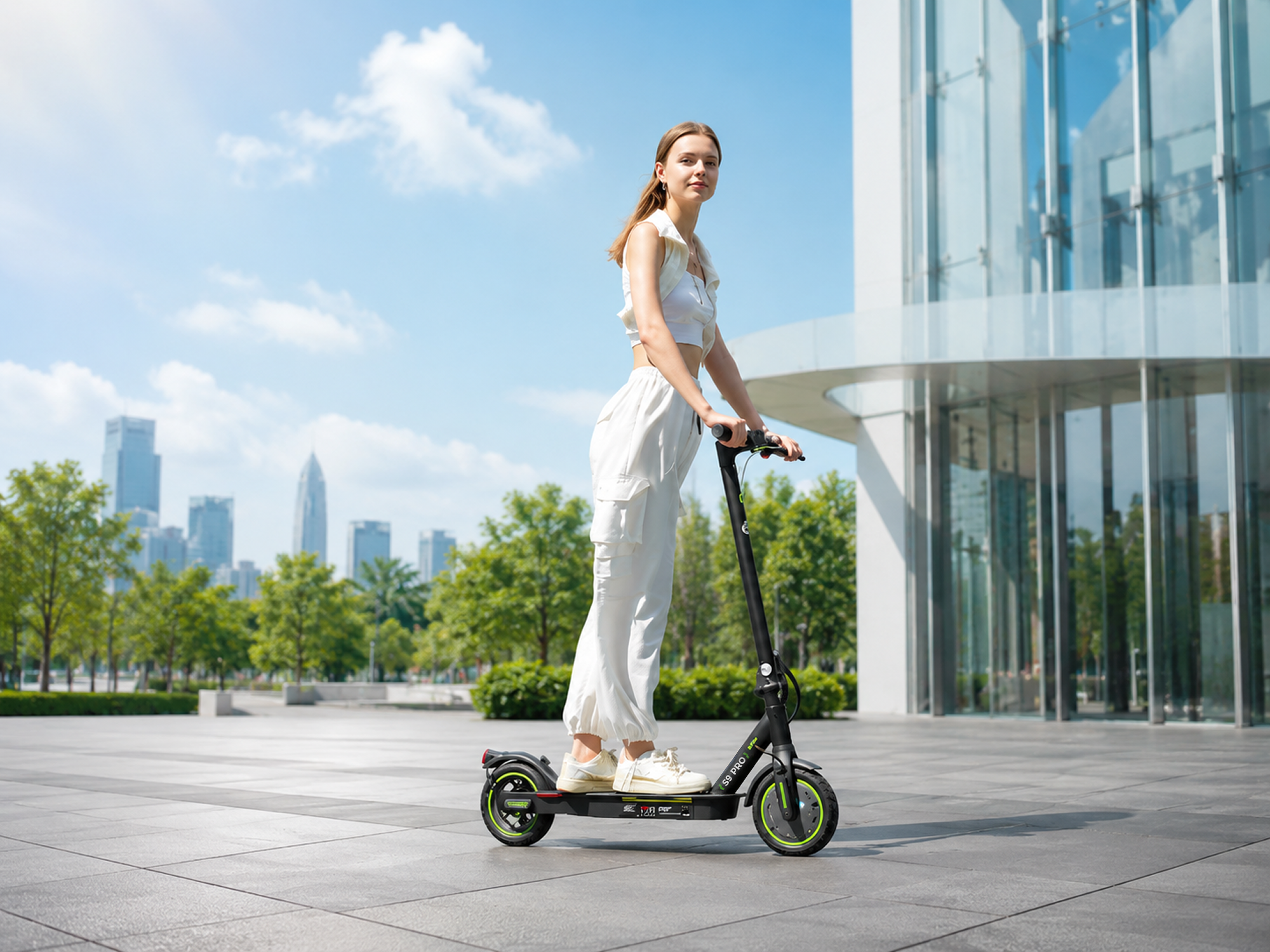
According to the current S9 Pro product listing, the scooter includes 8.5-inch pneumatic tires, EABS braking plus a rear disc brake, a headlight, turn signal, rear brake light, electronic bell, and a 27.5-pound net weight. Those are the kinds of signals that matter for shared beginner use, because they improve comfort and reduce intimidation without overcomplicating the ride.
Filter by realistic daily range
Range claims are useful, but only if you treat them as a ceiling, not a promise. Family use often drains batteries faster because there are more stop-start trips, mixed rider weights, and less-than-perfect surfaces.
A good rule is to match your budget family scooter to your usual round trip, then leave a cushion. If your household uses the scooter for school pickup loops, neighborhood errands, or park runs of 4 to 8 miles total, a claimed 19 to 22 miles can be workable. If you routinely stack several short trips in one day, that extra buffer matters even more.
Family scooter features that matter most
When families compare a family e-scooter under $500, a few details consistently decide whether the scooter feels reassuring or frustrating. These are the features that improve ride confidence day after day.
Safety signals to prioritize
Visible, low-stress riding starts with communication. Riders who are still learning benefit from being seen early and clearly.
Here are the most useful safety signals to prioritize:
- Front light for dusk, shade, and late-afternoon visibility
- Rear brake light to show slowing behavior
- Bell or signal feature for paths and neighborhood crossings
- Brakes that respond consistently without grabbing too hard
The current S9 Pro listing includes a headlight, turn signal, and rear brake light, while the S9 standard listing also highlights a bright headlight and smart turn signals. These features do not replace safe riding habits, but they do help a safe electric scooter for teens and adults feel more usable in real family settings.
Comfort details that reduce frustration
Small comfort details often decide whether a scooter gets reused next weekend or left folded in the garage. For family outings, low frustration is a feature.
Look for:
- Folding design: Easier to load into a trunk or store near the door
- Stable stem feel: Reduces nervous steering input from beginners
- Tire comfort: Pneumatic tires usually feel less harsh than solid tires
- Simple startup and controls: Shortens the learning curve for teen and adult riders
The S9 Pro and S9 both list a 3-step fold-style commuter format with similar dimensions, 8.5-inch pneumatic tires, and app support. That kind of platform is useful when your goal is not aggressive riding, but calm, repeatable trips.
Value checks before purchase
A cheap listing is not automatically a smart buy. For an affordable commuter scooter, value comes from how much stress it removes after purchase.
Check these points before you decide:
- Warranty coverage and return window
- U.S. shipping and delivery clarity
- Replacement and support availability
- Charging time that fits your household routine
- Water-resistance rating for basic daily exposure
Battery safety deserves a quick note here as well. In September 2025, the CPSC warned consumers about safe micromobility battery charging practices and urged care with chargers and overnight charging behavior. In plain terms, value includes safe ownership habits, not only range and speed.
Where does Isinwheel fit for this budget?
If your target is an easy-to-ride electric scooter under $500, Isinwheel’s S9-family lineup fits the exact middle of the decision: basic commuter pricing with enough comfort and control features to make family use realistic.
Good-fit product direction for entry family use
The clearest value anchor is the S9 Pro Electric Scooter. It is positioned well for budget-focused commuting and neighborhood use because it balances moderate power with comfort-led features. The current listing shows a 350W motor, 19 mph top speed, claimed 19-mile range, 36V 7.8Ah battery, 8.5-inch pneumatic tires, EABS plus rear disc braking, IP54 water resistance, turn signals, rear brake light, and a 220-pound max load. For many households, that is the sweet spot where the scooter feels capable without becoming intimidating.
The standard S9 sits close to that same family-friendly use case. Its current page also lists a 350W motor, 19 mph top speed, 19-mile claimed range, 8.5-inch pneumatic tires, EABS plus rear disc braking, 220-pound max load, app support, and turn signals. In practical terms, it works as a basic everyday neighborhood scooter when you want a familiar commuter format with simple controls.
Shop: S9 Pro Electric Scooter 19 Miles
Useful product signals from the lineup
If you want more performance headroom while staying in a budget-conscious zone, the S9Max 500W Electric Scooter is the step-up option. Its current listing shows a 500W motor, 21 mph top speed, 22-mile claimed range, 42V 10Ah battery, 10-inch honeycomb tires, front and rear dual suspension, EABS plus rear disc brake, 264-pound max load, and a 34-pound net weight.
That makes the lineup easy to map:
- S9 Pro: Best value anchor for beginner confidence and commuter basics.
- S9: Good for straightforward shared neighborhood use.
- S9Max: Better if your household wants stronger acceleration headroom, a higher load capacity, or more comfort from suspension.
For a true beginner-friendly scooter, the S9 Pro remains the easiest model to recommend first because its feature mix is centered on ride confidence rather than spec chasing.
Shop: S9 Electric Scooters for Adults 350W
Shop: iSinwheel S9Max 500W Upgraded Electric Scooter
Best practices and pitfalls
You do not need a long checklist to choose well, but you do need the right priorities. Families usually make better scooter decisions when they treat the purchase as a shared-use tool, not a solo toy.
Best practices
A few habits make it much easier to pick the right budget family scooter.
- Test fit every likely rider, even if only by comparing height and load specs.
- Prioritize braking feel over top speed claims.
- Choose comfort features that reduce vibration on local pavement.
- Leave real range buffer for repeated short trips.
- Check folded size and net weight before buying.
- Store and charge the scooter in a safer, supervised location.
If your family expects neighborhood errands, school pickup loops, or park trips, an affordable commuter scooter with good brakes and visible lighting will usually deliver better long-term satisfaction than a faster model with harsher ride quality.
Common pitfalls to avoid
Most buying mistakes are simple. They happen when one big number hides three small problems.
Watch out for these common errors:
- Buying only by advertised range
- Ignoring tire type and ride harshness
- Overlooking scooter weight for lifting and storage
- Treating lighting as optional
- Assuming every adult-and-teen shared scooter fits both equally well
- Charging carelessly with the wrong charger or in risky overnight setups
The easiest way to avoid disappointment is to picture one real week of use. If the scooter will be folded into a car, shared between riders, ridden at dusk, and used on mixed pavement, then comfort, braking, and lighting should lead the decision.
How to make the final choice
By the time you narrow the list, the best family e-scooter under $500 is usually the model that removes the most friction from shared rides. You want a scooter that feels steady for beginners, folds easily, and covers local trips without making range or braking feel stressful.
For most buyers in this price tier, the decision order is simple: start with fit, then braking, then comfort, then realistic range. If you want the most balanced beginner-friendly scooter in Isinwheel’s lineup for this budget, the S9 Pro is the strongest value anchor. If you need extra load capacity and more comfort from suspension, the S9Max is the upgrade path. Either way, choosing by family use case instead of spec hype is what turns a budget purchase into a scooter your household actually enjoys using.
FAQ
How do I know which electric scooter is right for me if I have a budget under $500?
The right scooter is the one that matches your real trips, rider size, and comfort needs without stretching the budget on features you will not use. In this price range, prioritize braking, tire comfort, lighting, and manageable weight before focusing on speed. A good target is a scooter with around 19 to 22 miles of claimed range, predictable brakes, and a folded size you can actually store.
What are the key safety features I should look for in a family scooter under $500?
The most important safety features are a reliable braking setup, strong front and rear visibility, and controls that do not overwhelm new riders. A combination such as EABS with a rear disc brake gives more stopping confidence than a basic single-brake design. You should also look for a headlight, rear brake light, bell, and ideally turn signals if the scooter will be used at dusk or in neighborhoods with driveways and crossings. Tire choice matters too, because 8.5-inch pneumatic tires often feel more forgiving than harder solid tires on uneven pavement.
How can I find a practical scooter for family outings that’s still cost-effective?
A practical family scooter should be easy to fold, light enough to move, and comfortable enough that different riders will actually want to use it. Cost-effective does not mean cheapest; it means the scooter covers your normal 4 to 8 mile family outings without obvious compromises in braking, lighting, or support. Try to balance purchase cost with useful ownership signals such as 4- to 6-hour charging, a water-resistance rating, and clear warranty support.
Are there scooters that offer good value for family use for both adults and teens?
Yes, but the best value comes from overlap in fit and ease of control, not from flashy specs. Look for a model with a practical height range, a useful load limit, steady low-speed handling, and a deck that feels secure for different riders. Isinwheel models such as the S9 Pro and S9 can fit this role because they combine commuter-friendly power with visible lighting, folding convenience, and beginner-oriented braking. For mixed adult and teen use, a 220-pound or higher load rating and clear lighting package are good minimum checks.
What is a beginner-friendly scooter for family use?
A beginner-friendly scooter is one that feels predictable from the first ride. That usually means moderate speed, smooth acceleration, comfortable tires, and brakes that do not feel abrupt in neighborhood riding. In this budget category, Isinwheel’s entry commuter direction makes sense, especially the S9 Pro, because it stays focused on confidence-building features rather than just extra power. New riders generally do best with a scooter around the 19 mph class, with visible lighting and a straightforward folding design.
What is the best scooter for families who want an easy-to-ride vehicle for neighborhood errands under $500?
For neighborhood errands, the best choice is usually a commuter-style scooter with enough range for repeated short trips, easy storage, and clear visibility features. The Isinwheel S9 Pro is a strong candidate because it combines a 350W motor, 19-mile claimed range, dual braking format, turn signals, and pneumatic tires in a beginner-friendly layout. That mix is especially useful when the scooter may be shared between adults and teens for short daily rides. If your family wants more rider capacity and a bit more performance headroom, then the S9Max becomes the logical next step.
Table of Contents
- What makes a family e-scooter easy to ride and worth buying?
- Which basics matter before you compare models?
- How should families narrow choices under $500?
- Family scooter features that matter most
- Where does Isinwheel fit for this budget?
- Best practices and pitfalls
- How to make the final choice
-
FAQ
- How do I know which electric scooter is right for me if I have a budget under $500?
- What are the key safety features I should look for in a family scooter under $500?
- How can I find a practical scooter for family outings that’s still cost-effective?
- Are there scooters that offer good value for family use for both adults and teens?
- What is a beginner-friendly scooter for family use?
- What is the best scooter for families who want an easy-to-ride vehicle for neighborhood errands under $500?

Share:
Dual vs. Single Motor for Hills: Torque, Weight, and Real Tradeoffs
Best Family E-Scooters Under $500 for Neighborhood Errands