


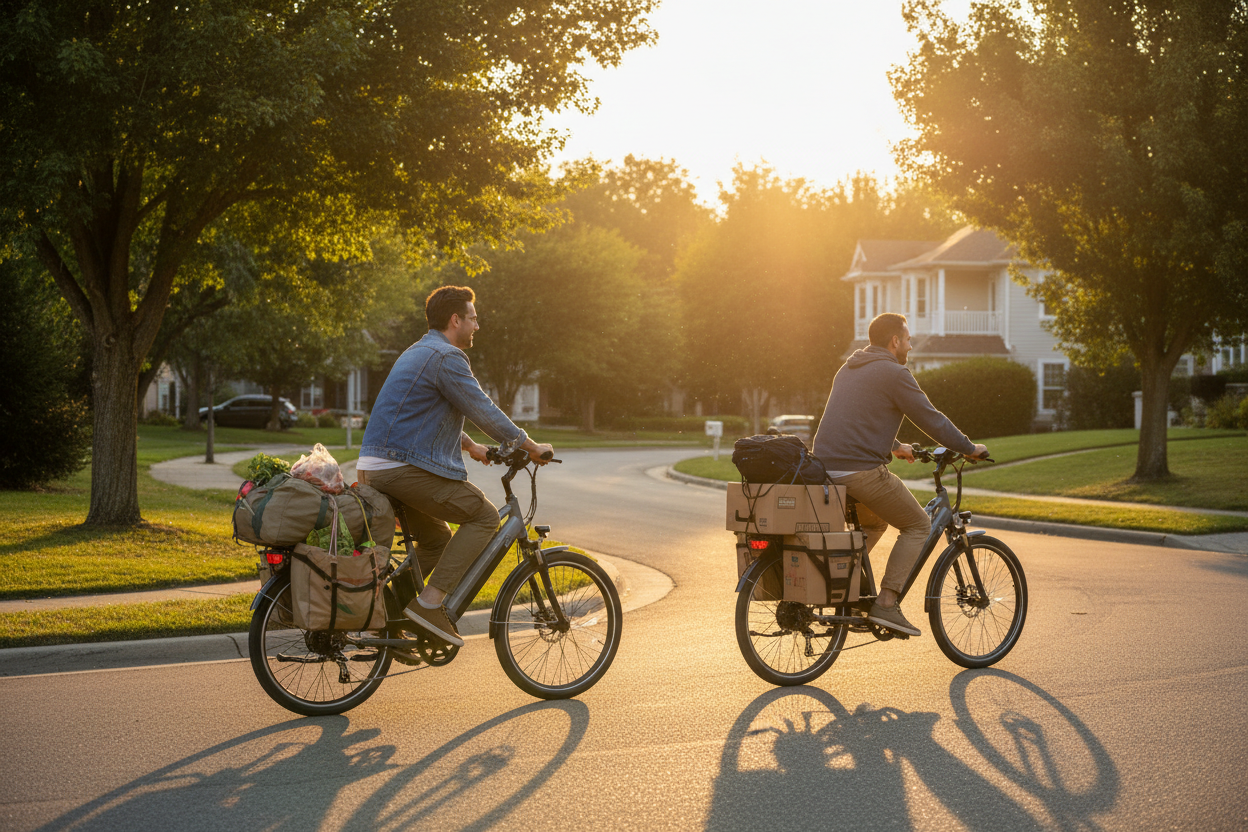
Electric Scooter or E-Bike for Family Errands? Compare Storage, Comfort, and Carrying Needs
Which one actually fits your family errand pattern?

If your errands involve groceries, backpacks, kid gear, or repeated multi-stop trips, the better tool is usually the one that carries awkward loads with less drama. That is why this electric scooter vs e-bike for errands question is less about top speed and more about what happens at the store, outside your building, and on the ride home. A vehicle that feels great on an empty solo run can become frustrating once you add bulky bags, uneven parking, or stop-start traffic.
For most households, the wrong fit creates daily friction in small ways. You may struggle to park indoors, balance bags on the way back, or feel worn down after several short stops. By contrast, the right fit matches your real errand pattern: cargo-first household runs, or quick solo pickups. According to the CPSC, e-scooters and e-bikes are both micromobility products built for convenient short-distance travel, but their main hazards include mechanical, electrical, and human-factor issues, which makes use-case fit more important than headline specs alone.
Is the U7 Cargo Bike the better family errand tool?

For family errand mobility, the isinwheel U7S Cargo Bike is the stronger fit when your trips regularly include real cargo. Its product page highlights a 1500W motor, 48V 20Ah battery, 30 MPH top speed, front and rear rack compatibility, app-enabled settings, and a 7-speed gear system. In plain terms, that means the U7 is built around hauling utility first, not just rider transport. That changes how useful it feels on grocery runs, school pickups, and hardware-store stops.
The bigger advantage is layout. The U7 gives you a more familiar bicycle posture, plus a frame and rack setup that can support baskets at both ends. That matters because family errands usually involve bags that shift, bulkier items that do not sit well on a scooter deck, or loads you want distributed front to rear instead of hanging from handlebars. Pedal backup also helps in stop-start city riding, especially when you are moving a heavier total load.
Shop: isinwheel U7S Cargo Bike
Where the U7 works best
The U7 makes the most sense when your household errands look like this:
- Weekly grocery trips with multiple bags
- School or daycare gear in addition to your own items
- Frequent stops where rack-mounted cargo stays organized
- Routes long enough that seated bike posture reduces fatigue
- Trips where replacing short car runs matters more than compact parking
Where the U7 asks for compromise
Even a utility-focused e-bike has tradeoffs. The U7 takes more floor space than a scooter, feels awkward if you must carry it upstairs often, and is less convenient in narrow hallways or small apartment entries. So while it is better for cargo e-bike vs scooter utility, it is not the easiest answer for buildings with tight storage rules.
When does the H7 scooter make more sense?
If your errands are mostly solo and light-duty, the isinwheel H7 Electric Scooter becomes a very practical answer. Its page lists a 1500W motor, 35 MPH top speed, up to 43 miles of range, a 48V 15.6Ah battery, 15 x 3 inch fat tires, 330 lb max load, padded seat, center basket, and dual suspension. That spec mix points to something very different from the U7: fast point-to-point convenience with a narrower footprint and easier curbside or corner parking.
The H7 is not trying to be a cargo platform. Instead, it suits quick pharmacy runs, takeout pickup, short office detours, and one-rider errands where you value simple parking more than rack capacity. The center basket adds some everyday usefulness, but the carrying setup is still limited compared with a cargo bike. In other words, the H7 is good at moving you efficiently. The U7 is better at moving you and your stuff.
Shop: isinwheel H7 Electric Scooter
The H7 is the better fit when
You will likely prefer the H7 when these factors matter most:
- Most trips are solo, not family load-outs
- You want easier parking near store entrances
- Your building has tighter storage space
- You rarely carry bulky grocery bags
- Your errands are short loops with frequent remounts
Storage and parking usually decide first
Before you compare comfort or range, check your daily storage reality. City storage electric vehicle decisions often fail because buyers imagine only the ride, not the parking routine at home and at each stop. A product that technically works on paper may still become annoying if you have to lift it past a narrow doorway, wedge it beside furniture, or lock it where you do not feel comfortable leaving it.
For many apartment dwellers, this is the first real decision fork. The U7 uses more floor space and has a larger overall footprint, so it wins less often in very small apartments. The H7 is still not light in an absolute sense, but its narrower shape makes it easier to position in corners, near walls, or in tighter storefront parking situations. That said, the U7 fits more naturally at bike racks and utility-oriented parking spots, which can be a hidden advantage if your city already supports bicycles better than scooters.
Which fits smaller apartments better?
The H7 usually fits smaller apartments better because its shape is narrower and easier to tuck away. If you store your vehicle in a hallway corner, behind a door swing, or beside shelves, that matters more than spec-sheet range. The U7 can still work, but you need to be honest about whether you have stable, dedicated floor space.
Carrying up stairs changes everything
Once stairs enter the picture, both options become less convenient than they look online. The U7 is more awkward because of its size and cargo-oriented frame. The H7 is still heavy, yet the narrower body makes stair handling more manageable if you must occasionally bring it indoors.
At-store parking convenience
Parking convenience splits in two directions. The U7 is more natural at bike racks and on longer errands where you want cargo to stay mounted and organized. The H7 is often easier to position near an entrance or in a tighter parking pocket, which helps on very short solo stops.
Comfort matters on multi-stop family routes
Comfort is not just about a padded seat. On errand days, comfort includes how easy it feels to restart after every stop, how stable the vehicle stays with bags, and how tiring the posture becomes after 20 to 40 minutes of repeated low-speed riding. That is why a vehicle that feels exciting on a test ride may feel less impressive on your fourth stop of the morning.
The U7 has the familiar riding posture advantage. If you already know how to ride a bike confidently, the learning curve feels shorter, especially in slow turns and curbside starts. The H7 counters with seated scooter stability, fat tires, and hydraulic suspension support. For shorter solo loops, that can feel easy and planted. For longer household routes with more items on board, the U7 generally stays more composed because the platform is built around utility rather than rider-only transport.
Seated stability versus step-on simplicity
The U7 feels intuitive if you are comfortable with bikes. You get a riding posture and steering pattern that most people already understand. The H7 feels simple in another way: step on, sit down, and go, with a stable platform for short urban hops.
Which handles longer errand loops better?
The U7 handles longer errand loops better because utility riding rewards a bicycle layout, pedal assist flexibility, and better cargo distribution. The H7 is more convincing on shorter personal errands where the route is direct and the bag load stays small. If you are doing three or four stops with household items, the e-bike format usually wears less on your body.
Stop-start traffic and low-speed control
In stop-start traffic, the U7 benefits from predictable bike-style handling and pedal backup when pace changes constantly. The H7 has strong power, but a heavier scooter feel can make repeated low-speed adjustments more demanding with cargo onboard. That difference grows once bags start shifting or you need precise starts beside parked cars.
Carrying needs expose the real best fit
This is where the electric scooter vs e-bike for errands debate usually becomes clear. Stated weight capacity is only part of the story. What matters more is where the load sits, whether it stays secure, and how much it changes the vehicle's balance. According to the CPSC, 38% of injured e-bike riders and 32% of injured e-scooter riders in its special studies were carrying or holding something while riding. That does not mean errands are unsafe by default, but it does show why carrying layout matters.
The U7 is plainly built around hauling tasks. Front and rear rack compatibility lets you distribute groceries, backpacks, and household supplies in a more stable way. The H7 can manage small items, and the center basket is useful for light-duty convenience, but it is not a substitute for a cargo system. Once errands become bulky, oddly shaped, or family-oriented, the cargo bike format stops being a luxury and starts being the practical answer.
Groceries, backpacks, and bulky items
For groceries and bulky items, the U7 is the better tool because it is rack-ready at both ends. You can separate fragile items, keep weight lower and more centered, and avoid hanging bags from the bars. The H7 works better for a light tote, a compact backpack, or a few quick-pickup items.
Can you bring a child or extra load?
For child-related carrying or extra household load, the U7 is the stronger base because the platform is utility-oriented from the start. The H7 may post a high max load number, but that does not automatically make it practical for family cargo. Carrying practicality depends on mounting points, balance, and how naturally the load integrates with the vehicle.
Daily versatility beyond commuting
The U7 is built around hauling tasks, so it adapts better when your day changes from commute to pickup run to grocery stop. The H7 is built around rider transport, which makes it excellent for personal convenience but less flexible once the errand list expands. That is the core divide in family errand mobility.
Cost value depends on what you replace
Value is not the sticker on day one. For short trip electric transport, value comes from how many frustrating car-dependent trips you actually remove from your week. If one vehicle helps you replace regular grocery runs, supply pickups, and child-gear errands, its practical value can be much higher than a model that is easier to park but handles fewer real tasks.
That is why lower upfront simplicity is not always higher value in practice. The H7 gives strong speed value for solo riders, especially if your trips are fast, light, and repetitive. The U7 gives higher utility value per trip when the job includes hauling. If your goal is true car-trip substitution for family logistics, the cargo bike usually does more real work. If your goal is fast personal convenience, the scooter may feel more efficient day to day.
Comparison table: U7 vs H7 for family errands
| Dimension | isinwheel U7S Cargo Bike | isinwheel H7 Electric Scooter |
|---|---|---|
| Primary role | Cargo-first utility | Solo commuting convenience |
| Motor | 1500W | 1500W |
| Battery | 48V 20Ah | 48V 15.6Ah |
| Top speed | 30 MPH | 35 MPH |
| Range focus | Longer utility runs | Longer solo rides |
| Riding posture | Familiar bicycle stance | Seated scooter stance |
| Cargo setup | Front and rear rack-ready | Center basket, limited carry |
| Apartment storage | Needs more floor space | Easier in tight spots |
| Bike rack parking | More natural fit | Less natural fit |
| Multi-stop comfort | Better with cargo | Better with light loads |
| Best errand type | Groceries, bulk, family gear | Quick solo pickups |
| Limitations | Larger footprint, awkward upstairs | Limited practical cargo layout |
Which replaces more car trips?
The U7 replaces more family car trips because it can handle grocery substitution, larger bags, and utility loads with less compromise. The H7 replaces more personal errands, such as pharmacy runs, food pickup, or solo shopping with one small bag. So the best fit depends on whether your weekly pattern is household transport or rider transport.
Best fit verdict for city family errands
If your decision starts with carrying needs, the answer is straightforward: the U7 is the better family errand tool. It is designed for practical loads, longer utility loops, and a riding posture that stays more forgiving as tasks pile up. If your decision starts with compact storage and solo speed, the H7 makes more sense. It fits tighter spaces more easily and feels more natural for quick one-person hops.
There is also a safety angle to this choice. The CPSC reports brake problems among investigated e-scooter incidents, while fire hazards appeared prominently across both e-scooter and e-bike investigations, so whichever category you choose, stable loading, proper charging habits, and regular brake checks matter. Separately, a 2025 study in Scientific Reports found e-scooter injury patients were more likely to ride without helmets than bicycle riders, which is one more reason to match the vehicle to your comfort and control level rather than chasing the quickest option.
Conclusion
For city family errands, the best fit is not one universal winner across every household. The isinwheel U7S Cargo Bike is the better match if your priority is groceries, kid gear, repeated multi-stop routes, and replacing more practical car trips. The isinwheel H7 Electric Scooter is the better fit if your errands are mostly solo, lighter, and shaped by tight storage or fast curbside parking.
If you are still deciding, use this order: check storage reality first, then carrying needs, then route length. That sequence usually reveals the right answer faster than comparing speed or range alone. For utility-first family runs, start with the U7. For compact personal convenience, start with the H7.
FAQ
Should I choose an e-scooter or an e-bike for commuting in the city, considering value for money?
For city commuting on value for money, choose an e-scooter if your priority is the lowest overall cost, easy storage, and portability for mixed trips with elevators, offices, or public transit. Choose an e-bike if your commute is longer, you want more comfort and stability, or you regularly carry a backpack, groceries, or other work gear, since that added utility can make the higher price worth it. If family errands are part of your routine, an e-bike usually delivers better real-world value because it handles cargo and repeated daily tasks more comfortably. If your trips are mostly solo and light, an e-scooter is often the better budget-friendly choice.
Is an e-bike safer than an electric scooter for commuting in urban areas, considering safety features and price?
For urban commuting, an e-bike is often considered safer than an electric scooter because its larger wheels, more stable frame, and seated riding position usually handle potholes, curbs, and uneven pavement better. E-bikes also more commonly include commuter-focused safety features such as integrated lights, stronger braking systems, fenders, and better visibility in traffic, though many electric scooters now offer solid lighting and dual brakes as well. Price-wise, electric scooters are usually more affordable upfront, so they can still be a practical choice if you ride shorter distances on smoother roads and prioritize portability. If safety is your top concern, an e-bike generally has the edge; if budget and convenience matter more, a well-equipped scooter can still work well for city commuting.
Which is easier to control: an e-bike or an electric scooter for a beginner commuter?
For most beginner commuters, an e-bike is usually easier to control than an electric scooter. The larger wheels, seated riding position, and bicycle-style handlebars make balancing, braking, and turning feel more natural, especially at low speeds or on uneven pavement. Electric scooters can still be beginner-friendly, but they demand more balance and body control because you stand upright on a smaller platform. If you want the gentlest learning curve for daily commuting, an e-bike is typically the better choice.
How much cargo capacity do family errands usually require?
Family errands usually require more carrying space than people expect, especially once you combine groceries with school items, household supplies, or bulky packaging. In practice, the key issue is not only weight but also load shape, stability, and where the cargo can be secured. A front-and-rear rack layout is usually more useful than a higher rider load number because it keeps bags organized and reduces awkward steering effects. If you expect two or more medium grocery bags on a regular basis, a cargo-style e-bike is typically the better category.
Which is easier to control: an e-bike or an electric scooter for a beginner commuter?
An e-bike is usually easier for a beginner commuter to control because the posture, steering feel, and braking rhythm are closer to a standard bicycle. That familiarity helps in stop-start traffic, low-speed turns, and situations where you need to ride one-handed only briefly while adjusting position at a stop. Scooters can feel simple at first, but weight distribution and throttle response often take more practice once traffic gets busy or the road surface turns rough. If you are new to micromobility and expect to carry items often, the e-bike category generally gives you a calmer learning curve.
What should I compare first before buying for short urban errands?
Compare storage reality first, then carrying needs, then route length. If the vehicle does not fit where you live or cannot hold what you routinely buy, speed and range become secondary. Next, check whether your trips are mostly solo convenience runs or household supply runs, because that choice separates scooter logic from cargo-bike logic very quickly. After that, confirm comfort, braking feel, and parking routine based on your actual neighborhood rather than ideal conditions.
Table of Contents
-
Electric Scooter or E-Bike for Family Errands? Compare Storage, Comfort, and Carrying Needs
- Which one actually fits your family errand pattern?
- Is the U7 Cargo Bike the better family errand tool?
- When does the H7 scooter make more sense?
- Storage and parking usually decide first
- Comfort matters on multi-stop family routes
- Carrying needs expose the real best fit
- Cost value depends on what you replace
- Best fit verdict for city family errands
- Conclusion
-
FAQ
- Should I choose an e-scooter or an e-bike for commuting in the city, considering value for money?
- Is an e-bike safer than an electric scooter for commuting in urban areas, considering safety features and price?
- Which is easier to control: an e-bike or an electric scooter for a beginner commuter?
- How much cargo capacity do family errands usually require?
- Which is easier to control: an e-bike or an electric scooter for a beginner commuter?
- What should I compare first before buying for short urban errands?

Share:
Off-Road Electric Scooter vs E-Bike: Which Makes More Sense for Weekend Adventure?
Five Things to Compare Before Buying a Beginner Scooter for Steep City Streets